


Most houses do fine with 5 inch gutters, and 6 inch gutters earn their extra width on big roofs, long runs and spots where a lot of water lands in one place. The size is a match to your roof, not a step up in quality.
The short version
- A 5 inch K-style gutter is the usual starting point for most homes.
- A 6 inch gutter carries about 44% more roof area than a 5 inch one, and it copes better with sudden surges.
- Roofs with valleys, long runs or steep pitches are where 5 inch gutters tend to run out of room.
- Downspouts matter as much as the gutter. Too few of them will overflow either size.
- If your gutters overflow while they are clean, size is one of three things to check.
What is the difference between 5 inch and 6 inch gutters?
Width, mostly. The number is how wide the trough is across the top, and a wider trough holds more. Gutter channels are typically available in 4-, 5-, and 6-inch sizes (opens in a new tab), and the same guide says a larger size carries more water at a faster rate.
For the common K-style gutter, the one with the flat back and the decorative front, a 5 inch gutter can handle up to 5,520 square feet of drainage area (opens in a new tab). A 6 inch gutter raises that to about 7,960 square feet (opens in a new tab). “Drainage area” is the part of the roof that sends its rain into that gutter.
How do 5 inch and 6 inch gutters compare?
| 5 inch | 6 inch | |
|---|---|---|
| K-style capacity | Up to 5,520 square feet of drainage area | About 7,960 square feet |
| Half-round capacity | Up to 2,500 square feet | Up to 3,840 square feet |
| Usual home | Most residential roofs | Larger homes, heavy rain, concentrated water |
| Weak spot | Long runs and several valleys feeding one section | More width to fit against the fascia |
Those capacity figures come from This Old House’s sizing guide (opens in a new tab). They assume fairly even runoff, so treat them as a ceiling you would rather stay well under, not a target.
Is a 5 inch gutter enough for a house?
For most houses, yes. 5-inch gutters are suitable for most residential applications (opens in a new tab), and a 5 inch K-style gutter is the standard starting point (opens in a new tab) for many homes.
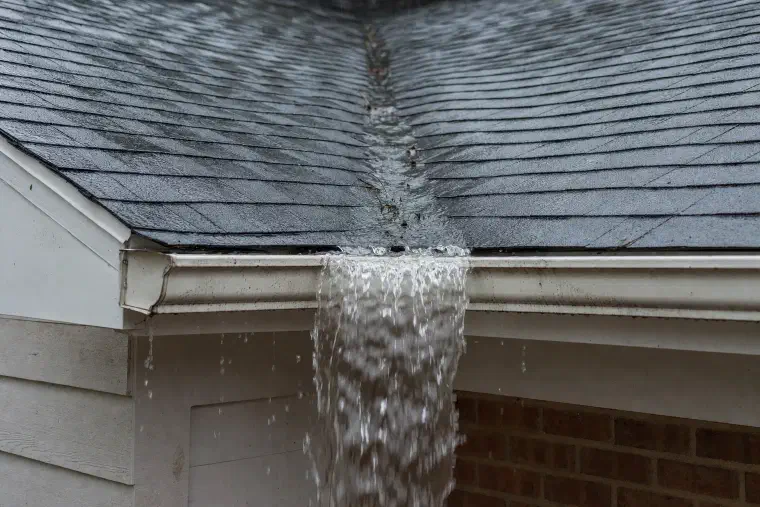
The catch is how the water arrives, not only how much of it there is. Where 5 inch gutters run into trouble is on roofs with long gutter runs or multiple valleys feeding into one section (opens in a new tab). A valley collects rain from two roof planes and drops it in one spot. A run with a single downspout at the far end does the same thing on a smaller scale.
When do you need 6 inch gutters?
When a lot of roof drains to one place. 6-inch gutters may be recommended for larger homes or in regions with heavy precipitation (opens in a new tab). The sizing guide adds that 6 inch gutters also work well on smaller roofs where water collects in one place, because the extra capacity helps prevent overflow without changing the layout.
Steepness plays a part too. Steeper roofs shed water faster and can collect more wind-driven rain (opens in a new tab), which raises the load on the gutters below. Ellicott City has plenty of big, cut-up roofs on sloped lots, and those are the ones we would look at twice before choosing 5 inch.
Do you need bigger gutters if yours overflow?
Maybe, but check the cheap causes first. On our gutter installation page we say it this way: when gutters overflow even though they are clean, the usual cause is that they are too small, too flat, or do not have enough downspouts. Size is one of three suspects.
Slope is the one people forget. Gutters should slope at least 1/16 inch per foot of run (opens in a new tab), so water travels to the downspout instead of sitting. A sagging gutter loses that slope, and a sagging 6 inch gutter overflows just like a sagging 5 inch one. Our gutter repair page covers re-pitching and resealing.
If the gutters are clean, level and still pour over the front in a storm, going up a size is a sensible fix. Going bigger than 6 inch is usually a last step. This Old House calls 7 or 8 inch gutters a last step rather than the first fix (opens in a new tab).
How many downspouts do you need, and what size?
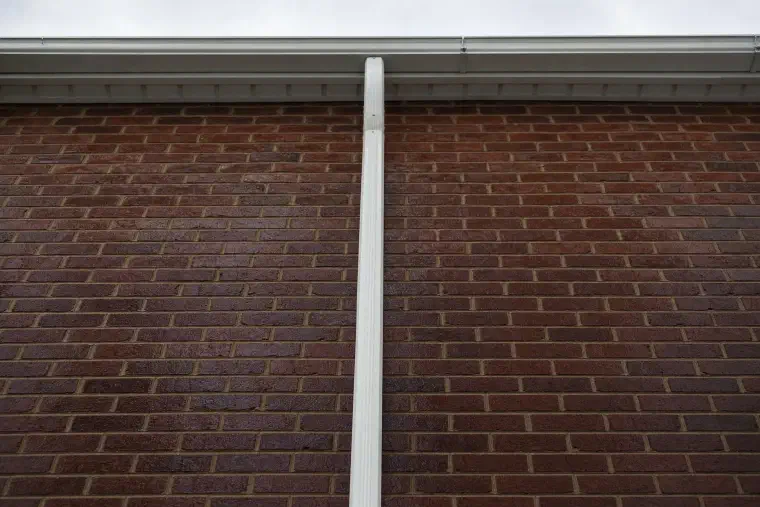
Enough that no stretch of gutter has to carry its water too far. The Department of Energy’s Building America guide says closer downspout spacing carries more water away during peak rainstorms (opens in a new tab), and gives a rule of thumb of 1 square inch of downspout cross-section for every 100 square feet of roof area (opens in a new tab).
The shape of the downspout counts. A 2 by 3 inch rectangular downspout handles about 600 square feet of drainage area (opens in a new tab), while a 3 by 4 inch one handles up to 1,200. A big gutter feeding a small downspout just moves the bottleneck.
Where the water goes after the downspout matters as well. Our article on how far a downspout should extend covers that.
Does the material change the size you pick?
Not really. Size is about water, and material is about how long the gutter lasts. We install aluminum gutters, which are cut to the length of each wall so there are fewer joints to leak. Our articles on how those gutters are made and aluminum vs vinyl gutters go through that side of the choice.
For capacity, the shape matters more than the material. K-style gutters can handle more than twice the water volume of half-round gutters of the same width (opens in a new tab), so a 5 inch half-round is not the same thing as a 5 inch K-style.
Common questions
Are most gutters 5 or 6 inch?
On most houses, 5 inch. That is the usual size for residential K-style gutters, and 6 inch is the step up for larger roofs, heavy rain and spots where water collects.
Can you switch from 5 inch to 6 inch gutters?
Yes, but it is a replacement, not a swap of one part. The old gutters come off, we check the fascia board behind them for rot, and the new ones go up with the right slope and enough downspouts. A new roof is a good moment, since the edge of the roof is already open.
Do 6 inch gutters cost more?
A wider gutter uses more metal, so expect the quote to reflect that. We do not have gutter prices to quote here, and the quote after a visit is the real answer for your house.
Will gutter guards fix an overflow problem?
Not if the gutter is too small. Guards cut down on cleaning under heavy trees, but they do not add capacity. Ask us about them when we look at your gutters.
What to do next
If your gutters overflow in storms, we will look at them for free as part of a roof inspection and tell you whether it is size, slope or downspouts. Our gutter installation page covers what a new set includes. Call us any time, 24/7.


