

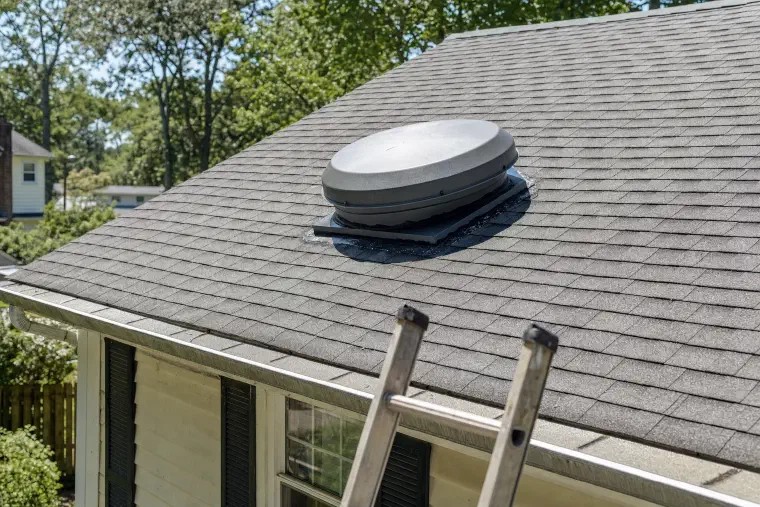
Attic fans are usually not worth it. A fan can move a lot of hot air out of an attic, but the electricity it uses can cost more than the cooling it saves, and it can pull cooled air out of your living space to do it. A passive setup, with air coming in low at the eaves and leaving high at the ridge, is the better first move for most Howard County homes.
The short version
- A powered attic fan does lower attic temperature, but research has found it can use more electricity than it saves.
- Without enough intake vents, a fan pulls air from the rooms below through gaps in the ceiling.
- Adding a fan to a roof that already has a ridge vent or gable vents can short-circuit the airflow.
- A fan can make sense in a few cases, but it should be the last step, not the first.
- The cheapest fix is often clearing blocked soffit vents and sealing ceiling gaps.
Do attic fans save money?
Usually they do not. A powered attic fan does exhaust more heat than a passive vent does, which is why it sounds like a good deal. The catch is the power bill: studies have shown a fan can use more electricity (opens in a new tab) than it saves on air conditioning.
There is a second problem. Cooling the attic does less for the rooms below than you would expect, because most of the heat reaches the ceiling as radiant heat from the hot roof, not as hot air. The same Department of Energy guide says passive ventilation is generally recommended over fans (opens in a new tab) for this reason.
Can an attic fan pull cooled air out of your house?
Yes, and it is the biggest reason we steer people away from them. A fan makes the attic pressure lower than the rooms below it. Air always moves toward the lower pressure, so the fan can pull air from the house through small holes in the ceiling (opens in a new tab).
Those holes are everywhere: around recessed lights, bath fan housings, plumbing pipes and the attic hatch. You pay to cool that air, and the fan throws it outside. ENERGY STAR puts it bluntly: if the soffit vents are blocked and the attic is not sealed from the house, a fan will suck cooled air up (opens in a new tab) into the attic.
The fan can also make the moisture problem worse in winter. Warm, damp air from the bathroom and kitchen that would have leaked slowly gets pulled up to the cold roof boards. We see this a lot: the fan is added to fix heat, and the decking starts to stain from the underside.
Does a fan work with a ridge vent or gable vents?
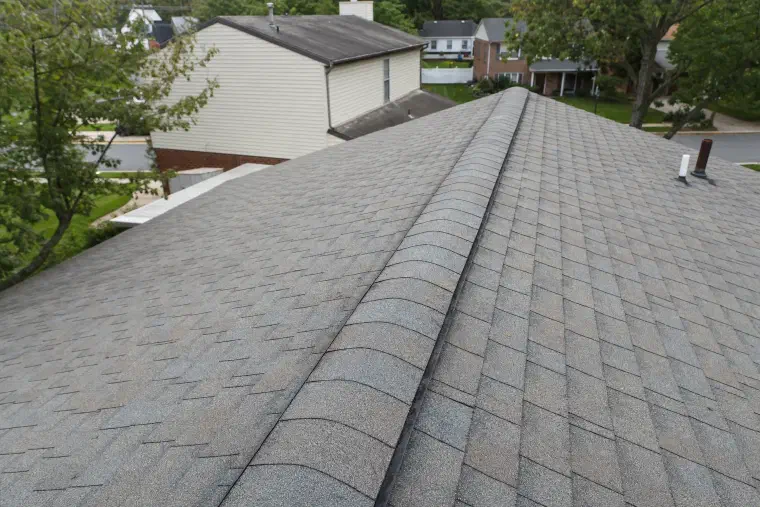
Not well. A ridge vent is built to pull air in at the soffits and out at the peak. Add a fan or gable vents and the new opening becomes the easiest way in, so the air takes a shortcut across the top of the attic and never sweeps the lower half of the roof.
The Department of Energy says gable-end vents (opens in a new tab) should not be used together with a ridge vent because they are likely to short-circuit the airflow. A fan next to a ridge vent behaves the same way. This mix of ridge vents, gable vents, box vents and fans is one of the most common attic setups we find, and it is often the reason an attic is still hot after someone spent money on it.
What should you check before buying an attic fan?
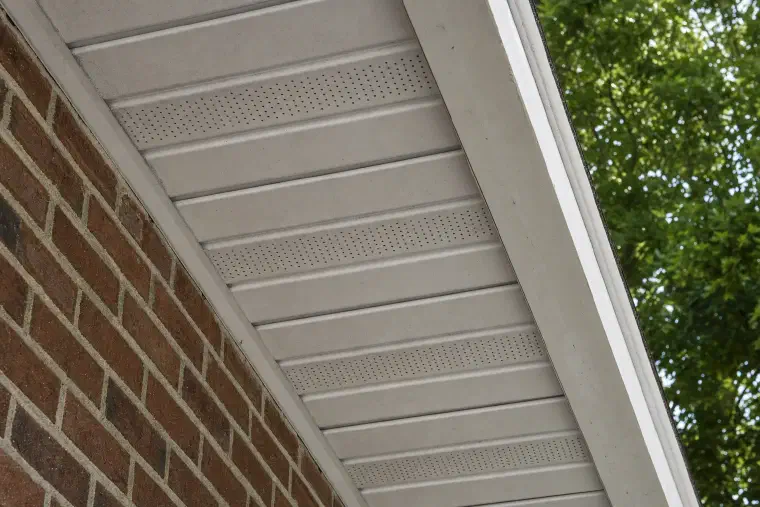
Check the intake first, then the ceiling, then the exhaust. Most hot attics are short of air coming in, and a fan cannot fix that.
| Check | What you are looking for | Why it matters |
|---|---|---|
| Soffit vents | Open slots or holes under the roof edge, with no paint or insulation over them | No intake means nothing for the exhaust to pull |
| Insulation at the eaves | Insulation pushed against the roof deck, blocking the channel | It seals the vents shut from the inside |
| Ceiling gaps | Recessed lights, hatch, pipe and wire holes | They let house air leak up, and a fan makes it worse |
| Bath fans and dryer vents | Ducts that end in the attic instead of outside | They dump warm, wet air straight into the space |
| Exhaust vents | One type only, usually a ridge vent | Mixed types short-circuit each other |
ENERGY STAR is firm on the second row: never cover soffit vents (opens in a new tab) with insulation, and use rafter vents to keep a clear channel for air. Sealing and insulating the attic floor comes before relying on any ventilation at all.
Why does attic ventilation matter for your roof?
An attic that cannot breathe cooks the shingles from below in summer and holds moisture in winter. ENERGY STAR says summer ventilation moves super-heated air out (opens in a new tab) of the attic, protecting the shingles, and winter ventilation helps keep the attic cold, which reduces ice damming.
We think poor ventilation is the most underrated roof killer. It is invisible and it does not feel like damage, yet it can cut a roof’s life nearly in half. That is why we would rather fix the airflow than add a motor to a bad setup. Our attic venting page explains how a healthy attic moves air, and the same problem shows up in does a 30-year shingle really last 30 years.
Are there times an attic fan makes sense?
Sometimes. A fan can help in a hot attic that has plenty of intake vents, a sealed ceiling and no ridge vent, where passive vents have been tried and are not enough. Even then, Florida Solar Energy Center research notes that natural ventilation can match (opens in a new tab) the heat reduction of a powered one, so it is worth being sure first.
If you do add one, put it on a thermostat so it only runs in the hottest part of the day, and make sure the intake area is generous. The aim is to pull outside air through the soffits, not air from your bedroom.
Common questions
Is a solar attic fan better than an electric one?
It removes the electricity bill, but not the other problems. A solar fan still lowers the attic pressure, so it can still pull air out of the house through ceiling gaps. It also does not help a roof that has mixed vents.
Will an attic fan make my house cooler?
A little at best. The attic gets cooler, but most of the heat coming through your ceiling is radiant heat from the roof surface, and a fan does not stop that. Insulation and air sealing do more for the rooms below.
Can I add a fan to my ridge vent roof?
We would not. The ridge vent is already the exhaust, and a second exhaust competes with it. If the attic is still hot, the usual cause is blocked intake, not too little exhaust.
How do I know if my attic is venting properly?
On a summer afternoon, an attic far hotter than outside is a warning sign. In winter, frost or damp on the underside of the roof boards is the better clue. Attic moisture can also show up as a ceiling stain after the rain stops.
What to do next
Before you spend money on a fan, have someone look at the vents and the attic itself. Our free roof inspection covers the roof, the vents and the attic when we can get into it safely, and we will tell you what we find, including when the answer is that you do not need a fan.


