

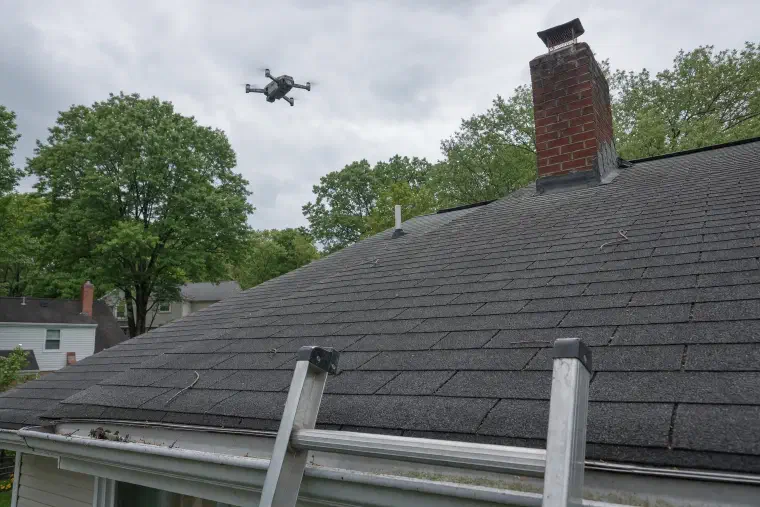
A drone roof inspection is good enough for a quick look at a roof you cannot safely walk, and not good enough on its own for hail, nailing or leaks. A drone sees the surface. It cannot touch it, and most of what decides a roof’s future has to be felt, lifted or pressed.
The short version
- A drone is a fine camera for steep, wet or fragile roofs.
- It cannot press a shingle, so it misses hail bruises and soft spots.
- It cannot lift a shingle, so it misses nails put in the wrong place.
- Drone imaging typically runs $200 to $450 when a roof is unwalkable.
- Our free roof inspection is a walk on the roof, not a flyover.
When is a drone inspection good enough?
A drone is good enough when the question is “what does the whole roof look like from above?” and the roof is too steep, too wet or too fragile to walk. It reaches a ridge or a second-story slope in minutes and gives you photos of every slope without anyone climbing.
That is a real use. It is also where it stops. The pictures show missing shingles, a sagging line, a tarp that blew loose and moss on a shaded slope. They do not show what the shingle is doing under your thumb.
If the roof can be walked safely, a drone is a supplement. If it cannot, drone images are the best option left, and it helps to know what the report cannot say.
What does a drone miss on a shingle roof?
A drone misses anything that is found by touch, by lifting or by looking underneath. On a shingle roof, that covers a lot of the problems that matter.
Here is how the two approaches compare:
| What you need to know | Drone images | Someone on the roof |
|---|---|---|
| Missing or lifted shingles | Usually seen | Seen, and checked up close |
| Hail bruises | Easily missed | Found by pressing |
| Where the nails went | Not visible | Shingles lifted to check |
| Soft spots in the deck | Not visible | Pressed by foot and hand |
| Flashing type and condition | Surface only | Looked at up close |
| Attic side of the roof | Not visible | Checked when the attic is reachable |
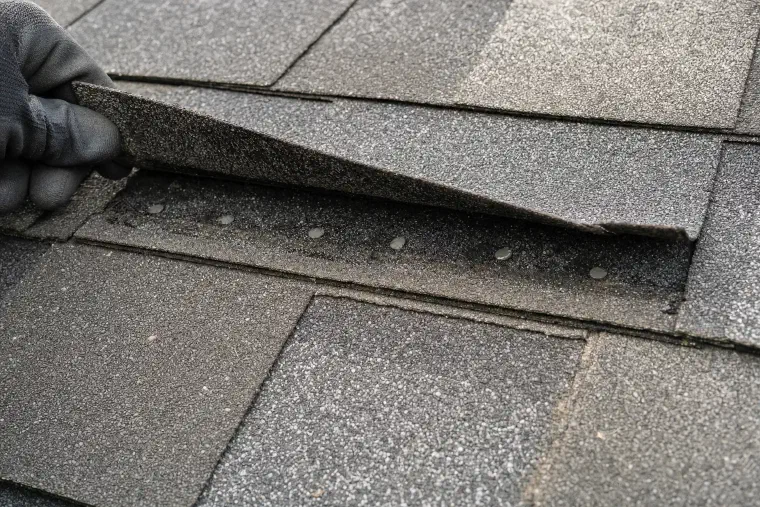
Our roofing notes put it plainly: the same shingle can last 25 years or 9, depending on where the nail went. A nail placed too high leaves a shingle held by its sealant strip alone. It looks perfect from above until a strong gust peels it. You find that only by lifting shingles.
Can a drone find hail damage?
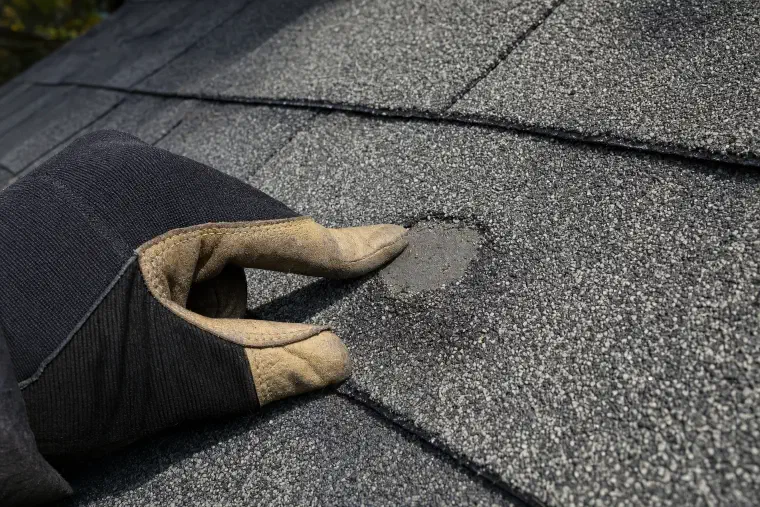
A drone can point at spots worth a closer look, but it cannot confirm hail damage. A drone-only inspection is inadequate for hail, because the damage is a bruise in the shingle’s mat and not a hole.
The Insurance Institute for Business and Home Safety says a bruise can usually be felt (opens in a new tab) on real hail impacts on shingles. The National Roofing Contractors Association describes a bruise as a localized soft spot felt with your fingertips (opens in a new tab), like a bruise on an apple, that may not show on the top surface at all.
There is a second problem for claims. Each insurance company can have its own standards, and an adjuster is the one to say (opens in a new tab) whether there is hail damage, according to University of Missouri Extension. If a claim is on the table, a HAAG-certified inspector is the person to ask for. We walk through the steps in how a roof is inspected for hail damage.
What can a roof that looks perfect still be hiding?
A roof that looks perfect from above can still have high nailing, a missing starter strip, reused flashing or unbalanced venting. None of that shows in a photo, from a drone or from the ground.
Finding it takes a shingle lifted by hand, a look in the attic and, sometimes, the permit and warranty records. That is the kind of “forensic” check a standard visual inspection, drone or otherwise, will not do.
Caulk is another one. Any flashing detail that leans on sealant has a life of about 5 to 10 years, and we call it a scheduled leak. The Pacific Northwest National Laboratory suggests you look at the caulk regularly (opens in a new tab), every two years or so. A drone photo from 40 feet up rarely shows a hairline gap in a bead.
What does a drone inspection cost?
Drone imaging when a roof is unwalkable typically runs $200 to $450. That is about the same as the other paid options, so the price is not a reason to pick it:
- A home inspector’s roof section, bundled with the house inspection, typically runs $150 to $250.
- A standalone independent inspector typically runs $200 to $450.
- An infrared or thermal moisture scan typically runs $400 to $700.
The cost of a visit that includes the roof is covered in how much a roof inspection costs. Our own inspection is free.
What happens on our free inspection?
Our free roof inspection is a walk on the roof, not a drone flight. We look at the surface, flashing, valleys, gutters and the attic when it is safe to get in. We lift shingles to check the nailing and press for soft spots, then write a condition report with photos, a measured square count and the pitch.
You get an estimate of how much life is left, with the reasons behind it. There is no obligation to book work. What is in the visit, step by step, is in what a roof inspection includes.
One honest caveat: a free inspection is also a sales visit. We make money when you book work. For a claim dispute or a home sale, a paid independent inspector is the better pick, and a roof that passes is a snapshot, not a warranty.
Common questions
Is a drone inspection accepted by insurance companies?
It depends on the insurer. Each company has its own standards, and your policy and the adjuster decide what counts. For hail, expect them to want someone on the roof. Ask your insurer what they accept before you pay for one.
Can a drone inspect a roof I cannot walk?
Yes, and that is its best use. Steep, wet, fragile or very high roofs are the cases where drone imaging makes sense. Keep in mind that a limited look gives a limited answer, so the report should say what it could not check.
Is a drone inspection safer than a walk on the roof?
For the person doing it, on a steep or fragile roof, yes. On a normal roof that can be walked safely, a trained person on the roof gives you more, and that is how we do it.
What to do next
If you want your roof checked by hand, book our free roof inspection. We will walk it, lift what needs lifting and send you the report in writing.


