

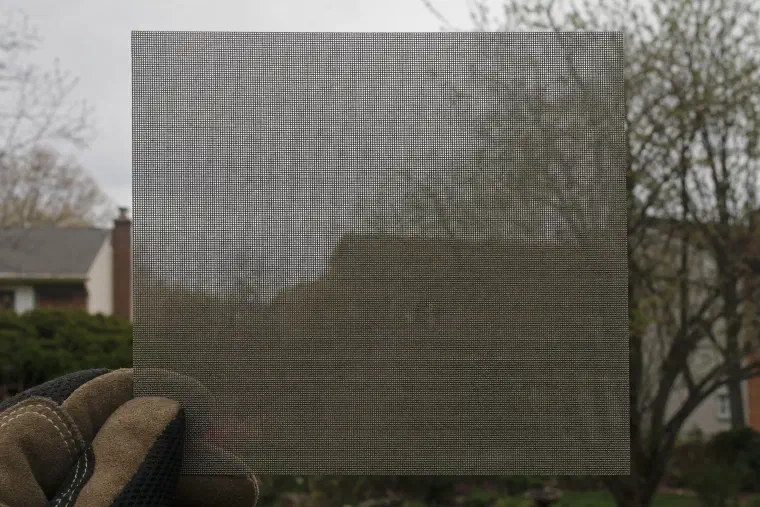
Micro mesh gutter guards are worth it on a house with trees close to the roof, because they keep out almost everything but water. They cost more than other guards, they still need a rinse on top now and then, and they only make sense on gutters that are in good shape.
The short version
- Micro mesh has tiny holes, so it blocks small debris like roof grit and pine needles that other guards let through.
- It costs more than foam, plain mesh or hooded guards, and it’s harder to fit well.
- It cuts cleaning down. It doesn’t end it.
- It’s a poor buy on a sagging gutter or a soft fascia board.
- Ask for it in the same quote as new gutters, so you pay for one trip.
What is a micro mesh gutter guard?
It’s a fine screen that sits over the top of the gutter. Water soaks through the holes and runs into the trough, and leaves and larger bits slide off or sit on top. This Old House says micromesh has 30 or 50 holes per linear inch (opens in a new tab), which is why it filters out pine needles and roof granules. Those are the little gray grains that wear off shingles.
Plain mesh has much bigger openings. That’s the whole difference, and it’s why the two behave so differently in the fall.
Do micro mesh gutter guards work better than other types?
Yes, on small debris. This Old House says micro mesh is highly effective at blocking debris (opens in a new tab) of all sizes, and that it filters fine particles like roof grit and pine needles better than standard mesh does. The same article says plain mesh screens don’t stop pine needles or shingle grit.
| Type | What it does well | Where it falls short |
|---|---|---|
| Foam insert | Easy to put in | Wears out after a few seasons |
| Mesh screen | Lasts for decades with upkeep | Lets pine needles and grit through |
| Micro mesh | Blocks debris of all sizes | Hard to fit, costs more than foam or plain mesh |
If you want the full comparison of every type, our article on gutter guards goes through them.
What do micro mesh gutter guards cost?
This Old House’s survey respondents reported paying $40.50 per linear foot (opens in a new tab) for micro mesh. That’s a national average, not a quote from us, and only reverse-curve guards cost more, at $41.22.
Price depends on how many feet of gutter you have, how high the eaves are and how cut-up the roof edge is. A house with long straight runs costs less per foot than one with lots of corners.
Is micro mesh hard to install?
It can be. This Old House found micro mesh difficult to install (opens in a new tab) because it needs precise fitting, especially on pitched or uneven roofs. A guard that’s slightly off leaves a gap where debris gets in, or a lip where water jumps the gutter.
There’s a safety side too. West Virginia University Extension warns never to crawl out onto a roof (opens in a new tab) and says to extend a ladder three rungs past the roof edge and secure it. Fitting guards along a whole eave means a lot of time on a ladder, which is a fair reason to hand it to a roofer.
Do micro mesh guards still need cleaning?
Yes. This Old House says gutter guards significantly reduce the need for cleaning (opens in a new tab) but don’t make gutters maintenance-free. In its reader survey, nearly 30% said they never clean after installing guards, and about 41% clean once a year.
The annoying part is what the tiny holes can’t pass. Fine debris sits on top and can matt into a film.
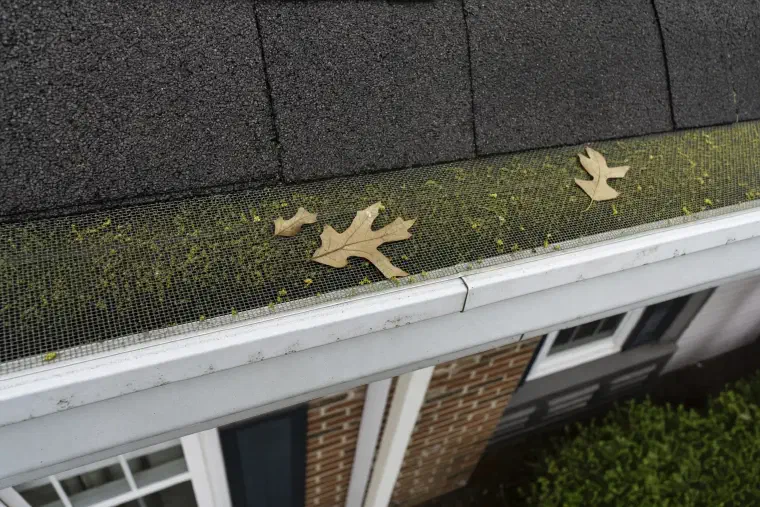
When that film builds up, rain has trouble getting through and can run over the front edge instead. A hose rinse or a soft brush on the surface usually clears it. If you’d rather not be up there, our gutter cleaning covers the troughs, downspouts and underground lines.
When are micro mesh gutter guards worth the money?
They pay off when trees drop a lot on your roof, or when the gutters are hard and risky to reach. Tree overhang is one of the biggest problems on Ellicott City’s wooded lots, and it dams up valleys and gutters. A gutter that stays full holds water against the fascia, the board behind it, and that board rots first.
They also make sense when new gutters are going on anyway. Our Gutter Installation work covers new aluminum gutters, guards and downspouts, so the guard goes in with the gutter.
When should you skip micro mesh?
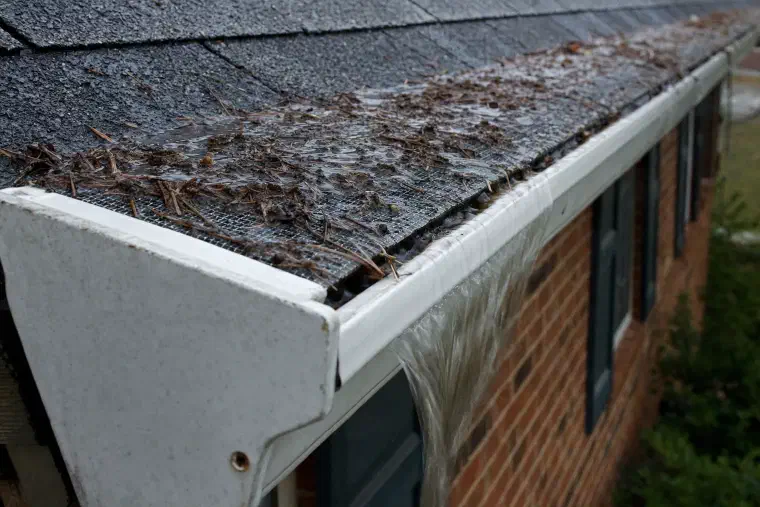
Skip it when the gutter under it is failing. A guard doesn’t fix a sag, a leaking seam or a gutter pulling off the house. It hides them. Get those put right first, and look at the fascia behind. Our gutter repair work covers resealing, re-pitching and fascia.
Skip it too if few trees are near your roof. A yearly clean is cheaper. West Virginia University Extension says gutters should be cleaned at least twice a year (opens in a new tab), more where storms are common, and a house with open sky overhead may do fine on that.
Common questions
Do micro mesh gutter guards stop pine needles?
Yes, that’s what they’re best at. This Old House picks micro mesh as the type for fine particles like pine needles (opens in a new tab) and roof grit.
Can I put micro mesh guards on old gutters?
Only if the gutters are sound and pitched correctly. Guards over a sagging gutter cover the problem and leave the damage to grow.
Do gutter guards come with a new roof?
No. Gutters and gutter guards aren’t part of a roof replacement price. Detaching and resetting them, or replacing them, is separate, so ask for it in the same quote.
What to do next
If you’re not sure whether micro mesh is right for your gutters, call us any time. We’ll look at the gutters and the roof edge on a free roof inspection and tell you straight whether it’s worth it, or whether a clean is all you need. If new gutters are on the list, start with gutter installation.


