

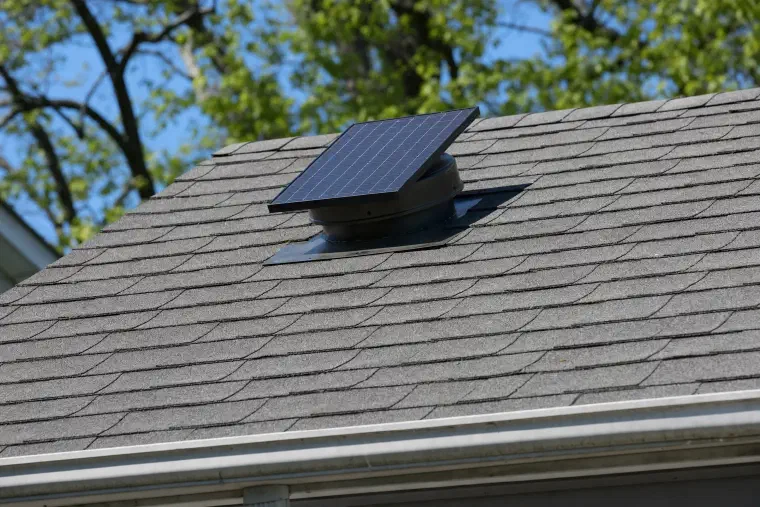
Solar attic fans are worth it only in a narrow set of homes. They run for free, which sounds like the end of the argument, but a solar fan still pulls the attic’s air pressure down, and it can draw cooled air out of your rooms through the ceiling. In most Howard County homes, fixing the intake and sealing the ceiling does more for less.
The short version
- A solar fan removes the electric bill, but not the pressure problem that powered fans cause.
- It can pull air from your living space up through holes in the ceiling.
- Researchers say a well-vented attic with plain passive vents can do about the same job.
- A fan added to a roof that already has other exhaust vents often makes the airflow worse.
- Check the intake vents and ceiling gaps first. Then decide if a fan is still needed.
What does a solar attic fan do?
A solar attic fan is a small exhaust fan, run by its own solar panel, that pushes hot air out of the attic. The Department of Energy’s building science team describes it as a unit that runs when the sun is shining (opens in a new tab) and does not draw power from the home’s electrical system.
That is the selling point, and it is a fair one. Because it only runs in daylight, it does not pull in damp night air and it stays off in the rain. A plug-in fan has neither of those habits unless someone wires in a control.
Do solar attic fans save you money?
Not much, and the reason is not the power. The same Department of Energy guide notes that powered fans can use more electricity than they save (opens in a new tab) in air conditioning. A solar fan gets around the electricity part, since the sun pays for it, but the second half of the sentence still applies: the cooling it adds is small.
The Florida Solar Energy Center found that natural ventilation can achieve similar (opens in a new tab) attic heat-flow reduction to a fan. Its research also points to radiant barriers, extra ceiling insulation and reflective roofing as measures that can save the same or more (opens in a new tab) cooling energy.
So the honest math is a fan that costs money to buy and put in, saves little on the bill, and replaces something that a few open vents were already doing.
Can a solar attic fan pull cooled air out of your house?
Yes, and a solar panel does not change it. A fan lowers the pressure in the attic, so the attic starts pulling air from wherever it can find it. The Department of Energy says that negative pressure draws conditioned air (opens in a new tab) from the living space into the attic through gaps in the ceiling.
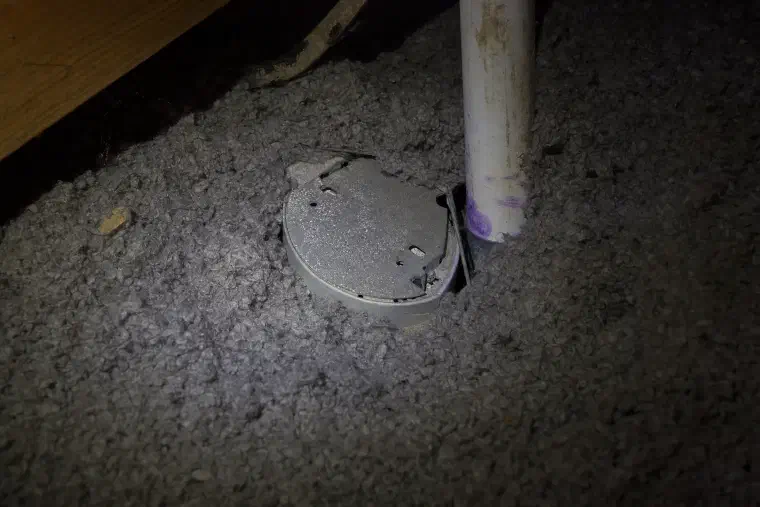
Those gaps are easy to find once you look: around recessed lights, bath fan housings, plumbing pipes and the attic hatch. ENERGY STAR gives the worst case. If the soffit vents are blocked and the attic is not well sealed from the house, a fan will suck cool conditioned air (opens in a new tab) up into the attic.
There is a safety side too. The Department of Energy’s guide says to make sure no combustion equipment (opens in a new tab) is in the attic, because the negative pressure a fan creates can backdraft it.
What should you check before you buy one?
Start with how air gets in, because a fan can only move air that has somewhere to come from. The Asphalt Roofing Manufacturers Association says a balanced system is best (opens in a new tab), with intake at the eaves matched by exhaust at or near the ridge.
| Check | What you want to see | If it is wrong |
|---|---|---|
| Soffit vents | Open slots under the roof edge, not painted shut | A fan has nothing to pull from but your rooms |
| Insulation at the eaves | A clear channel above it, with rafter vents | The vents are sealed from the inside |
| Ceiling holes | Lights, hatch and pipe gaps sealed | The fan pulls house air into the attic |
| Existing exhaust | One kind, such as a ridge vent | A second exhaust short-circuits the first |
| Bath fan and dryer ducts | They end outside the house | They dump wet air into the attic |
ENERGY STAR is blunt about the second row: never cover soffit vents (opens in a new tab) with insulation. If you want the longer version of this checklist, we wrote it up in are attic fans worth it.
Will a solar fan work with a ridge vent?
Usually not well. A ridge vent already pulls air in at the soffits and out at the peak. A fan next to it gives that air an easier route, so it takes a shortcut and the lower part of the roof never gets swept.
We see this mix of ridge vents, gable vents, box vents and fans all the time, and it tends to be the reason an attic is still hot after someone spent money on it. If your roof has one kind of exhaust vent, adding a second kind is rarely the fix.
Is there a time a solar attic fan makes sense?
Sometimes. If the attic has generous, clear intake vents, the ceiling is sealed, there is no ridge vent, and passive vents have been tried and fall short, a solar fan is a reasonable next step. The Florida research notes these units often include a thermostat (opens in a new tab) that limits running to the hottest part of the day.
Be honest with yourself about that list, though. Most attics that feel too hot are short of intake, not exhaust, and we would rather open the soffits than add a gadget to a roof that cannot breathe.
Why does a hot attic matter for your roof?
Because the heat sits on the underside of your shingles all summer. In our experience an unvented or badly vented attic cooks shingles from below and can cut a roof’s life nearly in half. The Asphalt Roofing Manufacturers Association agrees on the direction: improper ventilation can lead to premature deterioration (opens in a new tab) of shingles and the roof deck.
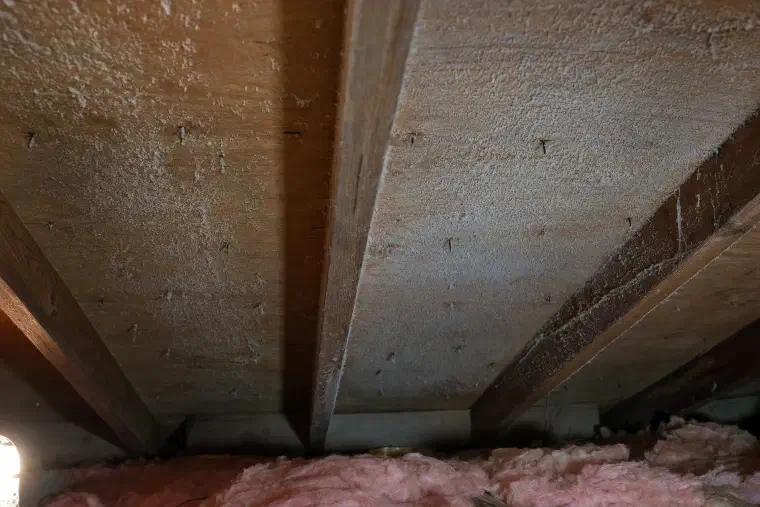
Winter is the other half. ENERGY STAR says a vented attic stays cold in winter, which reduces the potential for ice damming (opens in a new tab). That is also why winter is the best time to look at an attic: frost on the underside of the roof boards on a cold morning tells you where moisture is getting in. A fan that runs only in the sun does nothing for that.
Our attic venting page explains how a healthy attic moves air. The shingle side of the story is in how long do roof shingles last.
Common questions
Is a solar attic fan better than an electric one?
It is better on the power bill, and it only runs when it is sunny. It is not better on pressure. Both kinds can pull air out of the house through ceiling gaps, so the same checks apply to either.
Do solar attic fans work on cloudy days?
A solar fan is built to run only when the sun is shining (opens in a new tab), so expect little or nothing from it on a dark, rainy day. That is by design, and it is part of why the fan keeps damp air out of the attic.
Can I put one on a roof that has a ridge vent?
We would not. The ridge vent is already the exhaust, and a second one competes with it. If the attic is still hot, look at the intake first.
Will a solar fan make my house cooler?
A little at best. The attic gets cooler, but your upstairs rooms are heated by the roof and the ceiling too. Insulation and air sealing usually do more for the rooms below.
What to do next
If your attic feels like an oven and you are thinking about a fan, have someone look at the vents and the attic first. Our free roof inspection covers the roof, the vents and the attic when we can get in safely, and we will say so plainly if the answer is that you do not need a fan.


