

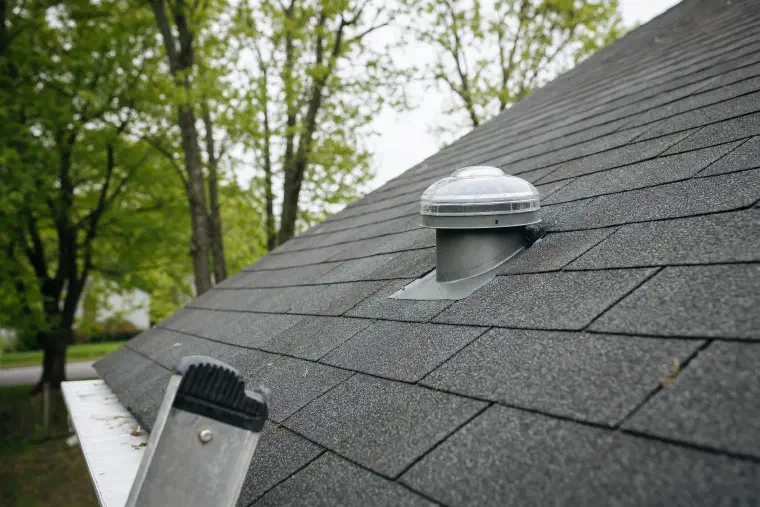
Solar tube skylights are worth it for a small, dark room that has attic space above it, like a hallway, a closet or a windowless bathroom. They are cheaper and leave a smaller hole in the roof than a regular skylight. They give you light, though, and nothing else: no view, no fresh air, and not much glow for a big room.
The short version
- A solar tube is a small dome on the roof, a shiny tube through the attic and a round diffuser in the ceiling.
- They typically cost less than a skylight and need a much smaller roof opening.
- They suit hallways, baths, closets and kitchens. They do not suit a room where you want a view.
- Both kinds can leak if the flashing around them is poor.
- If the room is big, or you want to open the window, a regular skylight is the better buy.
What is a solar tube skylight?
A solar tube is a skylight with the middle taken out. Also called a sun tunnel or tubular skylight, it works by capturing sunlight through a clear dome (opens in a new tab) on the roof and sending it through a reflective tube into the house.
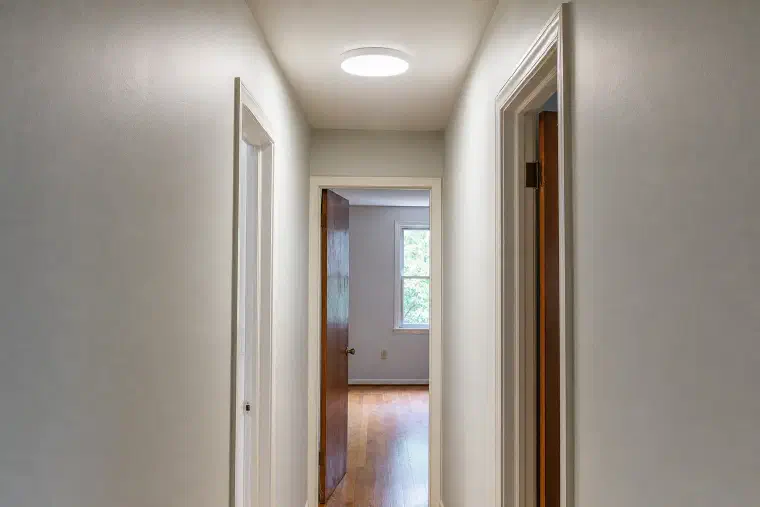
The light comes out of a round diffuser in the ceiling, which looks a bit like a flat light fixture. Most tubes are 10 to 20 inches in diameter (opens in a new tab), so the hole in your roof is about the size of a pizza pan rather than a window. Despite the name, there is nothing solar-powered about it unless you buy a model with a small panel and LED lights for after dark.
How much do solar tube skylights cost?
They typically run $600 to $1,000 each (opens in a new tab) with professional installation, according to This Old House. A regular skylight costs more. In the Ellicott City area, a skylight typically runs $800 to $2,000 or more each when it goes in during a reroof, and the price climbs when a new opening has to be cut and framed.
The table below puts the two side by side.
| Solar tube | Regular skylight | |
|---|---|---|
| Size of roof opening | Small, 10 to 20 inches across | Window sized, framed in |
| Gives a view | No | Yes |
| Opens for fresh air | No | Only on vented models |
| Heat coming in | Limited | Depends on the glass |
| Best for | Halls, closets, baths | Rooms where you spend time |
Keep in mind that these are area ranges, not a quote. Roof pitch, attic obstacles and what is in the way all change the price, and we look at that during a visit.
Do solar tube skylights light a room well?
Yes, and often better than you would guess from the size of the dome. A research study from Lawrence Berkeley National Laboratory found that tubes need a much smaller roof opening (opens in a new tab) than regular skylights and, because the tube is so reflective, can deliver daylight farther from the roof.
There are limits. In the same study, a wider tube used less lighting energy than a narrower one when the sun sat low. So a 10 inch tube that is fine for a closet will feel dim in a big kitchen. A long tube with several bends loses light along the way, and the light is gone at night, on a dark day and in deep winter evenings. A tube works with the sky, not against it.
Where does a solar tube make sense?
In a room with no outside wall and a clear path to the roof. This Old House says a sun tunnel can brighten almost any interior space (opens in a new tab), and points to kitchens, windowless bathrooms, hallways, stairwells and home offices.
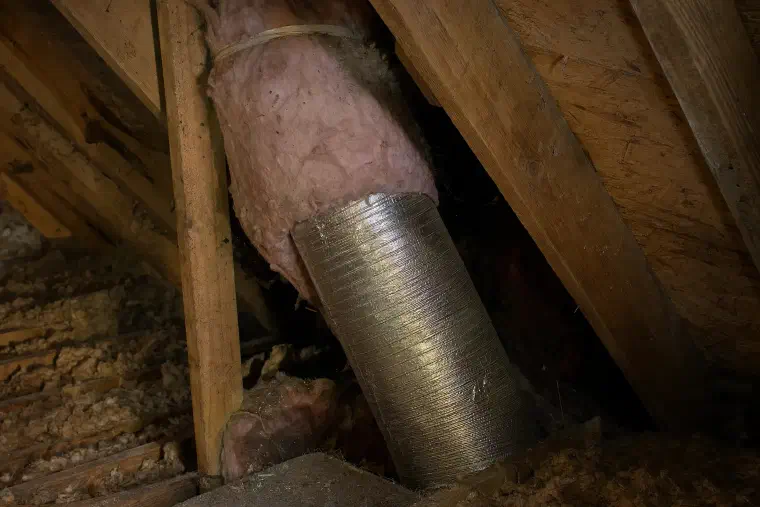
The path matters more than the room. Before anyone quotes a tube, someone has to climb into the attic. This Old House says to inspect your attic for obstacles (opens in a new tab) such as wires or ductwork. A duct run or a rafter in the wrong place can turn a simple job into a bent tube, and a bent tube gives less light.
Do solar tubes leak or add heat?
They can leak, and the reason is the same as for any hole in a roof. This Old House says solar tubes do not cause leaks when they are installed, sealed, and maintained (opens in a new tab) with care, and that poor work leaves them open to leaks and condensation.
That matches what we see on roofs in general. Water gets in at flashing, the metal that seals the roof around anything poking through it, and not at the middle of the shingles. Caulk is a scheduled leak, because sealant only lasts about 5 to 10 years. A tube is only as good as the flashing under its dome. Our piece on step flashing shows how overlapping metal does the job that caulk can’t, and ice and water shield is what we put around openings like this on a new roof.
On heat, there are two sides. This Old House says tubes give limited heat transfer (opens in a new tab), well below a skylight’s. It also says a tunnel does not become a source of heat loss in winter or heat gain in summer when it is properly insulated (opens in a new tab), and suggests wrapping the part of the tube that runs through the attic. A cold, bare tube over a warm room is where condensation starts.
Is a solar tube better than a regular skylight?
Only if light is all you want. A regular skylight gives you a view of the sky, can open if it is a vented model, and lights a bigger area. This Old House calls tubes a more affordable and low-maintenance (opens in a new tab) alternative, not a better one.
One more thing: if your roof is old and a replacement is coming, that is the cheapest moment to change either kind. The new flashing goes in with the new roof, and the opening is dealt with once. Our skylight installation page covers how a skylight should go in, and tubular skylights are part of what we do there.
Common questions
Do solar tubes work on cloudy days?
Yes, with less light. The dome still gathers daylight, only less of it. Expect a dim, even glow on an overcast day and nothing after dark, unless the model has its own small lamp.
Can a solar tube go in any room?
It needs a straight, short run between the roof and the ceiling. A room under a finished attic or a second floor has no such path. Rooms directly under open attic space are the easy ones.
How long do they last?
We don’t have a figure we trust for the tube itself, so we won’t make one up. This Old House warns that acrylic domes don’t withstand extreme weather (opens in a new tab), so look at the dome and the flashing every time someone is on your roof.
What if my skylight already leaks?
A dripping skylight is not always a bad skylight. On a repair, a reflash typically runs $900 to $2,000, and a full skylight replacement typically runs $1,200 to $3,000. The glass is often fine and the leak is in the seal around it, which is the reason to get it looked at before you replace anything.
What to do next
If you are weighing a tube against a skylight, or you want to know if your attic has room for either one, tell us which room you want lit. We will check the path through the attic and the roof around it. You can read about skylight repair if one is already dripping, and our free roof inspection is a no-obligation way to have the roof looked at while someone is up there.


