

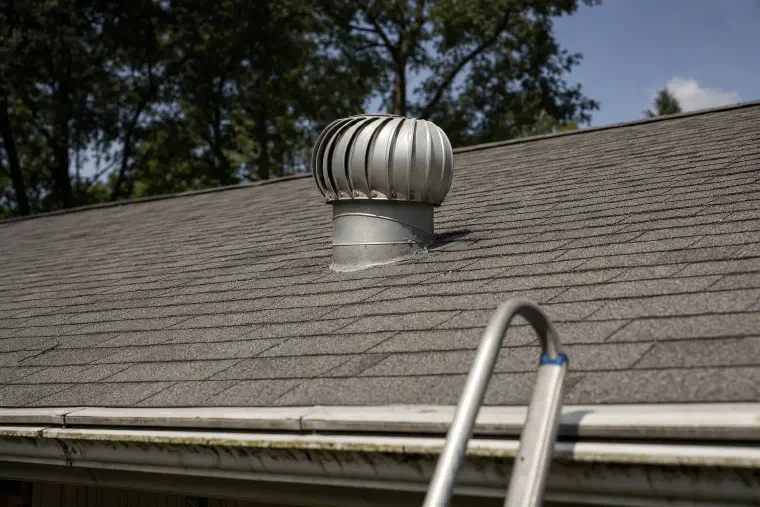
Turbine roof vents are decent at one job: letting hot air out of an attic when the wind is blowing. They are not the fix many people hope for. A turbine only works if cool air can get in low at the eaves, and it does very little for your cooling bill.
The short version
- A turbine vent spins in the wind and pulls hot air out of the attic. With no wind, it is an open hole.
- It needs open soffit vents under the roof edge, or it has nothing to pull from.
- A 1979 federal test found turbine venting cut a house’s cooling load by 3.1 percent at most.
- Mixing a turbine with a ridge vent or gable vents usually makes airflow worse.
- Check the intake and the ceiling gaps before you spend money on any exhaust vent.
What is a turbine roof vent?
A turbine roof vent is the round, ribbed metal ball you see spinning on some roofs. Wind turns the vanes, and the spinning pulls air up out of the attic through a hole in the roof. Some people call it a whirlybird.
It uses no electricity, which is its best feature. It also has no thermostat and no off switch, so it moves air only when the wind does.
Do turbine vents actually cool an attic?
A little, and mostly on windy days. In a federal test of three identical Houston houses, turbine venting was about as effective as ridge venting (opens in a new tab) at lowering attic air temperature in one house, and less effective than a powered vent in the other. Both houses already had soffit vents for intake.
That is a fair result for a part with no motor. The catch is what the attic temperature does for the rooms below it, which is the next question.
Do turbine vents lower your cooling bill?
Barely. The same National Bureau of Standards study worked out that the best turbine or power venting result cut the daily cooling load by only 3.1 percent (opens in a new tab), and usually far less. Adding either one on top of soffit venting did not produce consistent savings in air conditioner energy.
So if you are thinking about a turbine to save money on cooling, the numbers say it will not. The better reason to care about the attic is the roof itself. We see it constantly: an attic that cannot breathe cooks shingles from underneath and can cut a roof’s life nearly in half.
What does a turbine vent need to work?
It needs air coming in low. Roofing manufacturers say a balanced system is best (opens in a new tab), with intake at the eaves matched by exhaust at or near the ridge. A turbine is only the exhaust half. The intake is the soffit vents, the vented panels on the underside of the roof edge.
The Florida Solar Energy Center tested attics with and without them. A well-vented attic had 25 percent less ceiling heat flux (opens in a new tab) than one with a perforated soffit, and the ridge vent on top of it made only a nominal difference. Intake did the heavy lifting.
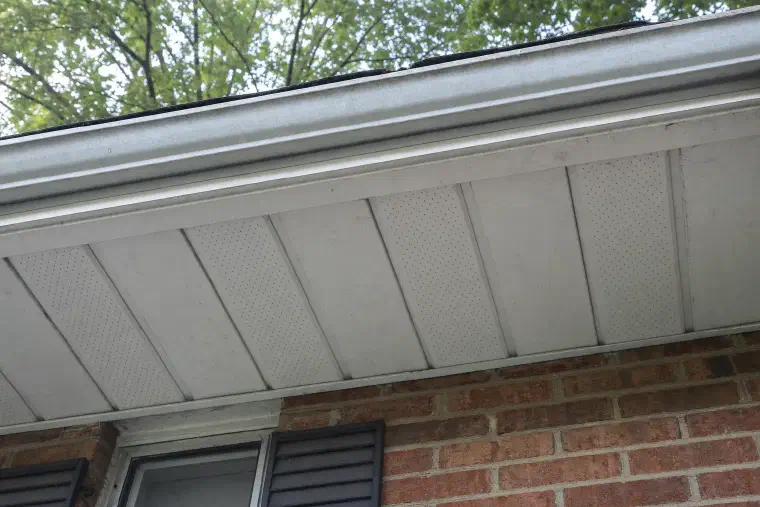
The usual intake problems are easy to spot from the ground or the attic:
| Problem | What you will see | What it does to a turbine |
|---|---|---|
| Soffit vents painted shut | Paint clogging the vent holes | The turbine pulls from the house instead |
| Insulation blocking the eaves | No daylight at the roof edge from inside | Air cannot travel up the roof |
| Too few soffit vents | A few small round holes on a big roof | The turbine starves |
| Ceiling gaps | Open holes around lights and pipes | Cooled house air gets pulled up |
ENERGY STAR puts the second row in capital letters: never cover soffit vents (opens in a new tab) with insulation. If the attic has no intake, a turbine does not fix that. It makes the lack of intake more obvious.
Can you mix turbine vents with a ridge vent?
You can, but we would not. A turbine next to a ridge vent, gable vents or box vents gives the air a short route out, so it skips most of the attic. We see a mix of exhaust types on a lot of roofs, and it is one of the main reasons an attic is still hot after someone paid to improve it.
It can also let weather in. The Asphalt Roofing Manufacturers Association warns that gable vents with a ridge vent and too little soffit intake can pull moisture into the home (opens in a new tab) during a heavy rain or snow. That is its wording about gable vents, but the same logic applies to any second exhaust fighting the first.
If your roof already has a ridge vent, leave it as the one exhaust and fix the intake.
How many vents does an attic need?
The usual rule is 1 square foot of open vent area (opens in a new tab) for every 300 square feet of attic. That is the open area of the vent, not the size of its box, and it gets split between intake and exhaust. It is a floor, not a target, and a busy roof with a turbine, a ridge vent and gable vents can fall short on intake while looking well vented.
When is a turbine vent worth keeping?
When the soffits are clear, the ceiling is sealed, and the turbine is the only exhaust on the roof. In that case it is doing a fair job for no running cost, and there is no reason to rip it out.
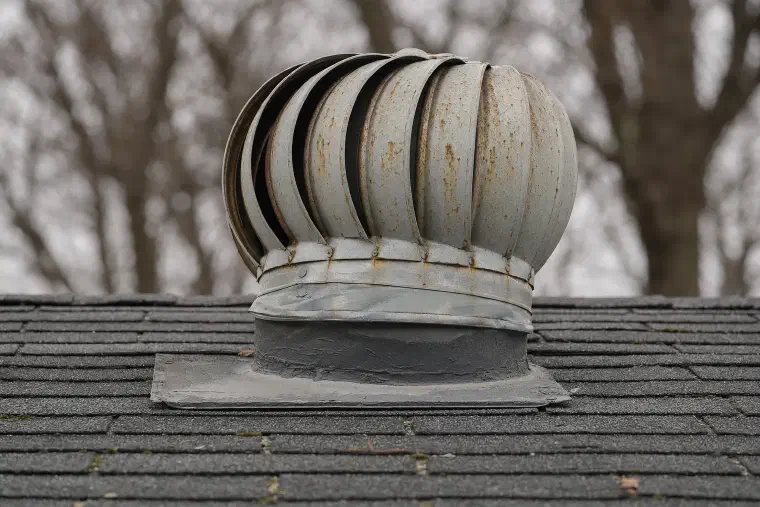
If it is working, leave it alone. If it squeals, wobbles or has stopped turning, that is a repair. A stuck turbine still lets some air out, but a noisy or wobbling one can let rain in, and a rusty head like this one is worth replacing before it fails.
Common questions
Do turbine vents leak?
They can. The base is flashed into the shingles like any other vent, and the seal wears out. A leak under a vent is a common cause of small roof leaks, so check the ceiling below it if the turbine is old.
Do turbine vents work without wind?
Hardly. They spin with the wind, so on a still, hot day they act like an open hole, and warm air rises out of that hole by itself.
Should I replace a turbine vent with a ridge vent?
Often, yes, if the soffits are open. A ridge vent runs along the top of the roof and has no moving parts to wear out. On a roof with short ridges, box vents sometimes fit better, and we will say so after looking.
Can I use a turbine vent and soffit vents together?
That is the setup a turbine needs. The soffits bring cool air in low and the turbine lets hot air out high.
What to do next
If your attic is hot, damp or smells musty and a turbine is the only fix on the table, start with the intake. Our attic venting page explains how a healthy attic moves air, and attic venting repairs covers a turbine that has gone noisy or stopped. For the other side of the same question, read are attic fans worth it and continuous vs round soffit vents. Our free roof inspection includes the vents and the attic when we can get in safely.


