No, a bathroom fan should not vent into the attic. The air it moves is warm and full of water from your shower, and an attic is a cold place with nowhere for that water to go. It lands on the underside of the roof boards, and over a few winters it can ruin them.
The short version
- A bath fan has to send its air outdoors, through a roof cap or a wall cap.
- Dumping it in the attic soaks the insulation and the roof boards from below.
- The usual result is mold, and sometimes new roof decking.
- You can check your own fan in about ten minutes, in a dust mask.
- Moving the duct is a small job. Replacing wet decking costs more.
Why can’t a bathroom fan vent into the attic?
Because the moisture has to leave the house, and the attic is still part of it. Federal building guidance (opens in a new tab) says to install the fan to vent outdoors, not into an attic, crawlspace or space between floors, to discourage condensation and the growth of mold and mildew.
Tom Silva of This Old House puts it more bluntly: fans have to be vented outside the house (opens in a new tab), not into the attic. Otherwise, he says, you’re dumping moisture on the underside of the roof.
Think of it as a kettle left boiling in a closed cupboard. The steam does not vanish. It finds the coldest surface and turns back into water.
What does that moisture do to the roof?
It condenses on the coldest thing it can reach. The Department of Energy’s Building America team says moist air from a duct can condense on cold rafters, trusses and sheathing (opens in a new tab), which are the roof boards, and that this can cause mold and damage the wood.
Here is how it plays out in a Maryland winter:
- You shower, and the fan pushes warm, wet air into the attic.
- The air meets roof boards that are close to the outdoor temperature.
- Frost or droplets form on the underside of the boards.
- On a warmer day the frost melts and soaks into the wood. Then it dries out and freezes again.
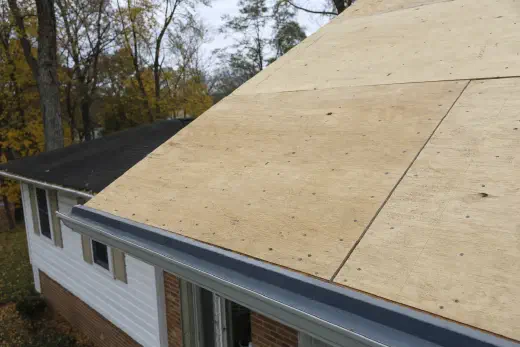
We see this a lot. Warm, humid air from inside the house condenses on the cold underside of the decking, which is the sheet wood under your shingles. The boards soak it up and dry out dozens of times, then start to come apart. It can wear out a roof deck without one drop of rain getting in from above.
How do you know if your fan vents into the attic?
Go and look. Winter is the best time, because frost on the underside of the roof boards shows a moisture problem that is hidden the rest of the year. Wear a dust mask and gloves, because attic insulation is not kind to lungs.
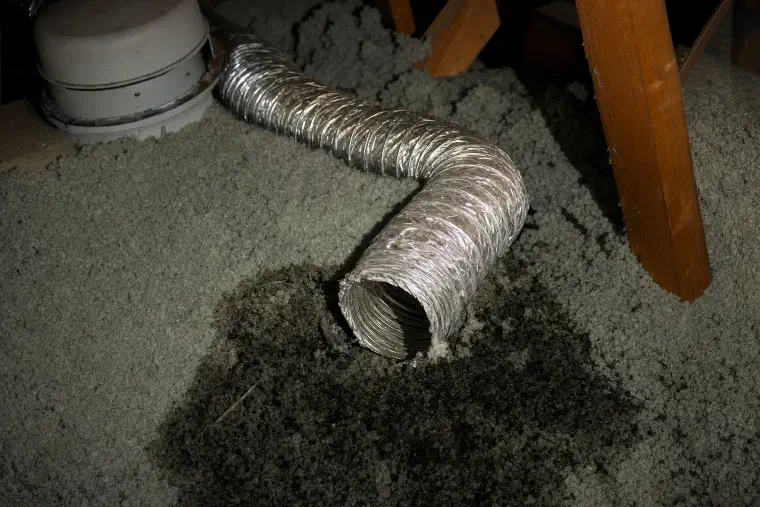
The federal guide says to trace each fan’s duct (opens in a new tab). The fan may be buried in insulation, but the duct should be visible. It should end at a dampered cap on the roof or at a vented opening in a wall. Warning signs are:
- A duct that stops on the attic floor, or has come off its fitting.
- A duct with no insulation on it.
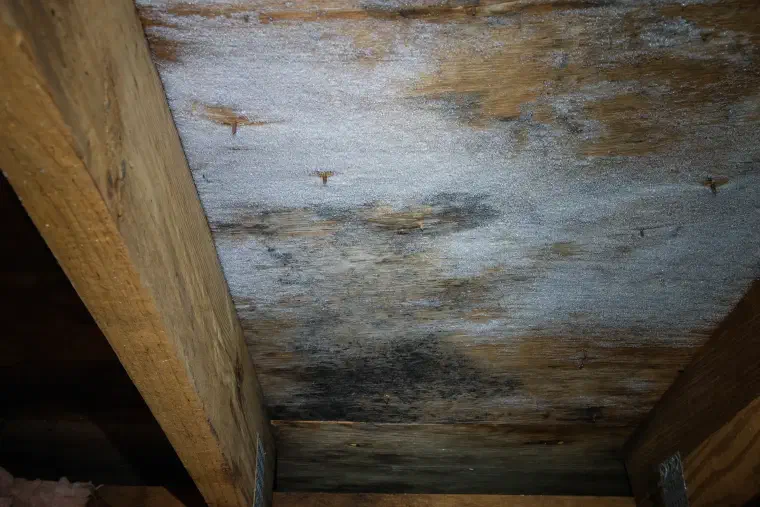
- Dark mold or water stains on the roof boards or framing above the fan.
- Matted, damp insulation around the end of the pipe.
No frost and no stains does not mean you are safe. A fan that has only been wrong for a season or two may not have left a mark yet.
What does it cost when it has gone wrong?
Moving the duct is the cheap part. Wet decking is where the bill grows. In the roof work we do, bath fans and dryers that end in the attic turn up while we are fixing ventilation, and they often lead to mold and new decking.
| What we find | What it usually means |
|---|---|
| Duct ending loose in the insulation | Fix the duct, check the boards above it |
| Dark patches on the roof boards | Mold, so the cause comes first and the boards after |
| Boards soft or crumbling when pressed | Decking replacement |
| Frost on the boards but no stains | Early stage, so fix the exit now |
Decking is priced per 4 by 8 sheet. Replacing it typically runs $70 to $150 installed, and that is on top of the work to fix the duct. Our article on mold in the attic covers what to do about the mold itself.
What is the right way to vent a bath fan?
Straight to the outside, on the shortest, straightest run you can manage. The federal guide says the duct should end at a dampered roof cap (opens in a new tab) or a vented opening in a side wall, and that the wall cap should have a damper that closes when the fan is off.
The duct should be insulated too. The same guide says to insulate the duct (opens in a new tab) to minimize condensation, and This Old House recommends a minimum R-value of 6 (opens in a new tab). R-value is how well insulation resists heat. Higher is better.
Our article on a bathroom fan that leaks water goes through the duct fixes in more detail, and the one on condensation in the attic explains where the rest of the moisture comes from.
Common questions
Can a bathroom fan vent into the soffit?
Not as a fix. A soffit is the underside of the roof overhang, and soffit vents are also how fresh air gets into your attic. Exhaust that ends near one can drift back in. A cap on the roof or a wall is the better exit.
Is it okay if the fan only runs a few minutes?
It helps, but it does not solve it. The federal guide recommends leaving the fan running for one hour after a shower (opens in a new tab). A timer switch does that for you, and it only makes sense if the air is going outside.
Who fixes a duct that ends in the attic?
The duct side is often a handyman or HVAC job. The cap on the roof is ours. The federal guide suggests calling a roofer to put in a proper vent where the duct has to go through the roof.
Does mold in the attic mean I need a new roof?
No. Often the fix is the duct and a patch of decking. We would rather repair than replace when a repair is all that is needed.
What to do next
If your fan ends in the attic, or you see stains on the boards above it, have it looked at before another winter goes by. Our attic venting repairs page covers how we put in a proper roof cap. Our free roof inspection includes the attic when we can reach it safely, and we will tell you what we see. Call us any time, day or night.