

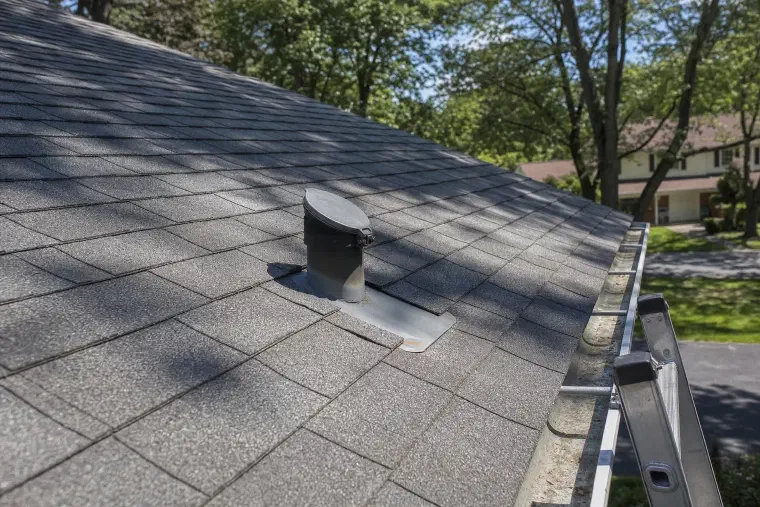
A dryer vent can go through the roof, but it is usually the wrong place for one. Codes want dryer air sent outdoors, and a roof is outdoors, so it can pass. The trouble is that a vent on the roof is hard to clean, hard to keep watertight and easy to get wrong, so a wall is almost always the better exit.
The short version
- Dryer air has to end up outdoors. It must never end in the attic, a soffit or a crawlspace.
- A roof termination can be done, but a federal energy lab says to avoid terminating the duct at the roof (opens in a new tab).
- A roof vent is one more hole in your roof, and every hole is a place for a leak.
- Long, bendy routes get clogged with lint faster, and that is where dryer fires start.
- If your dryer ends in the attic, that is the problem to fix first.
Is it legal to vent a dryer through the roof?
In most places, yes. Building codes say a dryer duct has to end on the outside of the building, and a roof is outside. Washington State’s code, for example, says dryer ducts must terminate on the outside of the building (opens in a new tab) with a backdraft damper where the duct ends. That is the flap that keeps cold air and animals from coming back in.
Legal and wise are two different things, though. Your county and the dryer maker’s instructions decide what is allowed at your house, so check both before anybody cuts a hole. The rest of this article is about why we would rarely choose the roof.
Why is a roof a poor place for a dryer vent?
A roof vent is harder to keep clear, harder to keep dry and harder to reach. All three matter more than they sound.
Length. The duct from the dryer to the outlet should be no more than 35 feet, and the limit drops 2.5 feet for every 45-degree bend (opens in a new tab) and 5 feet for every 90-degree bend. A run up through a second floor and an attic uses up most of that before you count the bends. A longer, bendier duct slows the air, and slow air drops lint.
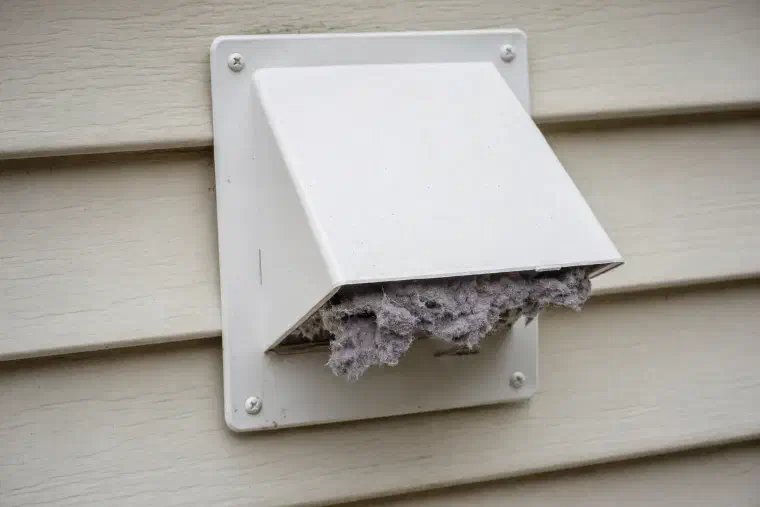
Cleaning. The same lab says cleaning your dryer duct annually (opens in a new tab) dries clothes faster and could prevent a fire. A wall vent can be cleaned from the ground. A roof vent means a ladder, a steep slope and a brush you cannot see the end of.
Leaks. Every roof vent is held in by flashing and a rubber or metal collar. We find pipe boots with cheap rubber collars that crack in 3 to 5 years, and any seal that depends on caulk is a scheduled leak. A dryer cap also gets hit by every storm, so it ends up being a small leak point that sits right above your attic.
Moisture. Dryer air is warm and wet. In winter, a metal duct running through a cold attic can sweat inside, and the water runs back toward the dryer or drips onto the insulation. The Department of Energy lab says to insulate ducts in unconditioned spaces (opens in a new tab), especially in cold climates, to avoid condensation.
Can a dryer vent end in the attic?
No. A dryer vent that ends in the attic is one of the most common ventilation faults we find, and it does real damage. If the dryer duct empties into a crawlspace, attic or other building cavity, the potential for moisture-related damage is significant (opens in a new tab).
A load of laundry puts a lot of water into the air, and an attic has nowhere to send it. The damp air condenses on the cold underside of the roof boards in winter. The boards soak it up, dry out, and soak it up again, dozens of times a season. Over a few winters that can ruin the decking without a single drop of rain coming through from above. Lint also piles up on the insulation and the rafters, which is a fire problem as well as a mold one.
We often find this while correcting the ventilation on a roof. When we do, the decking usually has to be replaced too, and decking is priced per sheet, typically $70 to $150 installed, on top of whatever else the roof needs. Our free roof inspection looks into the attic when we can reach it safely, so a duct that ends there tends to turn up.
What does a good dryer vent route look like?
A good route is short, straight, smooth and ends at an outside wall. Here is the checklist, in plain terms.
| Part | What it should be | Why |
|---|---|---|
| Where it ends | Outdoors, not in the attic or crawlspace | Wet air and lint stay out of the house |
| Duct material | Rigid or semi-rigid metal (opens in a new tab) with a smooth inside | Lint does not catch on a smooth wall |
| Length | 35 feet or less, minus the bends | Short runs keep the air moving |
| Fasteners | No screws poking into the duct | Screws catch lint (opens in a new tab) |
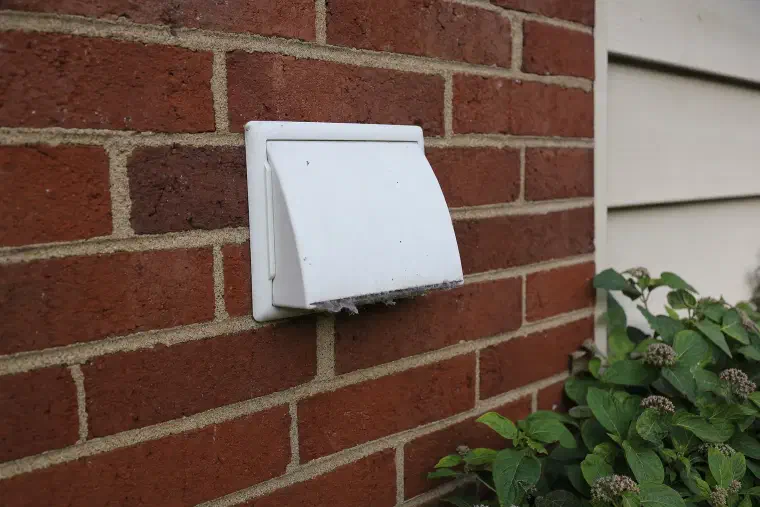
| The outlet | A flap that opens when the dryer runs, with no screen | A screen clogs with lint |
| Distance | At least 3 feet from any door or window | Keeps damp air out of the house |
The outlet should have a hood that points down and sits at least 12 inches off the ground, and a louvered flap works better than a single hinged door. A wall outlet is easy to build to those rules and easy to check.
What if the dryer is in the middle of the house?
Then the answer is a longer run to the nearest outside wall, and the roof is the last resort. A laundry room in a hallway closet or the middle of the house can sit far from an outside wall. It is tempting to go straight up through the attic and out, because it looks short on paper.
Look first at the other routes: down through the floor to a rim joist wall, or across to the nearest gable end. A longer horizontal run to a wall is often better than a short vertical run to the roof, because you can still reach it. If the roof really is the only choice, ask whoever does the work for a short, straight duct of smooth metal, insulated where it passes through the cold attic, with a roof cap that has a damper and no screen. The cap also needs the same flashing any pipe through your roof gets. Rerouting the duct is usually a job for an appliance or HVAC installer. The roof side, sealing the opening and flashing it, is where we come in.
How do you find out where your dryer vent ends?
Follow the duct from the back of the dryer, then look at the outside while the dryer runs. The U.S. Fire Administration says to make sure the outdoor vent covering opens (opens in a new tab) when the dryer is operating. If you cannot find a cap outside, the air is going somewhere else.
Winter is the best time to check the attic. A cold morning shows frost on the underside of the roof boards when moisture is getting in, and it is invisible the rest of the year. Fluffy lint on the insulation near the duct is the other giveaway. Our piece on why attic ventilation matters explains what else an attic should be doing, and are attic fans worth it covers the vents that get added when the attic feels hot.
Common questions
Can I use flexible foil duct on a roof vent?
We would not. The Department of Energy lab calls for rigid or semi-rigid metal duct with a smooth inside. Screws and ridges catch lint, and foil duct has plenty of ridges.
How often should the dryer vent be cleaned?
At least once a year. The U.S. Fire Administration says you are at higher risk of a fire (opens in a new tab) if you do not clean the lint filter and the dryer vents. Lint that blocks the duct increases drying times (opens in a new tab), so clothes that take longer to dry are a warning sign.
Will a roof dryer vent leak?
It can. A roof dryer vent is held in with flashing and sealant like every other pipe through the roof, and those wear out. A cracked cap or a worn collar lets water run down the pipe into the attic, which is the kind of leak that does its damage out of sight.
Does a bathroom fan have the same rules?
The idea is the same. A bath fan that ends in the attic dumps warm, wet air under your roof, just as a dryer does. Both should end outdoors, through a cap that is sealed into the roof or the wall.
What to do next
If your dryer or a bath fan ends in the attic, or a roof vent is cracked, loose or leaking, the roof side is our job. Our attic venting repairs page covers cracked or leaking vents and how we reseal them into the roof, and a roof repair can follow if the decking has been damaged. Call us any time, day or night, or book the free inspection and we will tell you what we see.


