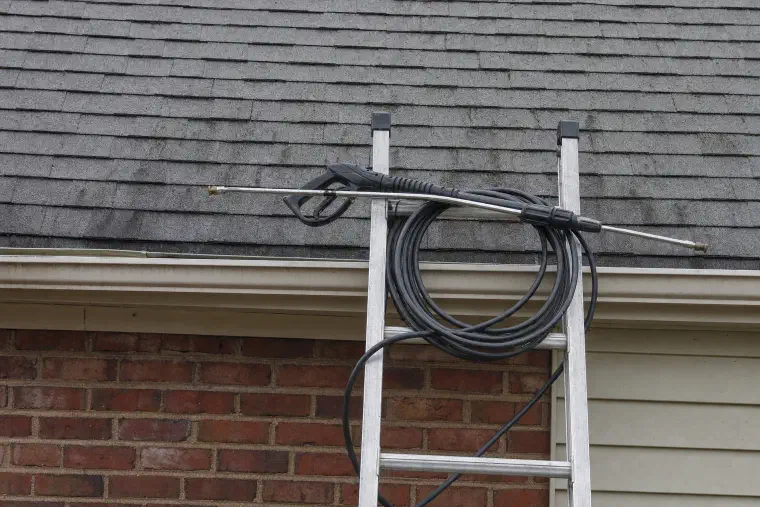
You shouldn’t pressure wash an asphalt shingle roof. The shingle makers’ trade group says never to use a pressure washer on one, because the blast strips off the gritty coating that protects the shingle. The streaks you want gone can be handled a gentler way.
The short version
- A pressure washer knocks the granules off asphalt shingles, and they don’t grow back.
- The trade group for shingle makers calls for low pressure water and a cleaning solution instead.
- Black streaks are mostly a looks problem. Moss is the one to deal with.
- Wet shingles are slippery, so the ladder and the roof are a bigger risk than the streaks.
- If the roof looks bad after a wash, have it looked at before more water goes on it.
Is it okay to pressure wash a shingle roof?
No. The Asphalt Roofing Manufacturers Association says never use a pressure washer (opens in a new tab) on an asphalt shingle roof. Its reason is plain: the water can strip the protective granules and lead to early failure of the roof.
Another page from the same group goes further and says high-pressure washing is likely to damage (opens in a new tab) asphalt roofing. It also says not to use a power washer or any brush or broom on the surface.
Oregon State University’s extension service is a little softer. It says experienced users may pressure wash, but improper technique can damage shingles (opens in a new tab). Its fallback for anyone unsure is to hire a professional or use a long-handled scrub brush. For a roof you plan to keep, we would skip the pressure washer.
What does a pressure washer do to shingles?
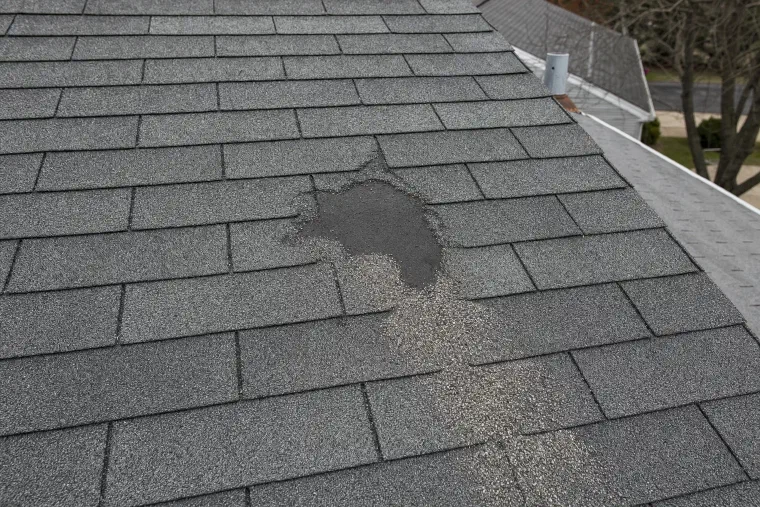
It blasts the granules off. Granules are the small stone pieces pressed into the top of a shingle. They shade the asphalt underneath from sun and rain, so once they are gone, the shingle ages fast.
The damage is easy to miss at first. A blasted spot can look cleaner than the roof around it, then show up later as a dark, smooth patch with grit in the gutter below. If you already see grit there, our piece on shingle granule loss shows what to look for.
Pressure also has another way to hurt a roof. Shingles are laid to shed water downhill. A hard jet aimed up the slope can push water under the edges, and nobody can see where it ends up.
Why not scrub it instead?
Scrubbing has the same problem on a smaller scale. The trade group warns to avoid scrubbing the surface (opens in a new tab), because the friction may loosen and remove granules. Brooms and stiff brushes count.
We see the same thing from foot traffic. Every tech or cleaner who walks a roof scuffs granules off, and on a hot day their footprints can crack the shingle. A scrubbing job is a lot of walking.
What should you use instead?
For algae, the trade group’s advice is a cleaning solution, not force. It describes a 50:50 mix of laundry strength liquid chlorine bleach (opens in a new tab) and water, left on the roof for 15 to 20 minutes and then rinsed with low pressure water. The page also tells you to protect your landscaping from the solution.
It also warns that the results are temporary. Cleaning only lightens the discoloration (opens in a new tab), and it may come back. That is why a wash is a cosmetic fix and not a repair.
The full run-through, including what to ask a cleaner, is in our piece on whether soft washing is safe. If moss is the problem, getting rid of moss covers the gentler options.
How do the options compare?
| Method | What it does to shingles | Verdict |
|---|---|---|
| Pressure washer | Strips granules, can push water under edges | Skip it |
| Scrub brush or broom | Rubs granules loose | Skip it |
| Low pressure rinse with a cleaning solution | Kills growth without force | What the makers describe |
| Leave the streaks | Nothing, though the looks suffer | Fine for most roofs |
Are black streaks worth washing off?
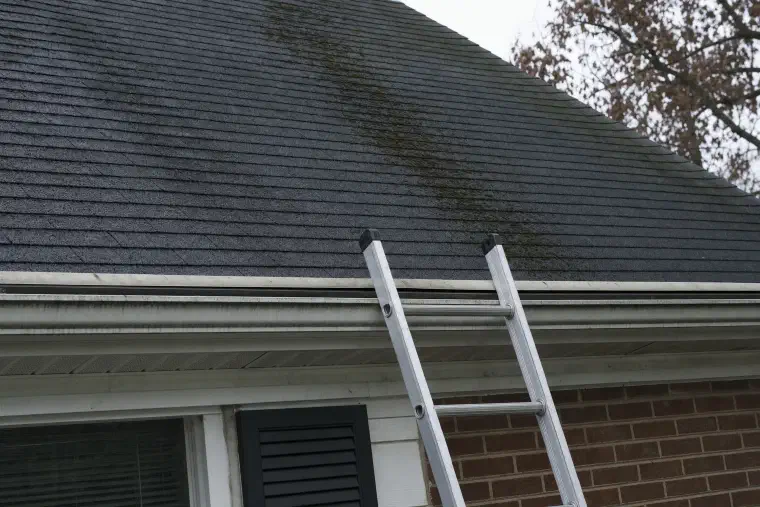
Often not. The streaks are mostly algae, and they are a curb appeal problem more than a roof problem. Moss is different, since it holds water against the roof and can lift shingle edges.
Oregon State says moss can lift shingles and let water in (opens in a new tab) and damage the layers below. So the question to ask is whether you have streaks or a green cushion. Streaks are flat and dark, and moss is thick and green.
On wooded lots around Ellicott City, we see roofs that stay damp under heavy tree cover. The growth comes back after any wash, and the branches sweep the surface and strip granules too. Trimming back the canopy does more than a second wash.
Is it safe to climb up and do it yourself?
Not on a wet roof. The trade group notes that cleaning may make the roof slippery (opens in a new tab) and recommends trained professionals for it. It says to work from a ladder or walkboards where you can.
If you use a ladder, Oregon State says to set it on stable ground and extend it at least 3 feet (opens in a new tab) above the roofline. Gutters bend and ladders slide, so a wet gutter edge is a poor place to lean one.
Common questions
Can I pressure wash a metal or flat roof?
Those materials aren’t covered by the shingle maker sources above. Check with the maker of your roof before any hard spray goes near it.
Will pressure washing void my shingle warranty?
We can’t say, because every maker writes its own terms. Read your paperwork or ask the maker before anything is sprayed. Keep in mind that the trade group’s own pages are not a warranty and say so.
I already pressure washed my roof. What now?
Look at the gutters and downspouts for loose grit, and at the roof for dark, smooth patches. Don’t wash it again. A walk on the roof will show how much damage was done.
What to do next
Roof washing is not one of the jobs we do. What we can do is look at what the water left behind. Our free roof inspection includes a walk on the roof and a written report with photos, with no obligation to book work. If the shingles are scuffed in one spot, that is usually a roof repair and not a new roof.