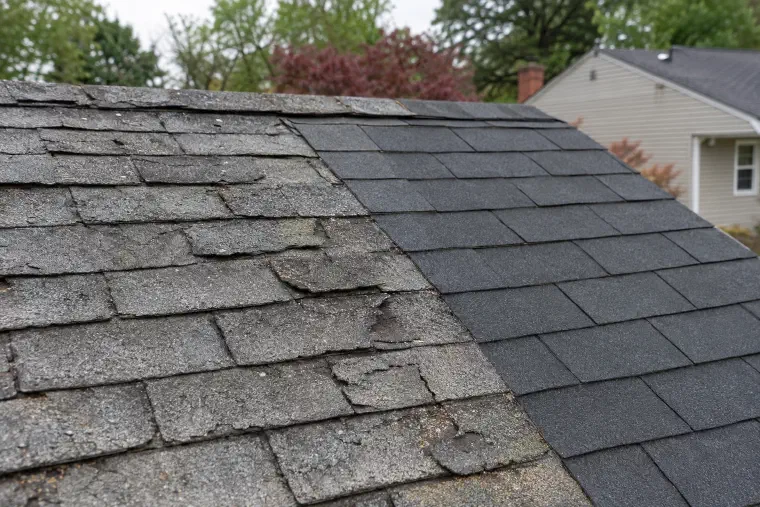
Yes, you can repair a roof instead of replacing it in many cases. When damage is localized and the roof is under 18 to 25 years old, a proper repair costs $500 to $1,600 on average, far less than a full replacement at $22,500 to $29,500 for a typical Ellicott City home. The key is an honest inspection that separates a fixable spot from widespread wear.
TL;DR
- Most roofs don’t need replacing, just the one spot that’s letting water in found and fixed correctly.
- Repair makes sense when your roof is under 15 to 20 years old and the damage is isolated (a few shingles, a pipe boot, flashing).
- Replacement is the honest call once age passes 18 to 25 years, wear is spread across the roof, or decking is rotting underneath.
- A free inspection that walks the roof gives you a real answer without a sales pitch.
- Repairs are cheaper upfront but don’t extend a roof’s lifespan, the math changes as a roof ages.
Can you patch a roof instead of replacing it?
Yes, when the damage is localized and the roof still has years of life left. A patch is a targeted fix: replacing a handful of missing shingles, resealing a pipe boot, or closing a nail pop. It stops water entry at that spot. And it works as long as the rest of the roof is sound.
The difference between a patch and a proper repair often comes down to root cause. A patch might seal the visible hole, while a roof repair digs into why water got in, bad flashing, a missing kickout, or a torn underlayment. For a roof that is less than 15 years old and otherwise in good shape, a patch can easily buy you another five to ten years.
We’ve seen it plenty: one windstorm knocks loose three shingles, and suddenly everyone wants to sell you a whole roof. You don’t need it. Find that leaky spot and fix it properly. As a roof lifespan guide points out, asphalt shingles should last 18 to 30 years, so a seven-year-old roof with a localized problem is a prime candidate for repair.
Is repairing a roof better than replacing it?
It depends on what “better” means. For a young roof with isolated damage, repair is faster, cheaper, and leaves the rest of your money in the bank. For a roof that is pushing the end of its realistic life, replacing it is the more predictable investment.
EcoWatch’s homeowner guide notes that asphalt shingles last roughly 15 to 30 years, with the lower end applying to basic three-tab and the upper to well-installed architectural shingles. Once a roof passes the 20-year mark, small repairs often turn into a temporary patch rather than a long-term fix. You might spend $800 today and another $1,200 next year, when a full roof installation would have cost $25,000 and solved the problem for two more decades.
Financially, a repair almost always wins the first round. A $600 flashing fix compared to a $25,200 replacement is a 42-to-1 difference. The question is how many more rounds you want to play. For roofs under 15 years with no decking rot, repair is the smart choice. Once the roof is past 18 to 25 years and showing widespread granule loss, the math flips. We’ll give you the numbers either way, we’d rather earn your trust than push a roof you don’t need.
Should you repair or replace your roof?
Every roof tells its own story, but the decision usually comes down to four things: age, damage spread, cost, and how long you plan to stay in the house. This table lays them out side by side.
| Factor | Repair | Replacement |
|---|---|---|
| Roof age | Best under 15 to 20 years; possible on older if the rest is solid | Recommended once past 18 to 25 years or when widespread wear shows |
| Damage extent | Isolated (a few shingles, one leaking boot, flashing at one wall) | Widespread (curling, missing granules across slopes, multiple leaks, soft decking) |
| Cost (typical) | $350 to $2,200; structural repairs reach $15,000 | $6.00 to $9.00 per sq ft; a 3,580 sq ft roof in Ellicott City averages $25,200 |
| Timeline | 1 to 4 hours on site, 1 to 2 weeks from call | 1 to 3 days on site, 2 to 6 weeks including permits and scheduling |
| Warranty | 30 days to 1 year on repaired area (none on roofs over 15 to 20 years) | Manufacturer defect warranty plus a workmanship warranty from us |
A roof replacement warning sign guide lists widespread granule loss, sagging decking, and daylight peeking through the attic as clear signals that repair has run its course. When more than about 20% of your shingles show significant wear, repair stops being cost-effective. If you’re stuck between the two, a free roof inspection gives you the data to decide without guessing.
Can you fix just one section of a roof?
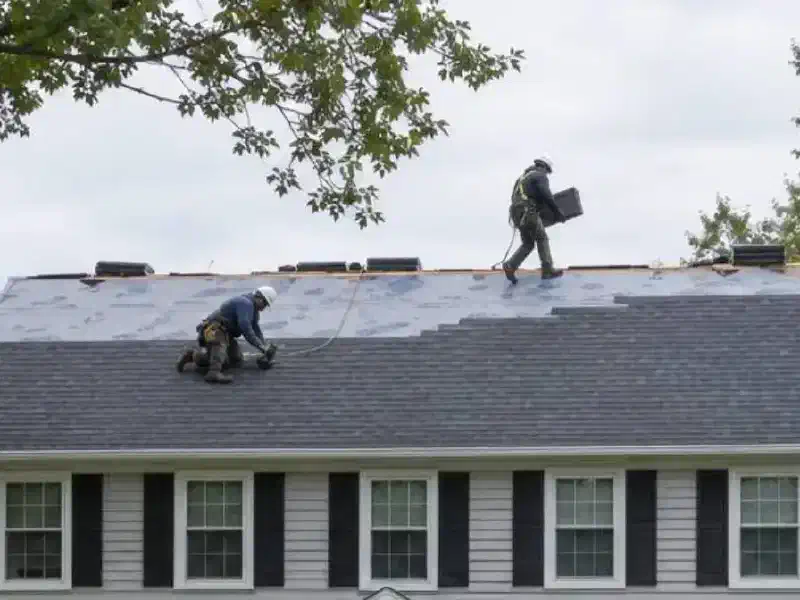
Yes, you can. Partial slope repair is a common job: remove the damaged shingles on one face of the roof, replace any wet decking underneath, and install new underlayment and shingles on that slope alone. It works when damage is confined to one roof plane, say the south-facing side that took the brunt of a windstorm, or a low-pitch section that trapped debris.
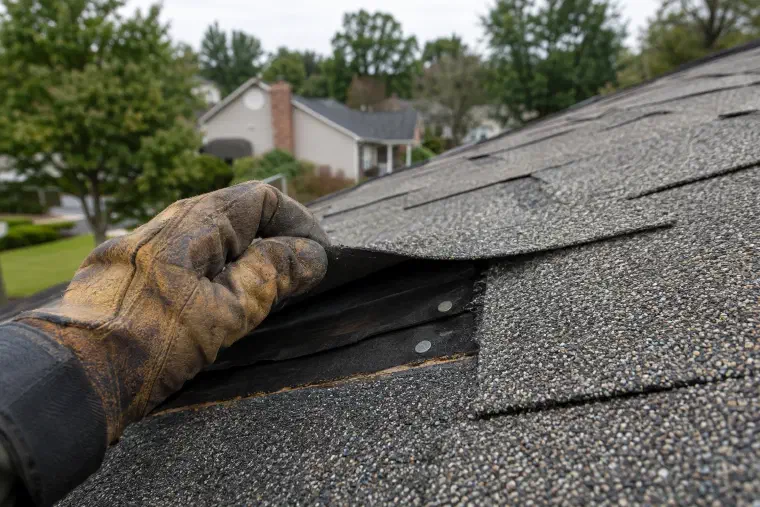
The catch is that matching old shingles is rarely perfect. Even if the color is available, years of sun fade the original, so the repaired section will look newer for a while. That’s not a structural problem, but it’s worth knowing. Partial slope work also carries a per-square price penalty, around $850 to $1,100 per square compared to doing the whole roof, because mobilization and setup still happen.
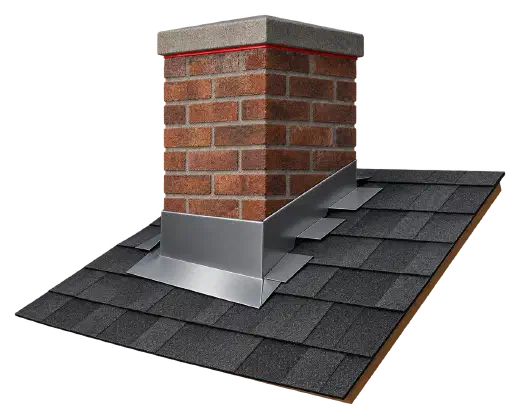
If the leak is at a transition point where one roof meets a wall or chimney, you might not need a full slope. A roof flashing repair can solve the problem without touching the field shingles. We’ll tell you which one applies after we get on the roof.
When a repair makes more sense than a new roof
You’re a repair candidate when the roof is under 15 to 20 years old, the decking is dry, and the trouble is confined to a single failure point. These repairs can extend a roof’s useful life by five to ten years without the cost of a full replacement.
Repair-friendly problems
- Flashing leaks at a chimney, wall, or valley
- Pipe boot failure (the rubber collar around a plumbing vent cracked from age)
- Missing or broken shingles from a wind event, covering less than 10% of the roof
- Ridge cap re-securement, a few loose pieces don’t mean the whole roof is done
- Small nail pops or sealant failures where a dab of sealant closes the gap for now
We’ve seen all of these force homeowners into a replacement quote they didn’t need. Our philosophy is straightforward: if a full replacement isn’t necessary, we’ll recommend repairing what’s there and waiting a few years. You shouldn’t pay for a new roof when an afternoon of flashing repair solves the leak.
One thing you should know: caulk is a scheduled leak. Any flashing detail that depends on sealant to stay dry has a built-in expiration of five to ten years. We fix leaks with proper mechanical integration, not a tube of caulk, because a repair that just covers the problem isn’t really a repair.
When roof age is on your side
A 10-year-old architectural shingle roof still has more than half its life ahead. Unless installation was botched, nails too high, no starter strip, unbalanced ventilation, the materials are still doing their job. At that age, repairing a localized problem keeps the roof in service, and the repair cost is a fraction of replacement.
When replacing is the more honest recommendation
Replacement becomes the right call when age has caught up with the roof or the damage isn’t confined to one spot. We won’t sell you patch after patch if they’re just buying a few months before another leak appears.
Signs repair has run its course
- Widespread granule loss, shingles look bald, and you find granules in gutters after every rain
- Curling or cupping shingles across multiple slopes, not just one sunny corner
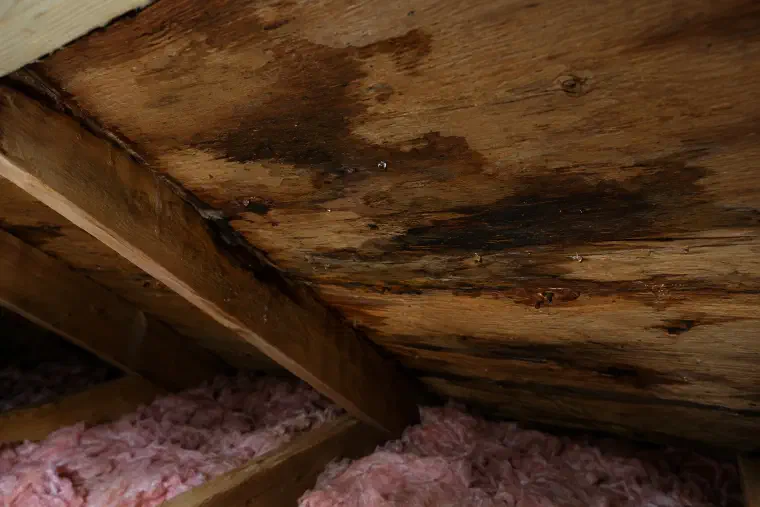
- Soft spots in the decking, which mean water has been soaking the wood long before you saw a ceiling stain
- Leaks in new places after a previous repair held for a while, the roof is telling you the whole system is tired
- Roof age over 18 to 25 years, at that point, any repair is a temporary patch, and you’ll spend more on repeat calls than a new roof costs
- Ventilation failure, inadequate attic venting can cut a roof’s life nearly in half, cooking shingles from underneath
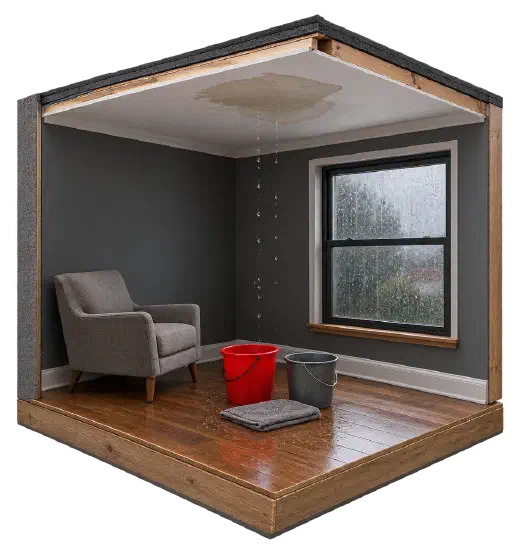
A ceiling stain is the last stage of a leak, not the first. By the time you see it, water has often been entering for years, quietly rotting decking and insulation. If a new roof is what the house needs, we’ll say so plainly, and we’ll show you the photos that explain why.
What a roof inspection actually tells you
The fastest way to stop guessing is a boots-on-the-roof inspection. We walk the roof, lift a few shingles, check flashing tightness, and look inside the attic when it’s accessible. The inspection is free, and you get a written report with photos, a measured square count, and a defensible remaining-life estimate. No obligation to book work.
What gets checked
- Shingle condition: granule loss, curling, cracking, seal failure
- Flashing integrity at chimneys, walls, valleys, skylights, and penetrations
- Pipe boots and vent collars for cracking or loosening
- Gutters for granule buildup and debris that can back water up under shingles
- Attic ventilation: intake and exhaust balance, signs of trapped moisture
- Decking firmness, we press for soft spots that signal rot
What a free inspection cannot promise
A free visual inspection is a snapshot, not a warranty. It won’t catch high nails hidden under intact shingles, and it can’t run a full ventilation calculation unless we pull measurements and run the numbers. Active leak diagnosis, where we hose-test or use a moisture meter to find the exact entry point, is a separate paid service at $150 to $400. Still, for most homeowners trying to decide between repair and replacement, the free inspection gives you the facts you need to make an informed call.
What a roof repair should cost in Ellicott City
Repair pricing is driven more by what failed and how hard it is to reach than by the number of shingles. Here are the typical tiers we see around Howard County.
| Repair tier | Typical cost | Examples |
|---|---|---|
| Tier 1 (near minimum) | $300 to $850 | Replace 1 to 3 shingles, pipe boot replacement, ridge cap re-secure, small sealant reseal |
| Tier 2 (most calls) | $500 to $2,200 | Leak diagnosis and repair, wind-lifted shingles, valley repair, step flashing, chimney reflash, skylight reflash |
| Tier 3 (structural or systemic) | $1,500 to $15,000 | Decking section plus reshingling, partial slope replacement, low-slope membrane, rafter sistering |
| Full roof replacement | $6.00 to $9.00 per sq ft ($22,500 to $29,500 typical) | Complete tear-off, new underlayment, flashing, shingles, ventilation, cleanup |
Keep in mind that decking found wet after tear-off is not included in a repair quote and will be added if discovered. We price it per sheet and show you the condition before any extra work starts. If you’d like a firm number, get a free quote after an inspection.
Common questions
How long does a repaired roof last?
A properly executed repair on a sound roof can last 10 years or more. The repaired area should hold as long as the surrounding materials. On an older roof, however, the repair might only last a year or two before nearby shingles start failing. The roof’s overall age dictates how long any fix will serve you.
Does homeowners insurance cover roof repair instead of replacement?
Insurance typically covers sudden, accidental damage like a tree falling or wind tearing off shingles. Wear and tear, age-related granule loss, or slow leaks from poor flashing are maintenance issues and usually not covered. Check your policy’s named perils and call your agent to understand what triggers a claim.
Can a roofer match old shingles on a repair?
Matching is possible when the shingle product is still manufactured and hasn’t changed color formulation. Even then, years of sun exposure fade the original, so a fresh batch will look slightly different. In many cases the mismatch fades over a season, but a perfect color match on an aged roof is rare.
What is the cheapest way to stop a roof leak temporarily?
A tarp securely fastened over the damaged area and extending past the ridge is the most reliable temporary fix. Inside, place a bucket under the drip and puncture the ceiling bubble (if any) to let water drain straight down instead of spreading. This buys a day or two until a roof repair can be scheduled.
Will a roof repair show as a patch?
Yes, a repair is often visible from the ground for a few months. The patched area will look fresher, and the granule color may not match the surrounding weathered shingles exactly. Over time, dirt, rain, and sun narrow the difference, but a patch rarely disappears completely.