

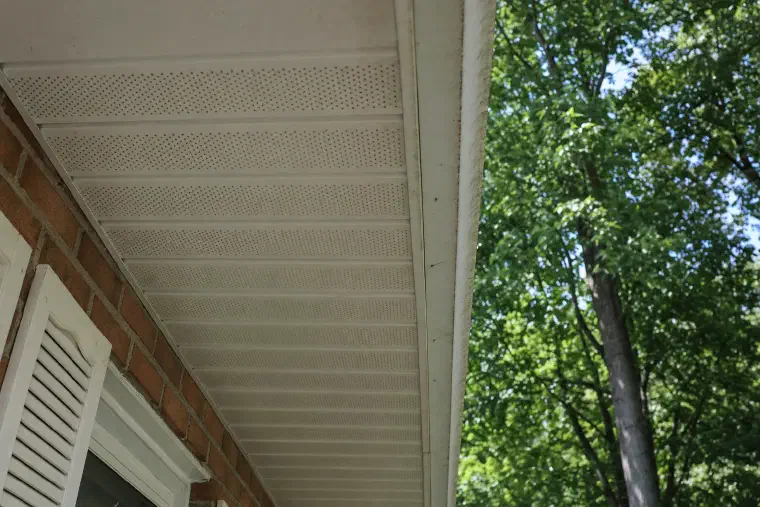
Continuous soffit vents are better for most houses, because they feed air along the whole eave instead of at a few spots. Round soffit vents are the fallback when a soffit is solid and a long strip will not fit. Either one works if the air can really get through it.
The short version
- A continuous vent is one long strip. A round vent is a small disc set into a hole, one at a time.
- Continuous vents spread the intake evenly and are what most attic guides recommend.
- Round vents suit solid soffits and add-on jobs, but you need a lot of them to match a strip.
- Neither does anything if paint, dust or insulation blocks it.
- Your attic needs air coming in low and leaving high, in about equal amounts.
What is the difference between continuous and round soffit vents?
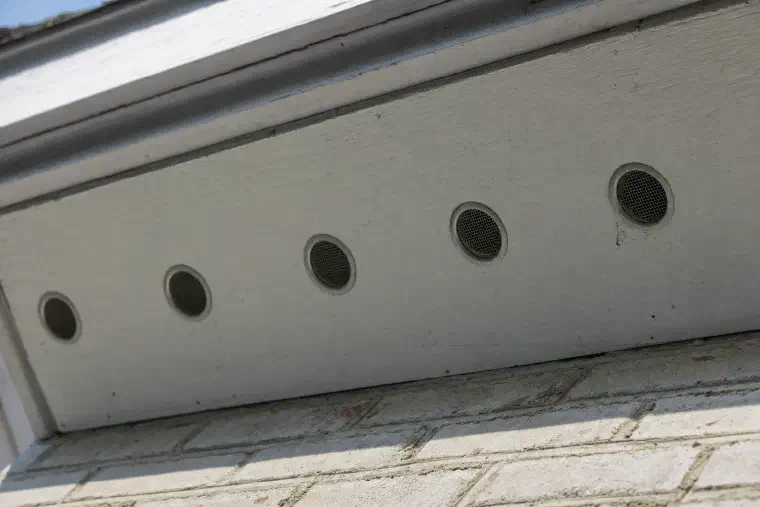
A continuous vent runs the length of the soffit, which is the flat panel under the edge of your roof. A round vent is a small circle, usually a screened metal or plastic disc, pushed into a hole cut in the soffit every few feet.
Both do the same job. They let cool outside air into the attic at the bottom of the roof. The Asphalt Roofing Manufacturers Association says that intake vents at the eaves or soffit (opens in a new tab) let air enter the attic naturally. The only question is how that air gets in: along a whole edge, or through a row of small holes.
Which one do the experts recommend?
Continuous. Virginia Tech’s extension service says most homes should have a continuous ridge vent (opens in a new tab) along the peak and continuous soffit vents at the eaves to give the most effective ventilation.
The reason is simple. Air moves up the roof slope from the soffit to the ridge. A continuous strip feeds every rafter space at the same rate. A round vent every four feet or so feeds the spaces right behind it and leaves the ones in between starved. That is not a disaster, but it is a lopsided attic.
When do round vents make sense?
Round vents make sense on a solid soffit that has no vents at all. Cutting a few holes is a smaller job than swapping out the whole soffit, and it gets some air moving. They also fit short overhangs, porch ceilings and boxed-in corners where a long strip cannot go.
The same Virginia Tech guide says that if individual vents are used instead of continuous ones, the vents should be divided equally between the ridge and soffits (opens in a new tab). So the count matters. A handful of round vents on a big attic with a long ridge vent is a common mismatch: lots of exhaust, not much intake.
How much air does each type let in?
What counts is “net free area”, the part of a vent that air can pass through. It is smaller than the vent itself, because the screen, the louvers and the holes take up room. The Asphalt Roofing Manufacturers Association defines it as the unobstructed area (opens in a new tab) air can pass through a vent, and sets the basic rule at 1 square foot for every 150 square feet of vented space.
The package of any vent lists its net free area, so you can do the sum yourself. The catch is that a strip is counted per foot of length and a round vent is counted per disc. A round vent that looks big on the box can still be a small share of what the attic needs.
| Continuous | Round | |
|---|---|---|
| Looks like | A long strip or a fully perforated panel | A row of small discs |
| Best on | Roof edges where the soffit is open or can be swapped | Solid soffits and short overhangs |
| Airflow | Even along the whole eave | Strong at each disc, weak between |
| Count to check | Net free area per foot, times the length | Net free area per disc, times how many |
| Weak spot | Paint, dust and insulation over the strip | The same, and too few of them |
Which type blocks up more easily?
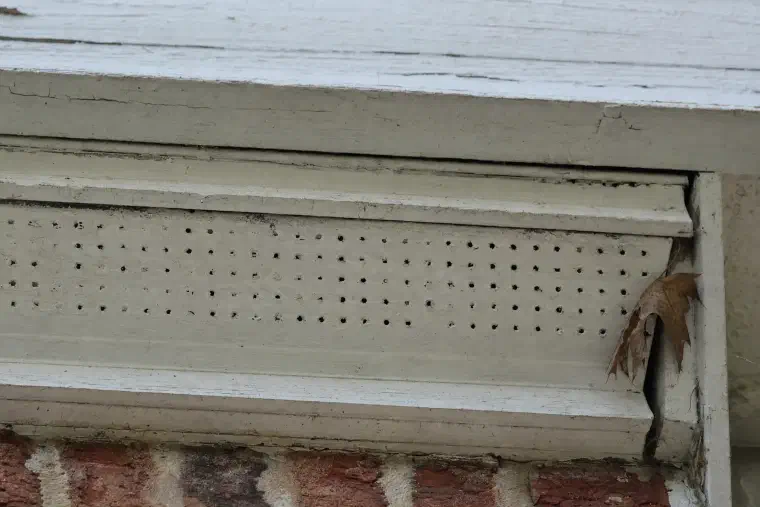
Both clog the same way, and we see it constantly. Paint fills the small holes. Dust and wasp nests build up behind the screen. The worst one is insulation, because it is out of sight. Blown-in insulation slides down the attic floor and packs against the roof edge, and the vent still looks perfect from the yard.
The fix for that is a baffle. Building America, a Department of Energy research program, says baffles are installed at each soffit vent to keep insulation from blocking (opens in a new tab) the vents and to give the air a path from the soffit up to the ridge.
What goes wrong with the intake most often?
Not enough of it. The Asphalt Roofing Manufacturers Association says that if the two sides cannot be balanced, it is better to have more intake than exhaust, because industry experience shows most attics lack proper intake (opens in a new tab).
Here is what that looks like on real roofs:
- A ridge vent goes on, but the soffit behind it is solid and never gets cut open.
- A few round vents are added to a long eave and the rest of it stays closed.
- The vents are fine, but insulation sits across them.
- Paint has sealed a continuous strip on one side of the house.
An unvented attic cooks shingles from underneath and can cut a roof’s life nearly in half. It is one of the most underrated reasons roofs wear out early, and it does not feel like damage until the shingles are curling. Our article on why attic ventilation matters goes through the heat and moisture side of it.
Can you swap round vents for a continuous one?
Often, yes, but it depends on the soffit. If it is already a vented panel, a strip can go in its place. If it is solid wood, the fix is a bigger carpentry job: cutting a long slot, or replacing the soffit panels. Rotted wood along the edge changes the plan, and on a full roof replacement, fascia, soffit and trim carpentry is not in the price. Rotted wood is billed as time and materials, or left out. Extra ventilation beyond the code minimum is its own line too, so ask about both before you sign.
We cover the board next to it in soffit vs fascia, and the exhaust side in are attic fans worth it.
Common questions
Can I use both continuous and round soffit vents?
You can, and many houses do, because different parts of the roof get different soffits. What matters is the total net free area and that the air has a path up the roof. Count them together, not one type at a time.
Do soffit vents need a ridge vent?
They work best with one. Air comes in low, rises as it warms and leaves at the peak. A soffit vent with no exhaust above it has nowhere to send the air, and a ridge vent with no soffit vent has nothing to pull from.
Can I paint over soffit vents?
Not over the vent itself. Paint fills the small holes and can seal them shut. If the soffit needs painting, mask the vent first, or clear the holes with a stiff brush once the paint is dry.
Will the free inspection check my soffit vents?
We look at the attic when we can get in safely, and we say so if the intake looks blocked or short. We do not run a full vent-area calculation on the free visit. If the vents look wrong, we talk through what a fix would involve.
What to do next
If your attic runs hot, shows frost in winter, or you are not sure the air has a way in at the eaves, have it looked at. Our attic venting installation page explains how we add intake, and a free roof inspection is the easy way to start.


