

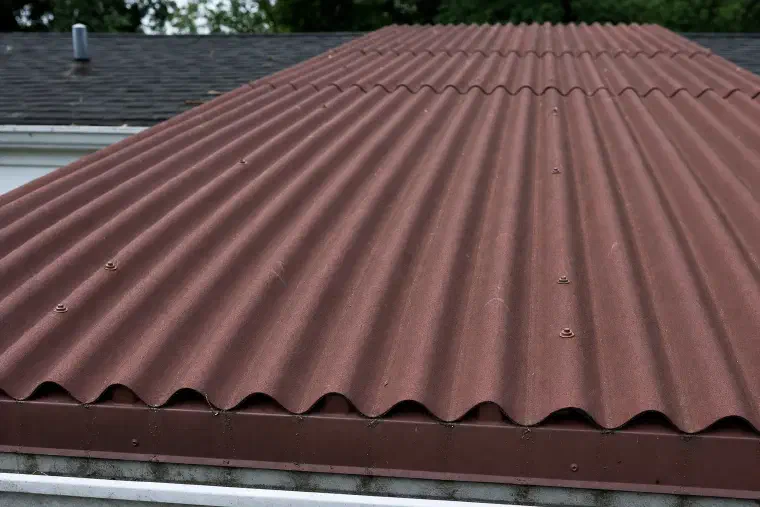
A corrugated metal roof is cheaper and goes on fast, but its screws sit out in the weather. A standing seam roof costs more and hides its fasteners, which is the main reason it leaks less over the years. For most homes around Ellicott City, the real choice comes down to how long you will stay and how much you want to pay today.
The short version
- Corrugated panels are wavy and held down by screws through the face of the metal.
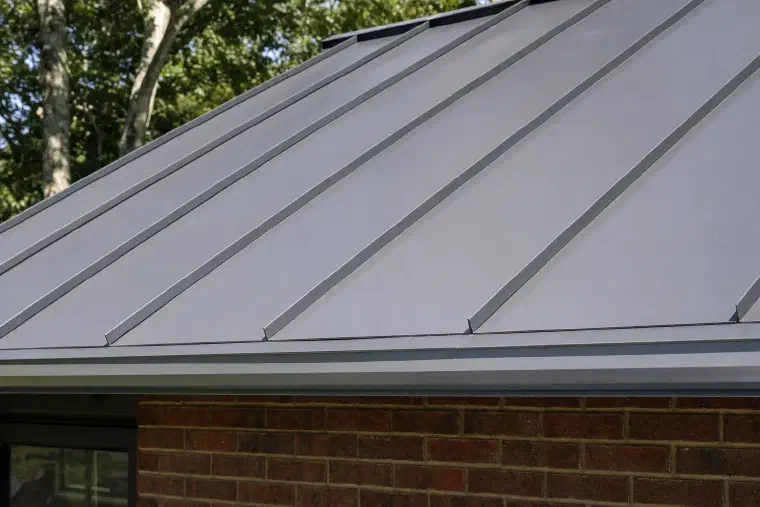
- Standing seam panels are flat with raised seams, and the clips that hold them are hidden.
- Standing seam typically runs two to two and a half times the cost of asphalt. Corrugated usually costs less.
- Corrugated roofs need their screws checked every few years. Standing seam mostly does not.
- Which one is better depends on your roof’s slope, your budget and your plans for the house.
What is the difference between corrugated and standing seam?
The difference is how the panel is held to the roof. Corrugated is the wavy, ribbed metal you may know from barns and porches. It is an exposed fastener panel, and the Building America Solution Center says these are attached using gasketed screws (opens in a new tab). The gasket is a small rubber washer under each screw head.
Standing seam is flat between narrow raised seams. Its panels are attached to clips (opens in a new tab) that are attached to the roof, and the seams lock the panels together. Nothing goes through the face of the metal.
We cover how that second type goes together in our article on what a standing seam metal roof is.
Which one costs less?
Corrugated usually costs less, although the ranges overlap. This Old House puts corrugated roofs with exposed fasteners at $4 to $26 per square foot (opens in a new tab) and cut-to-size standing seam at $9 to $30 per square foot. Those spreads are wide because the roof’s shape, steepness and trim work change the price so much.
For comparison, asphalt shingles around Ellicott City typically run $6.00 to $9.00 per square foot installed, and standing seam typically runs two to two and a half times that. These are typical ranges, not a quote. Our full breakdown is in how much a metal roof costs.
Which one leaks more?
Corrugated, almost always, and the screws are the reason. Every screw is a hole through the roof, closed by a rubber washer. That washer ages in sun and heat, then cracks or flattens, and water finds the gap. IBHS notes that these panels must include EPDM washers (opens in a new tab), and also warns against fasteners that are too tight or too loose, because either one can damage the seal.
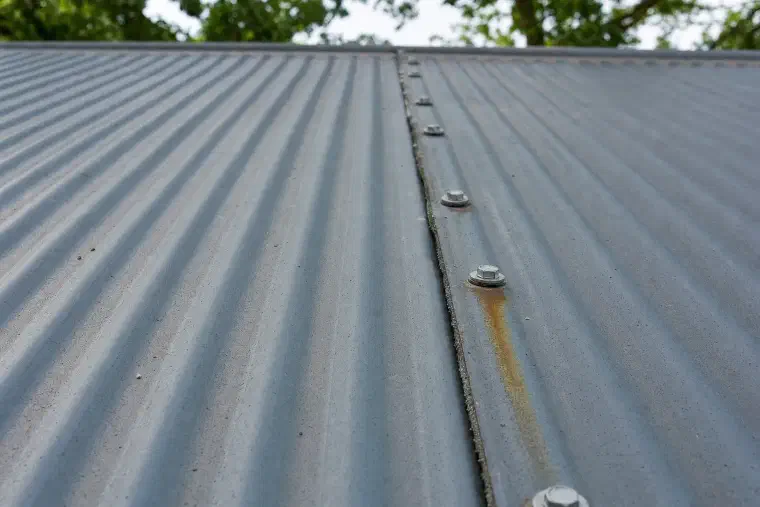
Standing seam has no screws on the face to wear out. That does not make it leak-proof. Chimneys, walls, skylights and valleys still need careful trim, and we say caulk is a scheduled leak, because sealant only lasts about 5 to 10 years. We go through the corrugated side of this in why metal roof screws leak.
Do both types handle heat and cold the same way?
No. Metal grows when it is hot and shrinks when it is cold, and the two types deal with that differently. On standing seam, IBHS says sliding clips allow the roof to expand (opens in a new tab) and contract. This Old House says the locked seams let the panels expand and contract with temperature.
On a corrugated roof the screws pin each panel at many points. Over years of heating and cooling, that is one more reason screws can work loose and need a look.
Can either one go on a low slope?
Standing seam can go much lower. The Building America Solution Center says the minimum slope for standing seam is one quarter unit in 12 (opens in a new tab), a nearly flat roof. IBHS says a panel with lapped seams and no sealant is allowed down to 3 in 12 (opens in a new tab), which is a real pitch.
Each maker sets its own minimum, so the product’s sheet decides, not a general rule. If your roof is very flat, ask us what the maker allows before you pick a panel.
Side by side
| Corrugated | Standing seam | |
|---|---|---|
| Look | Wavy ribs, screw heads in rows | Smooth, narrow raised seams |
| Fasteners | Screws through the face, with washers | Hidden clips |
| Up-front cost | Usually lower | Typically 2 to 2.5 times asphalt |
| Where it tends to leak | At the screws, and at trim | At trim around chimneys, walls and valleys |
| Upkeep | Check the screws and washers | Check the trim and sealant |
| Lowest slope | Higher, check the maker | One quarter in 12 |
Is corrugated worth it for a house?
It can be, on the right roof. A simple roof, a porch, a shed or an addition you will keep an eye on suits corrugated well. The money you save is real, and screws can be checked and replaced.
On the main roof of a home you plan to keep for decades, the screws become a job that never ends. The installer matters more than the panel. A crew that sets screws at the right tightness and builds proper trim will beat a better panel put on carelessly.
Common questions
Is corrugated metal roofing the same as exposed fastener?
Mostly, yes. Corrugated panels are almost always held down with screws through the face, so people use the two names together. Some ribbed panels hide their fasteners, so check what a quote actually says.
Does standing seam need a solid deck?
Usually. The Building America Solution Center says standing seam panels typically must be installed on roof decks (opens in a new tab) with sheathing. Exposed fastener panels are often stiff enough to go over spaced wood strips instead, which is part of why they cost less.
Which lasts longer?
This Old House says metal roofs overall hold up for 40 to 70 years (opens in a new tab), and it does not split that by panel type. In practice the corrugated roof’s washers wear out long before the metal does, so plan to maintain them.
What to do next
If you are weighing the two, start with a free roof inspection so you know what your roof and deck are like today. Then our metal roofing installation page shows who metal suits and who it doesn’t. You can also call us anytime, day or night.


