Maybe. A metal roof sheds snow far better than shingles do, so if snow can drop onto a door, a walkway, a car or a lower roof, then yes, you want snow guards. If the snow lands on open lawn, you may not need them at all.
The short version
- Metal is slick, so snow tends to let go in one big slide instead of melting off a little at a time.
- Snow guards are small stops fixed to the roof that hold the snow in place until it melts.
- Where the snow lands decides the answer: doors, walkways, parking, gutters and lower roofs are the places to protect.
- They are cheapest to plan for before the panels go on.
Why does snow slide off a metal roof so easily?
Snow slides off a metal roof easily because the surface is smooth and gives it almost nothing to grip. The University of Minnesota Extension notes that shingled roof decks do not shed snow and ice as easily as metal roofs (opens in a new tab), and that is the whole story in one sentence.
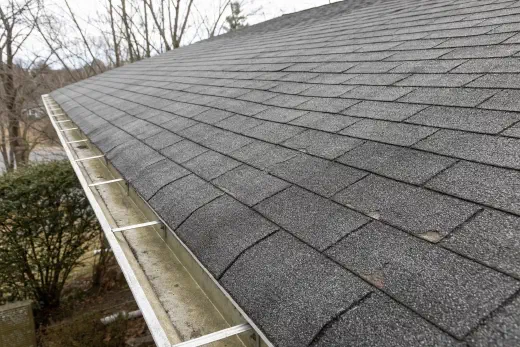
Shingles are rough, like fine sandpaper, and snow sticks to them. A painted metal panel is closer to a skating rink. Add a little warmth coming up from the house, and the bottom layer of snow turns to water. The whole slab is then sitting on a film of it.
That is why metal roofs clear themselves nicely after a storm. It is also why the snow can leave all at once.
What can sliding snow actually damage?
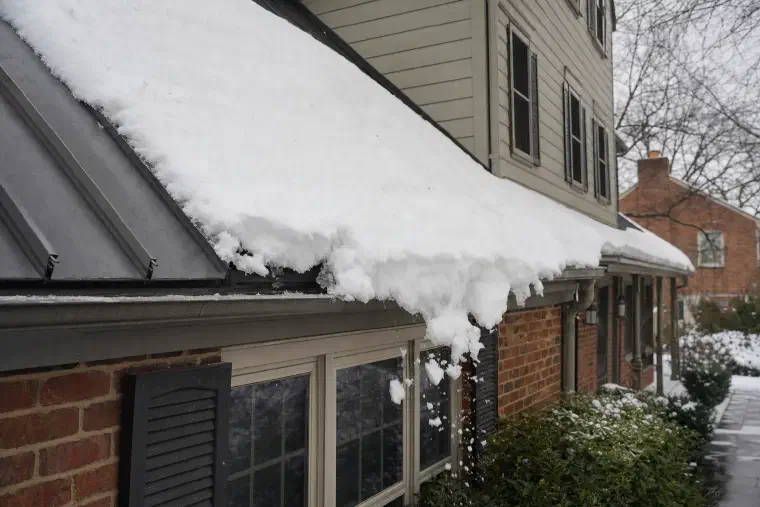
Sliding snow can hurt people and break things, which is why this is more than a looks question. The National Roofing Contractors Association says that sliding snow and ice can damage property, kill people and overload lower roofs (opens in a new tab).
On a normal house that usually means a few specific targets:
- the gutter along the eave, which can get bent or ripped off
- the shrubs and the air conditioner under the edge
- a car parked below
- the front steps or back door
- a lower roof, such as a porch or garage, that takes the whole load
Standing seam panels have their own weak spot. The same NRCA page warns that in valleys, moving snow can roll the standing seams (opens in a new tab) onto their side, which breaks the seals that keep water out.
Which roofs need snow guards, and which can skip them?
A roof needs snow guards when its snow has somewhere bad to land, and it can skip them when the drop zone is open and empty. Walk around the house and look at what sits under each roof edge.
| What is under the edge | Snow guards? |
|---|---|
| Front door, back door, steps or a walkway | Yes |
| Parking spot or driveway | Yes |
| Lower roof, porch or garage | Yes |
| Gutters you want to keep attached | Usually yes |
| Open lawn, far from the house and the path | Often no |
Roof shape matters too. A steep slope shoots the snow farther and harder. A long run of unbroken panel from ridge to eave gives the snow plenty of room to build speed.
A Canadian building research digest hosted by MIT puts the rule plainly: parking and pedestrian access below sloping roofs should be avoided (opens in a new tab), or fenced off. Fencing off your own front door is not much of a plan, which is the case for guards.
Does Howard County get enough snow to bother?
Yes, enough to design for. The Maryland Department of Labor says Howard County roofs must be designed for a 40 pound load (opens in a new tab), which the code treats as the ground snow load. That is a design number for the structure, not a forecast, but it shows the county plans for real snow.
Most winters here are not Colorado. The risk is one wet, heavy snow followed by a warm day, which is exactly the setup for a slide. A roof can go years without trouble and then drop a load onto the walkway on the one morning somebody walks out with the dog.
What do snow guards look like, and how do they work?
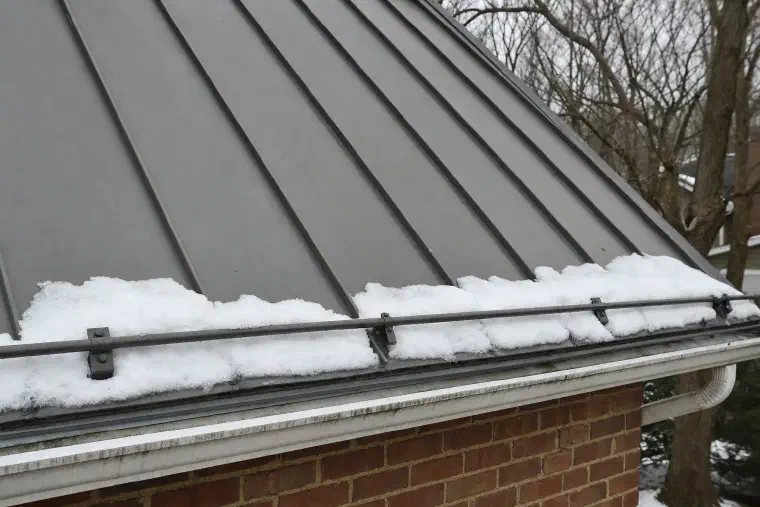
Snow guards are small stops or bars fixed to the roof that hold snow in place so it melts off in pieces. NRCA describes the job simply: snow guards are used to hold snow on roofs (opens in a new tab).
There are two common styles. Individual guards are little blocks or pads set in a pattern across the slope. Rails are long bars that run across the roof near the eave. Some guards clamp onto the standing seams with set screws, so set screws are used to attach several commercially available snow guards (opens in a new tab) to the seams without drilling through the panel.
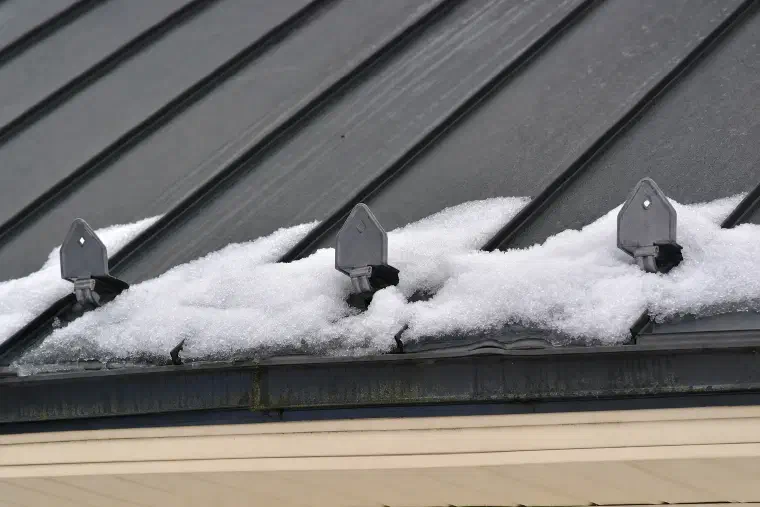
One thing to keep in mind: a snow guard does not make snow disappear. It holds a lot of weight, and that force has to go somewhere. The building research digest advises designing snow stops to take the full sliding force, assuming zero friction between the snow and the roof (opens in a new tab), especially on metal. A few cheap guards scattered near the edge can be overpowered, and a layout that works for one roof can fail on the next.
Can you add snow guards after the roof is done?
Yes, you can add them later, but it is easier and cleaner to settle it before the panels go on. Adding them to an existing roof means working on slick panels in cold weather, and every fastener or clamp is one more spot that has to stay watertight.
If you are still deciding on metal, bring it up early. Our metal roofing installation page covers what we do and how a metal roof sheds rain and snow. For the money side, standing seam metal typically runs 2 to 2.5 times the cost of asphalt, and we break that down in how much a metal roof costs.
If your roof is already on and the snow has been landing in the wrong place, a free roof inspection is a good way to find out what is under each edge and whether guards make sense. And if a slide has already pulled a gutter loose, that is a job for gutter repair.
Common questions
Do all metal roofs need snow guards?
No. A metal roof with open, empty ground under every edge may be fine without them. The ones that need them are roofs that drop snow onto doors, paths, cars, gutters or a lower roof.
Do snow guards stop ice dams?
No, they do a different job. A snow guard holds snow on the roof, while an ice dam is a ridge of ice at the eave caused by heat escaping from the house. Fixing that is a matter of insulation and attic venting, not guards.
Will snow guards damage my metal roof?
They should not, if they are the right kind for your panels and fitted to the maker’s instructions. Every clamp or fastener is a spot that has to stay tight and watertight, so it is worth asking how a given guard attaches before you agree to it.
Are snow guards the same as a snow rail?
A snow rail is one type of snow guard. Individual guards are small pads or blocks spread across the slope, while a rail is a continuous bar. Which one fits depends on the roof, the snow and what sits below.
What to do next
Walk around the house after the next snowfall and look at where it lands. If the answer is a door, a path or a car, plan for guards. For a new roof, ask about them while you are choosing the panels.