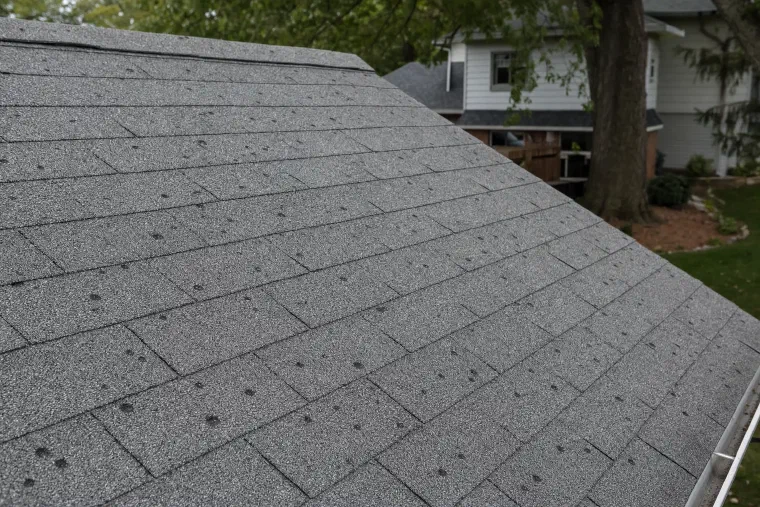
It depends on why the roof needs replacing. Homeowners insurance usually pays toward a new roof when a covered event such as wind or hail damaged it. It usually does not pay when the roof wore out with age.
The short version
- Covered storm damage can lead to a replacement. Age and wear do not.
- Maryland’s insurance regulator says policies cover losses that are “sudden and accidental” and do not cover “maintenance.”
- If only part of the roof is damaged, the policy may pay for that part only.
- Your policy’s settlement terms and deductible decide the amount, and an older roof can be paid at a much lower value.
- Your policy and the insurer’s adjuster make the call. We cannot promise what a claim will pay.
When does homeowners insurance cover roof replacement?
It can when a sudden, covered event did the damage. The Maryland Insurance Administration says homeowners policies typically cover losses (opens in a new tab) that are sudden and accidental, caused by perils such as fire, wind, hail and the weight of ice or snow.
So a hailstorm that bruises every slope is a different story from a roof that has slowly given up. The first is an event. The second is a birthday.
Even then, a replacement is not automatic. The adjuster looks at how much of the roof was damaged and whether repairing it makes sense. Our free inspection can tell you what we see on your roof, but it is not an adjuster’s decision.
Why won’t insurance pay for an old, worn-out roof?
Because a worn roof is a maintenance problem, and policies are not written to cover maintenance. The same advisory says policies do not provide coverage (opens in a new tab) for “maintenance,” so damage from wear and tear or deterioration over time generally will not be paid.
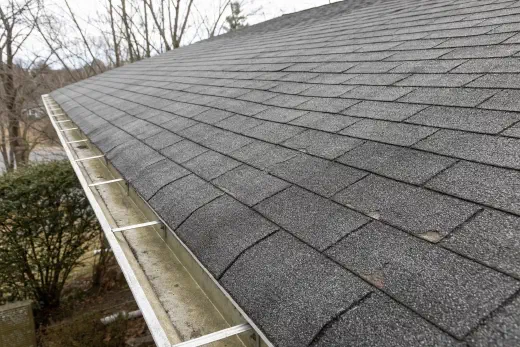
Cracked shingles, bare patches and curling edges all fall in that bucket. The annoying part is that a storm can land on a roof like this too. Our view is that storms usually show you a weak spot rather than make one. A gust finds the shingles that had already lost their seal, and the adjuster has to sort out how much was the weather and how much was age.
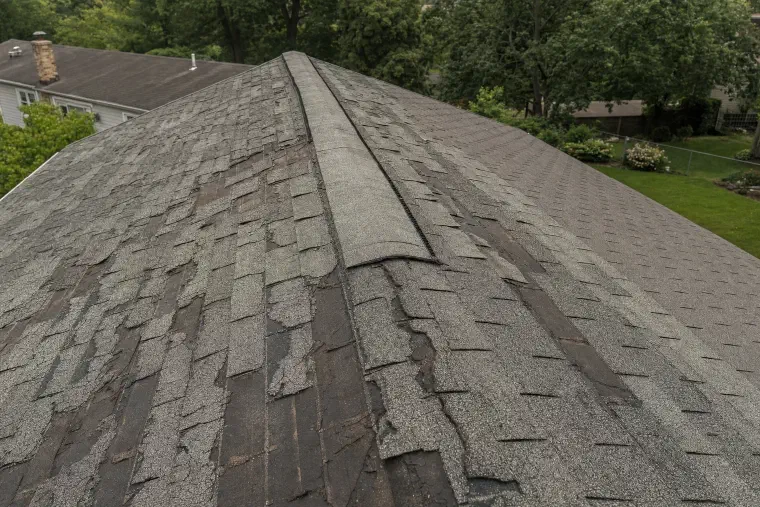
If a covered peril hits a roof that already needed work, the advisory says your policy may not cover all or part (opens in a new tab) of the claim.
What if only part of the roof is damaged?
You may be paid for that part and nothing more. Maryland’s advisory says that if only a portion is damaged, the policy may cover the repair (opens in a new tab) of the damaged portion only.
That is why a roof with one bad slope often ends up as a repair rather than a new roof, whatever the neighbor’s claim looked like. It is also worth knowing that shingles may not match after a patch, and a discontinued color can push a repair toward a larger job. Ask your insurer how your policy treats that before the work starts.
How much will the insurance company pay toward a new roof?
It depends on three things in your policy: how it values the roof, the deductible and the coverage limits. The advisory points homeowners to the “loss settlement method” section of the policy for exactly this.
| Policy term | How it pays | What it means for a roof |
|---|---|---|
| Replacement cost value (RCV) | Cost to replace, with no cut for age | Usually paid in two steps: first less depreciation, the rest after the work is finished |
| Actual cash value (ACV) | Cost to replace, minus depreciation | Can be far less (opens in a new tab) on an older roof |
| Wind or hail deductible | A flat amount or a percent of the home’s coverage | Can eat most or all of a small claim |
Depreciation is the amount taken off for age and wear. The advisory says the amount deducted may be significant, especially when the roof was at or near the end of its useful life. Its own example is a 20 year old roof, where RCV pays the full replacement cost once the work is done and ACV pays a depreciated amount that is likely far less.
For scale, a replacement for a roof of about 3,500 square feet typically runs $22,500 to $29,500 in our area. Our guide to roof replacement cost has the rest of the sizes. Against numbers like that, the deductible and any depreciation matter.
Do you get all the money up front?
Often not. With replacement cost coverage, Maryland’s consumer guide says the most usual way is a partial payment first, then the held-back amount, called recoverable depreciation (opens in a new tab), once the property has been fully repaired or replaced.
The guide adds two time limits worth knowing about. By law you have at least two years from the date of loss to claim that recoverable depreciation, and an insurer may ask you to tell it within 180 days of the loss that you intend to repair or replace. Your policy will list the exact periods that apply to you.
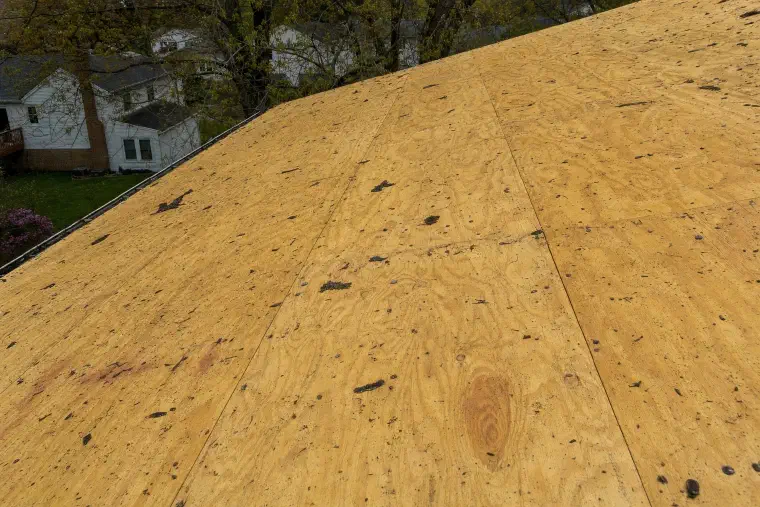
One more thing to keep in mind: the tear-off can show problems nobody could see from the ground. Rotted decking, for example, is priced separately in our work, at $70 to $150 per 4x8 sheet installed, and whether your insurer pays for it is a question for your policy and adjuster.
What should you do after storm damage?
Protect the roof, document it and call your insurer. The state guide tells homeowners to protect your property (opens in a new tab) from further loss, keep a record of temporary repairs and save every receipt. It also warns that delaying a claim or failing to protect the property can put your coverage at risk.
- Take dated photos of the damage you can see from the ground, and of any stains inside.
- Call your insurer or agent and ask how to file a claim and what deadlines apply.
- Cover the damaged area if more rain is coming. Emergency tarping typically runs $350 to $900, so save the receipt.
- Hold off signing for a full replacement until you know what the adjuster found.
If you are not sure whether the damage is storm or age, book our free roof inspection. It is a sales visit, not an independent opinion, so for a dispute a paid independent inspector is the better pick. For the leak side of this question, read does homeowners insurance cover a roof leak.
Common questions
Will insurance replace my roof if it is 20 years old?
Possibly, if a covered event damaged it, but expect less money. On an older roof, the advisory warns the depreciation deducted may be significant. A policy with actual cash value coverage pays the depreciated cost, which most likely is far less than a new roof costs.
Does insurance cover a roof replaced because of age?
Generally no. Age and wear are maintenance, and policies do not cover maintenance. Some insurers do ask about roof age or condition, which is one reason they may request an inspection, as we explain in why insurance companies ask for a roof inspection.
Will a claim hurt my policy?
It can. Maryland’s guide says an insurer may decline to renew if you filed three or more weather-related claims (opens in a new tab) in the past three years. Talk to your agent before filing a small claim.
Who decides how much is paid?
Your policy and the insurer’s adjuster decide. We do not speak for your insurer or promise a result, and nobody can tell you the amount before the adjuster has looked at the roof.
What to do next
If you have storm damage or a roof near the end of its life, start with a free inspection so you know what you are dealing with. If a replacement is the answer, our roof installation page shows what a full job includes. The phone is answered 24/7.