

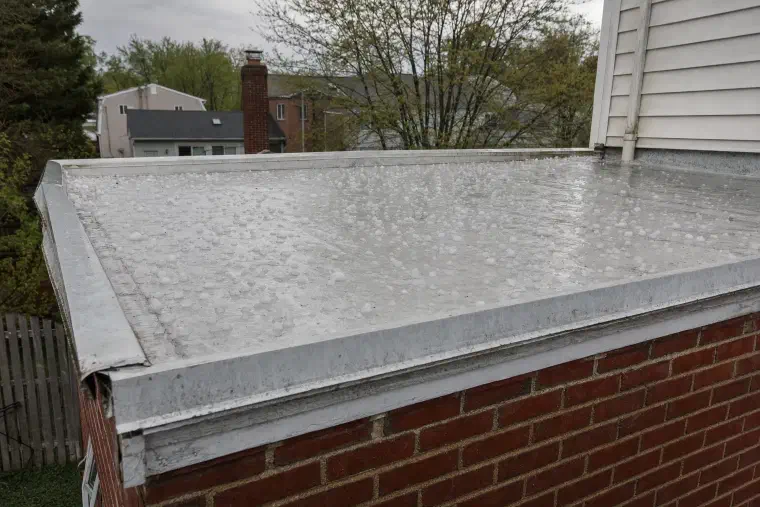
Hail damage on a TPO roof is usually small and easy to miss from the ground: a crack, a puncture, or a soft spot where the layers under the white sheet got crushed. Not every storm does it. Stones the size of a quarter or bigger are the ones to take seriously, and the only sure answer comes from someone walking the roof.
The short version
- Hail one inch across, about the size of a quarter, is the line the National Weather Service uses for a severe storm.
- Damage on TPO is often small, so check the dents on your gutters and air conditioner first.
- A roof only counts as damaged if it can no longer shed water or will not last as long.
- Do not walk a flat roof after a storm. Every trip adds scuffs and a chance of a puncture.
- A repair is a patch or a section. A new roof is for widespread damage.
How big does hail have to be to hurt a TPO roof?
There is no single size, but the bigger the stone, the likelier the damage. The National Weather Service calls a storm severe when it produces hail 1 inch in diameter (opens in a new tab), about the size of a quarter. A golf ball is 1.75 inches.
How a TPO sheet handles a stone depends on its age, how thick it is, how it is attached and what sits underneath it. We will not hand you a magic number, because anyone who does is guessing. An older sheet is a worse bet than a new one, so treat a quarter-size storm as a reason to look, not a reason to panic.
What does hail damage look like on a TPO roof?
It looks like small breaks in the white surface, plus damage to the metal around it. From a ladder or the roof edge, here is what we look for:
| What you see | What it can mean | What to do |
|---|---|---|
| Small round cracks or punctures in the white sheet | Water can get in now | Call before the next rain |
| A soft or spongy spot underfoot | The insulation under the sheet may be crushed | Have it checked, not walked |
| Dents in flashing, vents or the metal edge | Stones hit hard enough to dent metal | Photograph them, then look at the sheet |
| Torn or lifted seams | Could be hail, wind or age | Have a roofer tell them apart |
| Clean round spots where the dirt was knocked off | Marks where stones landed | Look closely around them |
Keep in mind that a leak is the last sign, not the first. Water can run into the insulation for a long time before a stain shows on your ceiling.
How can you tell how big the hail was?
Look at your air conditioner. The National Roofing Contractors Association says the best gauge of hailstone size is the dents left in the aluminum fins of air-conditioning units, and that a dent’s width is typically 80 percent (opens in a new tab) of the stone’s diameter. A dent about an inch wide points to a stone near an inch and a quarter.
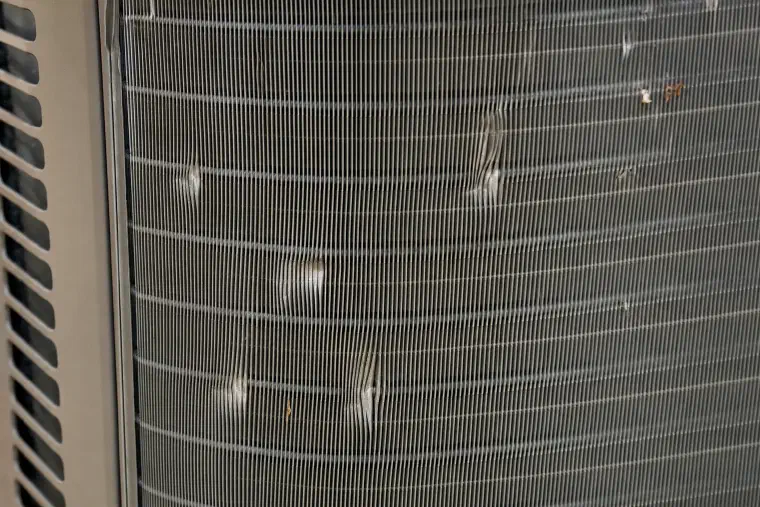
Gutters, downspouts and vent caps tell the same story. If those are clean and smooth, the roof probably got off lightly. If they are covered in round dents, the roof deserves a real look.
Does every hail hit mean the roof is damaged?
No. The NRCA says a roof system is not functionally damaged (opens in a new tab) by hail unless its ability to shed water is reduced or its expected life is shortened. It also points out that many people wrongly assume a roof needs a repair or replacement after every hailstorm. That article is about shingles, but the idea carries over to any roof: a mark is not the same as a failure.
A cosmetic scuff on a TPO sheet is one thing. A crack that lets water into the insulation is another. Telling them apart takes hands and eyes on the roof, and a photo from a drone does not do it. We cover the shingle version in how a roof is inspected for hail damage.
Should you go up and check a TPO roof yourself?
We would rather you did not. A wet flat roof is slippery, edges can be low, and TPO scuffs and punctures under boots. Stay on the ground and take pictures of what you can see: the dents, the hail on the ground, the gutters. Then have a roofer go up.
Our free roof inspection includes a physical walk on the roof and a written report with photos. The report is separate from any proposal, and there is no obligation to book work.
Can hail damage on a flat roof be repaired?
Usually, yes, when it is limited to a few spots. A cracked area gets cut out or patched with new membrane that is welded or sealed in, and anything wet underneath gets dealt with first. A low-slope membrane repair typically runs $2,500 to $6,000 around Ellicott City, which is a typical range and not a quote. Our flat roof repair page covers how we approach it.
When the damage is spread across the whole sheet, patching stops making sense. If you are headed for a new roof, ask about hail rating. The Insurance Institute for Business & Home Safety says the standard for low-slope roof assemblies has a minimum of Moderate Hail resistance and recommends Severe Hail (opens in a new tab) for hail-prone areas. That guide is written for commercial buildings, so treat it as a yardstick and ask your roofer what applies to a house.
What about insurance?
Hail is a named cause on most homeowners policies, but what gets paid depends on your deductible and your policy, and the adjuster decides. We cannot promise a result, and we do not speak to the insurer for you. Photograph the damage before anything is moved or patched, and read our guide on whether insurance covers hail damage before you file.
Common questions
How soon after a hailstorm should a TPO roof be checked?
As soon as it is dry and safe, and before the next heavy rain. A small crack is a cheap fix today and an expensive one after a month of water soaking the insulation.
Can you see hail damage from inside the house?
Only late. A ceiling stain means water has already come through the roof, the insulation and the deck. No stain does not mean no damage.
Is hail damage the same as blistering?
No. Blisters and bubbles come from age or trapped moisture, and hail leaves impact marks. They can look alike from a distance, which is why a walk-over matters. Our article on what a TPO roof is explains how the sheet is built.
What to do next
If a storm has come through and your flat roof or addition took hits, call us any time. We will walk it, show you photos of what we find and tell you whether it needs a patch or something bigger.


