

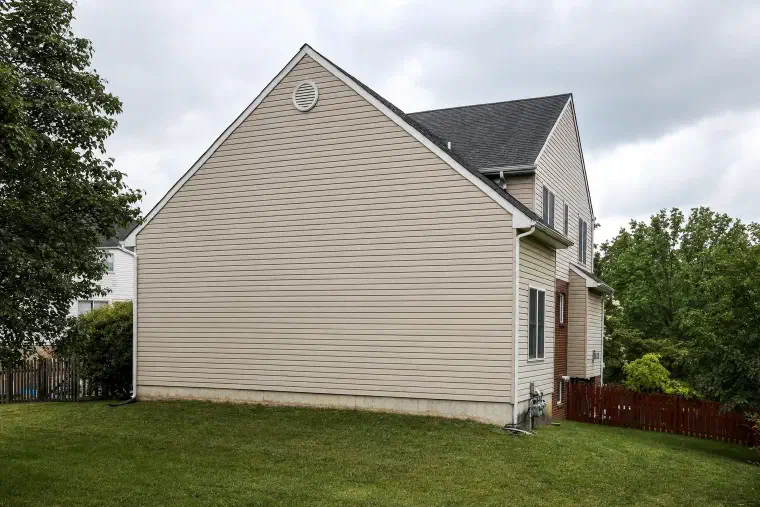
A hip roof slopes down on all four sides, and a gable roof slopes on two sides with a flat triangle of wall at each end. For most houses, the hip roof handles high wind better, and the gable roof costs less and gives you more attic. Neither one is wrong, and neither one is the one that fixes a bad roof job.
The short version
- A hip roof has four slopes and no flat end walls. A gable roof has two slopes and two triangle walls.
- Federal and building science sources agree that hips do better in strong wind, because a gable end acts like a sail.
- A gable is simpler to build, easier to vent and gives more attic room, which is why it is so common.
- Either shape leaks at the same spots: flashing, valleys and vents. The shape does not change that.
- If you are replacing a roof, you keep the shape you have. Changing it is a framing job, not a roofing job.
What is the difference between a hip roof and a gable roof?
A gable roof is the classic peaked house shape: two flat slopes that meet at a ridge, with a triangle of wall (the gable) at each end. A hip roof slopes on all four sides, so the ends slope too and there is no triangle wall at all. The sloping edge where two planes meet is called a hip.
You can often tell from the street. If you see a triangle of siding at the top of the end wall, you have a gable. If the roof edge runs level all the way around the house, it is a hip. Plenty of houses have both, with a hip over the main body and a gable over the garage or a front porch.
Is a hip roof better in high wind?
Yes, and it is the one point where the sources all agree. The Building America Solution Center, a federal building science guide, says peak wind pressures can be up to 50% lower (opens in a new tab) on a hip roof than on a gable roof. It also says a hip roof is inherently braced against racking (twisting sideways), while a gable roof has to be braced on purpose.
The reason is the flat end wall. A New York county fire and emergency office puts it plainly: a gable end presents a large, flat obstacle to the wind (opens in a new tab) and takes its full force. FEMA adds that wind can push or pull a gable end wall (opens in a new tab) until it collapses if it is not properly braced.
Keep in mind that this research is about hurricane-level wind. For an ordinary storm it is a small edge, not a deciding one. The bracing point is still worth knowing if you have a gable.
Does a gable roof cost less than a hip roof?
Usually, yes. The Building America guide calls a gable simple to design and construct (opens in a new tab) and a hip roof comparatively more complicated and more expensive. A hip has more corners, more cut shingles and more ridge cap to run.
On the roofing side, we price a replacement by size, pitch, access and how cut-up the roof is. A simple gable or hip, a single story and an easy-to-reach roof all push the price down. Cut-up geometry and steep pitch push it up. For asphalt shingles, a full roof typically runs $6.00 to $9.00 per square foot installed, and that range covers both shapes. Our roof installation page lists what a full replacement includes.
| Hip roof | Gable roof | |
|---|---|---|
| Slopes | Four | Two |
| Flat end walls | None | Two triangle walls |
| High wind | Stronger | Needs end wall bracing |
| Building cost | Higher | Lower |
| Attic space | Less | More |
| Venting | Shorter ridge, a bit harder | Easy, gable vents possible |
| Gutters | All the way around | Along the long sides |
Which one has more attic space?
The gable does. Because the ends are flat walls, the attic goes all the way out to the edge. The Building America guide lists less attic storage space (opens in a new tab) as the hip roof’s downside, since the slopes close in on every side.
That matters if you use your attic for storage, or plan to finish it. It matters less if you only go up there to change a filter or look for frost on the underside of the sheathing, which is the best winter check there is.
Is it harder to vent a hip roof?
A little. A hip roof has a short ridge, because the four slopes pull in toward each other, so there is less room for ridge vent along the top. A gable has a long ridge and flat end walls where vents can go. The Building America guide calls a gable roof easy to vent (opens in a new tab).
A hip roof usually gets its air from vents in the soffit (the underside of the roof edge) and a mix of ridge and box vents. None of that is a problem if it is planned.
One thing we see often on gable houses is mixed venting: a ridge vent, gable vents and box vents all on one attic. The vents pull air from each other instead of from the eaves, so the air never moves through the whole attic. If your attic cooks in summer, our attic venting page covers the fixes.
Does the roof shape change where it leaks?
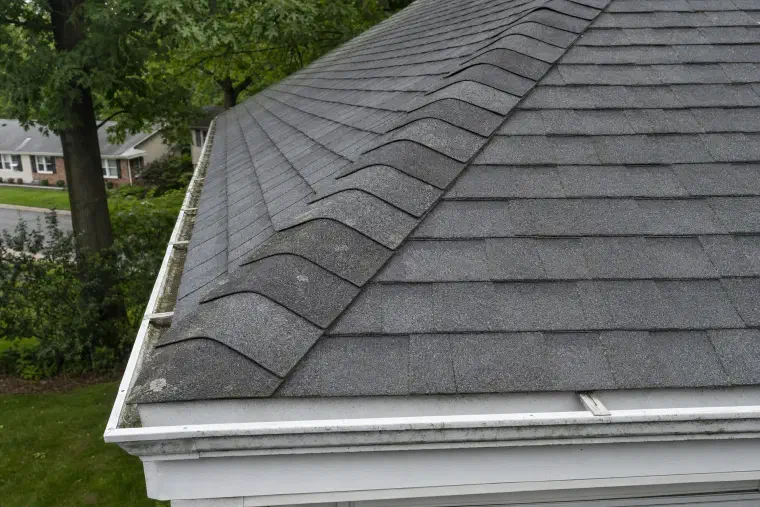
Not much. Roofs leak at flashing, valleys, vents and the places where one part meets another. A hip roof has a few more of those joints, because every hip line is one, but a properly capped hip line is rarely the problem. On a gable roof, the edge along the sloped end (the rake) and the wall it meets are the spots to watch.
Both shapes need drip edge along the edges, new flashing at every wall and chimney, and a clean tear-off. Our article on what drip edge is explains the edge metal, which runs along the rake on a gable and all the way around on a hip.
The shingle brand matters less than people think. Water gets in through labor details, and the crew decides how long the roof lasts. Our article on how long shingles last goes into that.
Can you change a gable roof to a hip roof?
You can, but it is a framing project, not a roofing one. Someone has to build new rafters or trusses to make the new slopes, and that means plans and a permit. We replace the roof covering on the shape you have. If you are thinking about changing the shape, ask a builder or an engineer first.
If a tear-off turns up framing trouble, like a sagging ridge or undersized rafters, an engineer’s letter typically runs $600 to $1,500. It can add $3,000 to $15,000 or more and days to weeks of delay. That is a different problem from the shape, but it is a good reason to get an inspection before you plan around a budget.
Common questions
Which roof lasts longer, hip or gable?
Neither one, on its own. A roof’s life depends on the nails, flashing, venting and the weather it faces. In Maryland, asphalt shingles realistically last 18 to 25 years on either shape, and where the nail went counts for more than which shape sits under it.
Is a hip roof better for snow?
It is not a deciding factor here. Both shapes shed snow, because both are sloped. What causes trouble in our winters is the freeze and thaw, which builds ice at the eaves and needs ice-and-water shield along the eaves, which is the same on both.
What to do next
If your roof is a gable and you are curious about the bracing, or you are comparing a quote for a replacement, start with a free roof inspection. We walk the roof, look at the attic, and write up what we find. No obligation to book anything.


