

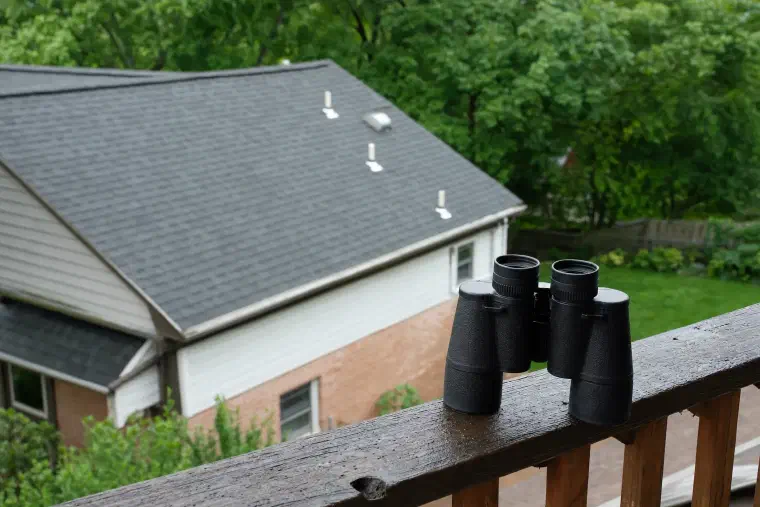
You can tell your roof has storm damage by looking for missing, creased or curled shingles, round dark spots where granules were knocked off, bent flashing, and water stains inside. Most of it shows from the ground. Some of it does not, so a roof can look fine from the driveway and still leak at the next heavy rain.
The short version
- Start from the ground. Walk the yard and gutters, and use binoculars on the roof. Stay off a wet roof.
- Wind leaves missing, lifted or creased shingles. Hail leaves round dark spots and soft “bruises” you can feel.
- Inside, look for new ceiling stains, damp attic insulation and daylight where there should be none.
- A storm tends to reveal a weak spot more often than it ruins a sound roof.
- Take photos before anyone touches anything, then get the roof looked at. Ours is free.
What can you check from the ground after a storm?
Most storm damage that matters can be spotted from the ground, with no ladder. As This Old House points out, you can often spot missing shingles, debris, or visible damage (opens in a new tab) from the ground with binoculars, or from a neighbor’s window or an upstairs one.
Walk all the way around the house and check:
- The yard and flower beds. Shingle pieces on the ground are a plain sign.
- The gutters and downspout ends. A pile of gritty, sand-like bits is shingle granules. A little is normal. A lot after one storm is worth a closer look.
- The roof itself. Bare patches, tabs that stick up, a ridge cap that is gone.
- Things that are not the roof. Dented siding, gutters or an air conditioner tell you how hard the storm hit.
What does wind damage look like on shingles?
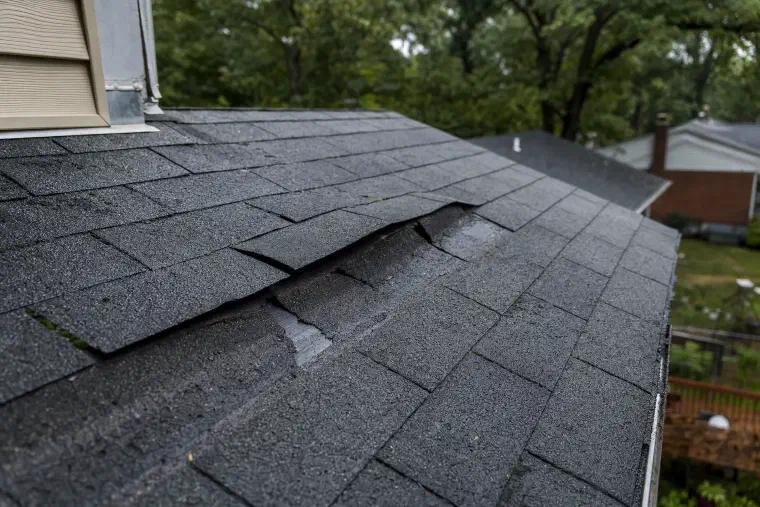
Wind damage looks like shingles that are missing, lifted, or folded back along a crease. Each shingle has a strip of sealant that glues its tabs to the course below. Once a gust breaks that seal, the tab flaps up and down and can fold along a line near the top, or tear off completely.
Here is the part most homeowners do not hear. A shingle that blows off in a 50 mph gust was often held by that sealant strip alone, because the nails were set too high to catch the course underneath. It looked perfect until the wind came. We also see the slow version: gusts of around 40 mph that do not take anything off but break the seal bonds a little at a time, over several years, until the shingles are effectively loose.
That is why we say storms tend to reveal defects, not create them. A sound, well-nailed roof usually rides out an ordinary storm. A roof with hidden faults tells on itself.
How do you spot hail damage?
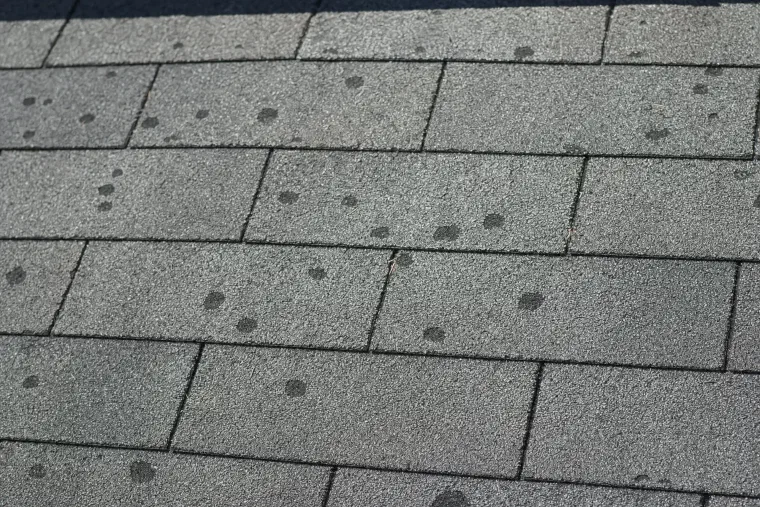
Hail damage shows up as round dark spots where granules were knocked off, scattered at random, and a soft spot you can feel with your fingers. The Nebraska Department of Insurance says hailstones leave a bruise in the mat (opens in a new tab), the fiberglass layer under the granules, and your fingers can usually detect it in and around the crater.
Two details help you tell hail from other things:
- It is random. The same source says hail leaves a random pattern of strike marks in various sizes. If the marks line up in a neat pattern, something else made them.
- A blister is not a hail hit. Heat can make the asphalt release gas that gets trapped and pops. The same source says a blister has no bruise you can feel, which is how you tell the two apart.
One more warning from that page: granules at the end of a downspout may show potential damage (opens in a new tab), but granule loss does not prove it. Old roofs shed granules all the time.
What signs show up inside the house?
Water stains, damp insulation and daylight in the attic are the signs inside. The Florida PACE program lists water stains on ceilings or walls (opens in a new tab) and moisture, leaks or mildew in the attic among the signs of roof damage after a storm.
Keep in mind that a ceiling stain is the last stage of a leak, not the first. Water has usually been getting in a while before it reaches the drywall, so the stain can show up days or weeks after the storm. No stain does not mean no damage.
If you can reach the attic safely, look at the underside of the roof deck on a dry day with a flashlight. Dark, wet-looking wood, damp insulation or a patch of light all point to an opening above.
Which signs mean what?
This is how the usual signs line up, and what each one tends to mean.
| What you see | Likely cause | What to do |
|---|---|---|
| Shingles on the ground or bare patches | Wind | Photograph, then get it checked |
| Tabs folded back along a crease | Wind broke the seal | Get it checked before the next storm |
| Round dark spots, soft to the touch | Hail | Photograph, then get it checked |
| Heavy granules in the gutter | Hail, or an old roof | Look closer, compare with the roof |
| Bent or gapped metal at the chimney or vents | Wind or debris | Get it checked, since leaks start here |
| New ceiling stain or damp attic insulation | Water is already in | Call, and keep the area dry |
Should you climb up to check?
No. A wet or steep roof is a bad place for anyone without the gear and the habit, and a careless boot can crack brittle shingles. Florida PACE makes the same point, noting that walking on the roof (opens in a new tab) can inadvertently cause damage.
Stay on the ground, take clear photos with a phone, and jot down what you see and when the storm hit. This Old House suggests photos and notes on the size, depth and appearance (opens in a new tab) of the damage, which helps if you end up talking to your insurance company.
What happens when you call a roofer?
A good roofer gets on the roof, lifts shingles, checks the flashing and writes it all down. Our free roof inspection includes a walk on the roof, a look at the attic when we can get to it, and a written report with photos. It is kept separate from any price, and you have no obligation to book work. We go into more detail in what a roof inspection includes.
A drone alone will not do for hail. Hail damage is subtle, and it takes a thumb press to find a bruised mat. If the roof turns out to need work, our storm and wind damage roof repair covers wind-lifted shingles, flashing and tarping.
One thing to expect: right after a big storm, inspections can take one to three weeks to schedule. Repairs can run three to six weeks in the busy stretch that follows a regional storm.
Will insurance cover storm damage?
It may, if the damage came from a sudden event like a windstorm or hail. Wear from age is a different matter, and a leak from a worn-out roof is usually treated as a maintenance issue. Your policy and your insurance company’s adjuster decide what is covered, and we cannot promise what a claim will pay.
What we can say is that claims take time. An adjuster’s review commonly adds four to twelve weeks before work starts. If a leak is active in the meantime, a tarp is a fair stopgap. Tarping typically runs $350 to $900, so ask whether it gets credited toward the repair. See emergency roof repair if water is coming in now.
Common questions
How soon after a storm should I check my roof?
Check from the ground as soon as the storm has passed and it is safe outside. You do not need to wait for a stain. Photos taken early also show what the roof looked like before anything else changed.
Can a roof have storm damage and no leak?
Yes. Lifted seals, bruised shingles and bent flashing often do not leak on day one. They leak at the next hard rain, or the one after. That is why a roof that looks fine from the driveway is still worth a look.
Is a few granules in the gutter a sign of storm damage?
Not by itself. Shingles shed granules as they age, so a little grit in the gutter is normal. A big pile right after a hailstorm, along with dark spots on the shingles, is what to watch for.
Can I repair storm damage myself?
Replacing a single missing shingle is within reach for some people on a low, dry roof. Anything that involves flashing, a steep slope or several damaged areas is better left to a roofer. Roof repairs also need a dry roof, so winter fixes may not bond until spring.
What to do next
If a storm has just gone through, take your photos, check the ceilings, and call. The phone is answered 24/7, and the free inspection will tell you what is storm damage and what is plain age.


