

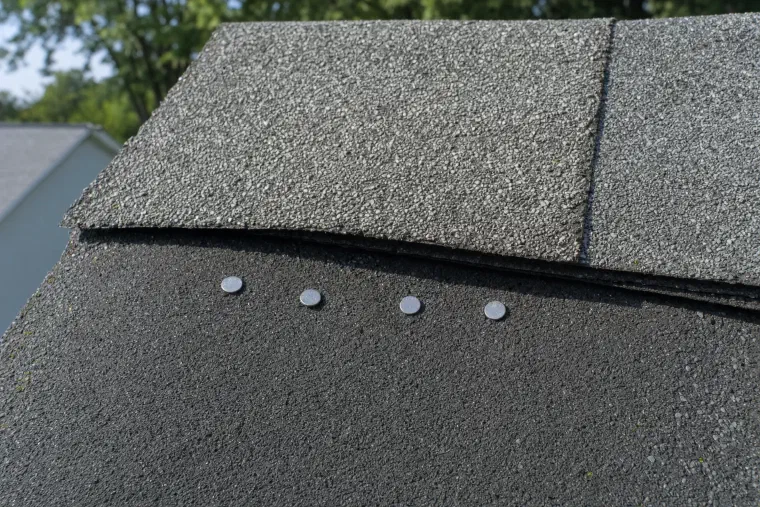
Most asphalt shingles need at least four nails each, and six is the number in high-wind areas or on steep roofs. The count is only half of it, though. Where each nail lands and how deep it goes matters just as much, and a homeowner can’t see any of it once the roof is finished.
The short version
- Four nails per full-size shingle is the usual minimum. Six is for high wind and steep slopes.
- Your shingle wrapper has the final say, and it can ask for more than the minimum.
- Nails go in a narrow band, below the sealant strip and above the part that shows.
- Too high, too deep or too few are the three mistakes that matter.
- You can’t check from the ground, so ask the crew how they check their work.
How many nails per shingle is the minimum?
Four nails per full-size shingle is the usual minimum for asphalt shingles. The Asphalt Roofing Manufacturers Association says that a minimum of four nails (opens in a new tab) is required for most full-size strip shingles, and adds that some shingles and jobs differ, so the maker’s instructions come first. A federal energy lab guide says the same, describing the code minimum as four fasteners per strip shingle (opens in a new tab).
Notice the word “minimum.” A crew that stops at four on a roof that wants six has met the lowest bar and nothing more. The instructions printed on the shingle wrapper are the rule, not the minimum.
When does a roof need six nails per shingle?
A roof needs six nails per shingle in high-wind areas, and some makers ask for six on steep slopes too. The same federal guide says each shingle strip should be installed with six nails (opens in a new tab) in high-wind areas, and that the installer should follow the maker’s instructions for those locations.
Which roofs count as “high wind” is not always obvious, and codes differ from place to place. We check the wrapper on the shingle going on your roof and match what it says. If it shows a six-nail pattern for your roof’s slope, that is the pattern we use.
Where on the shingle should the nails go?
Nails go in a narrow band, below the sealant strip and above the part of the shingle that shows. The Asphalt Roofing Manufacturers Association puts it as below the sealant strip (opens in a new tab) but above the area that will be visible. It also says no nail head should sit less than an inch from either end of the shingle.
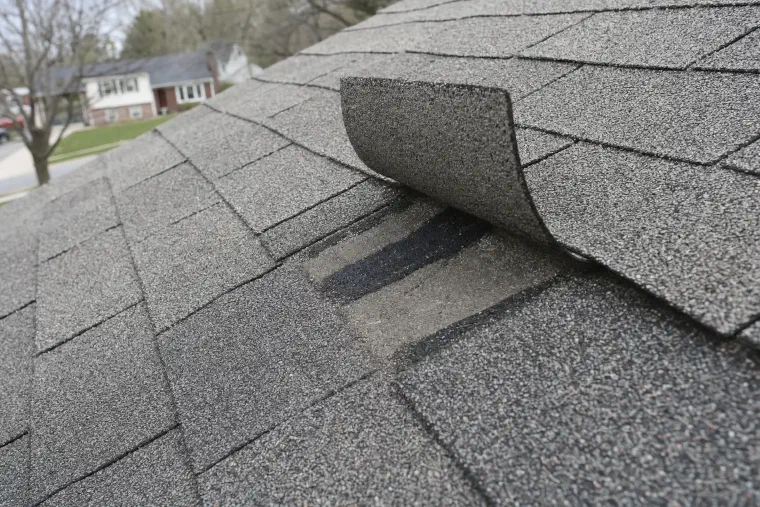
The reason for the band is simple. A nail in the right place goes through two layers, the shingle you see and the one beneath it, so both are pinned down. A nail set too high only catches one. That shingle is then held by its sealant strip alone, and it looks perfect until a gust gets under it. This is the single most costly installation mistake we see, and nobody can spot it from a driveway.
What are the three mistakes that matter?
The three that matter are too few nails, nails in the wrong place and nails driven too hard or too soft. They look like this:
| Mistake | What goes wrong | How you’d find it |
|---|---|---|
| Too few nails | Fewer anchors than the shingle was made to have, so it lets go earlier in wind | Only by lifting shingles |
| Too high | The nail misses the shingle underneath, leaving the sealant strip to do all the work | Only by lifting shingles |
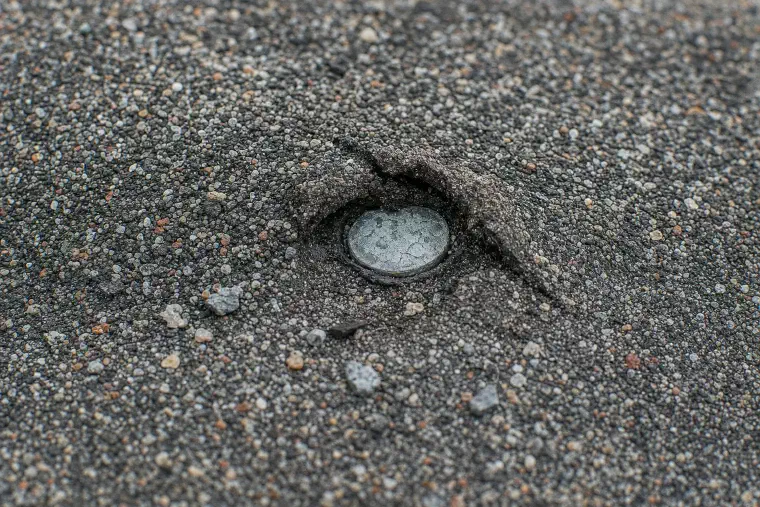
| Overdriven | The nail head cuts into the shingle and weakens its grip | Sometimes a torn ring around the head |
| Underdriven | The nail head stands up instead of sitting flush | Only by walking the roof |
On driving depth, the same association says nails are not to be underdriven, overdriven (opens in a new tab), or driven crookedly, and that a bad one should come out, with the hole repaired and a new nail placed nearby. It also warns that a poorly adjusted air system (opens in a new tab) on a nail gun can cause raised tabs and blow-offs. Speed is how most overdriven nails happen.
Can a roofer use staples instead of nails?
No. Staples are not a good swap for roofing nails. FEMA’s guidance for high-wind areas says plainly to use roofing nails instead of staples (opens in a new tab), and the federal energy lab guide tells installers not to use staples at all. If a bid mentions a stapler, ask why.
Does the nailing really change how long a roof lasts?
Yes, and by a lot. Shingle brand matters less than most people think, and our view is that the person holding the nailer is the bigger factor. The same shingle can last 25 years or nine, depending on where the nail went. Our article on whether a 30-year shingle lasts 30 years explains why the number on the wrapper is not a promise.
Nailing also decides how a roof handles wind. Storms tend to find high-nailed rows first and peel them in courses, which is why wind damage so often turns out to be an installation problem that a storm uncovered. Sealant matters too, and it only works if the nails are right.
How can you tell if your roof was nailed right?
You can’t tell from the ground, or from a photo. The only way is to lift shingles and look, which is part of our free roof inspection. We walk the roof, lift shingles to check the nailing, and write it up in a report with photos, separate from any proposal.
A roof that looks perfect can still be nailed wrong. A look from the ground or a drone won’t catch it, because the nails sit under the shingle above.
What to ask before a crew starts
Three questions will tell you most of what you need to know:
- Which nail pattern does the shingle wrapper call for on my roof, four or six?
- Do you use nails only, with no staples?
- Who checks the nailing as the job goes, and how?
A crew with a clear answer to each has thought about it. Our roof installation follows the wrapper for the shingle going on. For what the nailing step looks like in real time, see our walk through replacement day.
Common questions
Do architectural shingles need the same number of nails as three-tab?
The minimum of four applies to most strip shingles, but each maker sets the pattern for its own product. Follow the one printed on the wrapper of the shingle going on your roof.
Can too many nails hurt a shingle?
The wrapper sets the number, so extra nails are not a bonus. The goal is the right number in the right place, not the most nails.
What happens if my roof was high-nailed?
A high-nailed shingle can hold for years in calm weather, then peel in a strong gust. It usually shows up first as lifted or missing shingles after wind. Have it looked at, because the fix depends on how many courses were nailed that way.
Do nails ever show on a finished roof?
They shouldn’t. The Asphalt Roofing Manufacturers Association says to never place nails (opens in a new tab) where they will be fully or partly visible once the roof is done. A nail head showing in the open is a sign it went in the wrong spot.
What to do next
If you’re getting bids for a new roof, ask the nailing questions above and compare the answers. If you already have a roof and wonder how it was done, book a free inspection and we’ll lift a few shingles and show you.


