

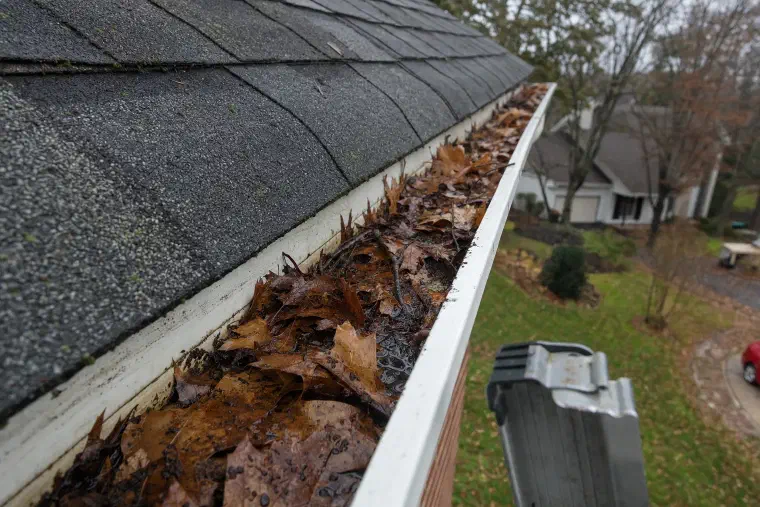
Plan on cleaning your gutters at least twice a year, once in spring and once in fall. Under oaks, maples or pines, plan on more. A house with few trees nearby can sometimes get by on one cleaning in late fall, but a quick look in spring still pays off.
The short version
- Twice a year, spring and fall, is the usual baseline.
- Heavy tree cover can mean every three months or so.
- The best single time is late fall, once most of the leaves are down.
- Water spilling over the front, plants growing in the trough and stains on the siding all say the next cleaning is overdue.
- Gutter guards cut the work. They don’t end it.
What is the usual schedule for cleaning gutters?
Most guidance lands on twice a year. This Old House recommends clearing debris at least twice a year (opens in a new tab), ideally once in spring and once in fall. That fits what we tell Ellicott City homeowners: at least once a year for most homes, in late fall after the leaves come down, and a second round in spring where trees drop seeds and flowers.
Think of it as the minimum. Your own yard decides the real number.
How do trees change how often you clean?
The more trees that drop things on your roof, the more often the gutters fill. This Old House says to clean every three months (opens in a new tab) if your yard has deciduous or pine trees that shed often. The town of Takoma Park, Maryland, tells homeowners surrounded by trees that they might want to do this chore a few times (opens in a new tab) because of the fall leaf build-up.
Wooded valley lots are common around Ellicott City, and we see overhanging trees do three things to a roof: scrape the shingles, hold moisture so moss and algae grow, and drop debris that dams up valleys and gutters. Here’s a rough way to place your house.
| Your yard | How often to plan on |
|---|---|
| Few or no trees close to the roof | Once in late fall, with a quick look in spring |
| A few trees nearby | Spring and fall |
| Oaks, maples or pines over the roof | Spring and fall, plus a check after big leaf drops and storms |
| Heavy canopy or pines right over the gutters | About every three months |
These are starting points. Let what you find in the trough change the schedule.
When is the best time of year to clean gutters?
Late fall is the best single time, after most of the leaves have come down and before freezing weather starts. Cleaning too early means the next windy week refills the trough. Spring is the second round, when seeds, pollen and winter debris need to go.
Keep in mind that a gutter full of wet leaves freezes into a solid block. That gives ice something to build on along the roof edge, which is the reason to get the fall cleaning done before the cold.
How can you tell your gutters need cleaning now?
Your gutters need cleaning when water stops going where it should. You don’t have to wait for the calendar. Look for:
- water pouring over the front of the gutter in the rain
- plants or seedlings growing out of the trough
- water dripping from the downspout slowly, or not at all
- stains or streaks on the siding below the gutter
- debris showing at the edge of the trough from the ground
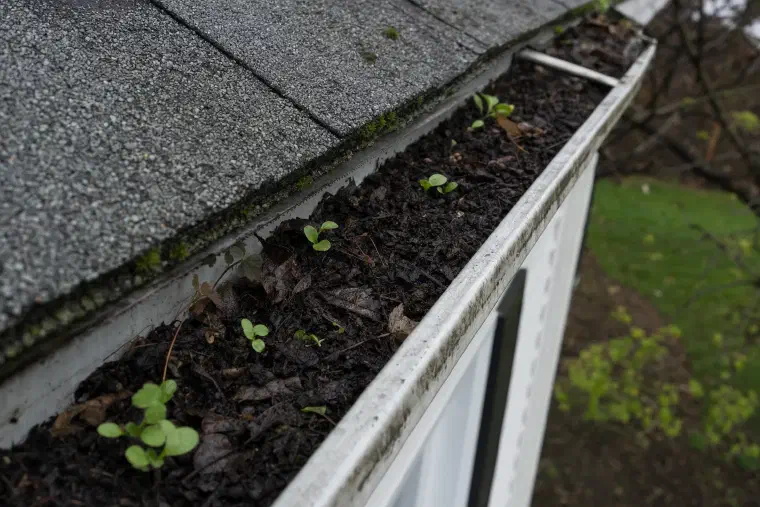
The downspouts count too. A clogged downspout makes a clean gutter overflow just the same, so run water through and see that it comes out the bottom. For a downspout that goes into an underground line, our article on underground drain pipes explains what to check.
What happens if you skip cleaning your gutters?
Water that can’t drain goes somewhere worse. Takoma Park’s page says clogged gutters can lead to roof damage and a flooded basement (opens in a new tab), because the water falls right next to your foundation instead of away from it.
The part you can’t see from the ground is the roof edge. Standing water in a full gutter rots the fascia, which is the board the gutter hangs on. Then it works on the rafter ends and the first few inches of roof deck. It’s a real repair at the eave, and it’s hidden from both the attic and the yard. Our article on the fascia board shows how it goes.
Winter adds weight. The University of Massachusetts says gutters don’t cause ice dams, but they concentrate ice and water (opens in a new tab) at a very vulnerable part of the roof, and as they fill with ice they often bend and rip away from the house, taking fascia and downspouts with them. Clear gutters don’t prevent ice dams, which start in the attic, but they leave the ice less to hang on.
Do gutter guards change how often you clean?
Gutter guards cut the number of cleanings, and they don’t take it to zero. This Old House puts micro-mesh guards at once or twice a year (opens in a new tab), and screen guards at two to four times a year. Foam inserts need rinsing three to four times a year.
So a guard can turn “every three months” into “twice a year”, which is a real saving on a wooded lot. It’s still a chore. Our article on whether gutter guards are worth it goes through the types.
Common questions
Can you clean gutters yourself?
Yes, if you’re steady on a ladder and the gutters are on a low, easy edge. This Old House suggests an A-frame ladder (opens in a new tab), a spotter to steady it and never overreaching. On a two-story house, or with a steep yard, hire it out. Falling off a ladder costs far more than a cleaning.
Is it a problem if there are no trees near my house?
Less of one. Without trees you still get roof grit, which sheds from shingles, and wind-blown debris. One cleaning in late fall and a look in spring is usually enough, but check after a big storm.
Should the roof be checked when the gutters are cleaned?
Yes. Anyone up at the edge can see sagging gutters, loose hangers, leaking seams and damaged shingles. When we clean gutters we look at the gutters and the roof edge and tell you what we see. Our free roof inspection also covers the gutters.
What to do next
If you’d rather not be on the ladder, our Gutter Cleaning clears the gutters and downspouts and checks the roof edge while we’re there. If you’d like the whole roof looked at too, the free roof inspection includes the gutters. Call us any time, day or night, and tell us what you’re seeing.


