

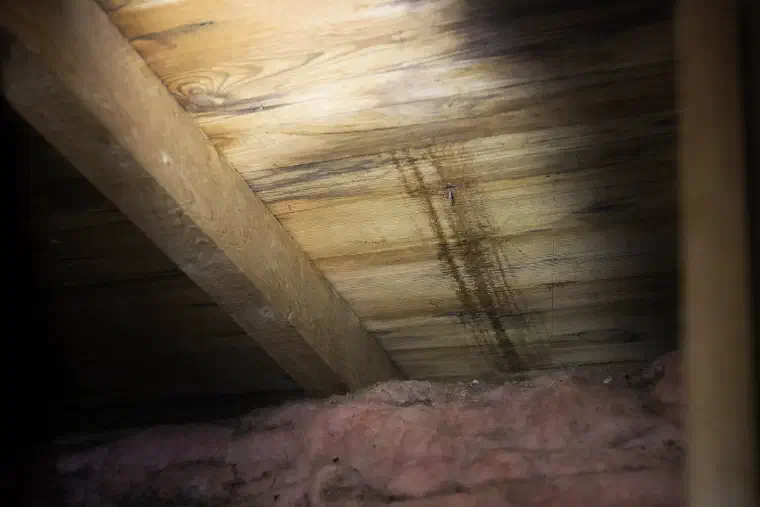
To find a leak in your roof, start in the attic, find where the water is coming in, and follow it uphill. The stain on your ceiling is almost never right under the hole. A flashlight, some patience and a dry day on the roof will get you most of the way.
The short version
- Check the attic first, with a flashlight, and look for dark trails on the wood.
- The hole is usually higher up the slope than the ceiling stain.
- Look at the roof from the ground with binoculars before you climb anything.
- A hose test finds the spot one section at a time, starting low.
- Not every wet attic is a roof leak, so rule out the other causes.
Where do you look first?
Look in the attic, because that is where a leak leaves its trail. This Old House says the attic is often the first place you’ll notice signs (opens in a new tab) of a leak. Take a flashlight and look at the underside of the roof for water stains, dark spots, mold, or damp insulation.
Step only on the wooden beams, never on the insulation or the ceiling drywall between them. A foot through the ceiling turns a roof problem into a bigger one.
Go up during rain if you safely can, or just after. Wet wood is much easier to spot than a stain that dried last week.
Why isn’t the leak above the stain?
Because water runs downhill along the roof boards and the rafters before it drops. A University of Wisconsin Extension guide says leaks are rarely located directly above the water spot (opens in a new tab) on the ceiling. Roof leaks love misdirection.
So treat the stain as a clue, not an address. This Old House puts it plainly: the leak likely originates higher up (opens in a new tab), so follow any signs of water uphill. Look for the highest spot on the wood that is dark or wet, and the place where the trail starts.
What does the leak look like from the attic?
Look for one of four things. The table shows what each one usually means.
| What you see | What it usually means |
|---|---|
| A dark trail running down a rafter or the roof boards | Water is running along the wood from a point above |
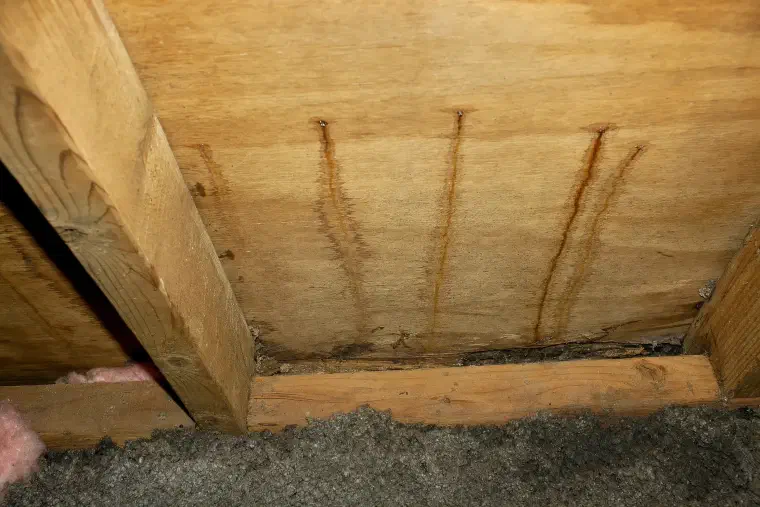
| Dark streaks around nail tips | Water is following the nail, or warm air is freezing on it in winter |
| A spot of daylight | A hole in the roof, or a missing shingle |
| Wet or flattened insulation | The water has been coming in for a while |
The Wisconsin guide says to check for a drip trail or a spot of light coming through (opens in a new tab) the roof. When you find one, push a nail, straw or wire up through the hole so you can see it from outside.
Take a photo of every mark before you move on. They help later, whoever ends up doing the repair.
What should you check from outside?
Start from the ground with binoculars. The Wisconsin guide says to try binoculars for a closer view (opens in a new tab) before you risk climbing up. Look above the spot you marked in the attic for missing, cracked or curled shingles.
Then look at anything that pokes through the roof or meets a wall. The same guide points to defective flashing (opens in a new tab) around chimneys, valleys and dormers as a common cause, and it adds that clogged downspouts and eaves can push water under shingles. Flashing is the thin metal that seals those joints. Pipe boots, the rubber collars around vent pipes, are on the same list. We see cheap rubber collars crack in 3 to 5 years, and our guide to the pipe boot on a roof shows what a failing one looks like.
Keep in mind that caulk is a consumable. Any joint that relies on it has a 5 to 10 year life, so old caulk around a chimney or vent is a prime suspect.
How does a hose test work?
Two people, one hose and one phone call. One person stays inside, watching the spot you marked. The other soaks the roof, starting low. This Old House says to start on the lower part of the roof and work your way up (opens in a new tab). Spray one small section for several minutes, then move up.
Starting at the top floods everything below it, and you can no longer tell which spot was the culprit. Water can also take a few minutes to show up, so the person inside should speak up at the first drip.
Only do this on a day when it is safe to be near the roof. If getting on a ladder worries you, run the hose from the ground and leave the roof to someone else.
Is it really a roof leak?
Not always, and a wrong guess gets expensive. This Old House warns that not all water damage in the attic comes from a roof leak (opens in a new tab), because condensation can look the same. The U.S. Department of Energy says warm, humid air from kitchens, bathrooms, and dryers (opens in a new tab) threatens attic durability, which is why a bath fan that dumps into the attic can soak the boards.
Other non-roof sources we see are HVAC condensation, leaks around windows and siding, and ice damming. A quick test: if the wet spots show up on cold mornings and not after rain, think condensation. If they show up only after rain, think roof.
When should you stop and call a roofer?
Stop when you cannot find the spot, when the roof is steep or wet, or when the wood in the attic is soft. The Wisconsin guide is blunt that you should not risk serious injury (opens in a new tab) trying to inspect or repair a roof.
Tracing a leak is also partly detective work. Pinning down the exact entry point is its own paid service for us, using attic tracing, a hose test or a moisture meter, and it typically costs $150 to $400. It is often credited toward the repair. Even then, no honest roofer can promise a repair stops the leak on the first visit, and a second trip is usually billable unless the same repair fails.
Meanwhile, dry anything that got wet. The EPA says it is important to dry water-damaged areas within 24 to 48 hours (opens in a new tab) to prevent mold.
Common questions
Can I find a leak without going on the roof?
Yes, most of the work happens in the attic and from the ground. The attic shows you where the water arrives, and binoculars show you what is wrong above that spot. The hose test can be run from a ladder or the ground on a low roof.
Why does my roof only leak in heavy rain?
Often wind is pushing the rain sideways into a gap that stays dry otherwise. That points to flashing or a lifted shingle, not a minor drip. It still wets the wood every time, so it is worth chasing down.
How long can I leave a small leak?
We would not leave it. A ceiling stain is usually the last stage, because water has often been getting in for a long time, wetting the decking and insulation first. Our piece on what happens if a roof leak is left untreated has the details.
What to do next
If you have found the spot and it looks small, our guide to how to fix a roof leak covers what is fair game for a handy homeowner. If you have a stain and no idea where it comes from, call us and we will look at it for you, at any hour. We can also do a free roof inspection: a written report with photos, and no obligation to book work. Tracing the exact entry point of an active leak is a separate paid service.


