You can’t fix a leaking roof from inside the house, not for good. From inside you can catch the water, limit the damage and find where it’s coming in. Only work on the roof itself stops the leak.
The short version
- From inside, the goal is to control the water, not to seal the roof.
- Make the room safe first: wet ceilings and light fixtures are a bad mix.
- A trip into the attic with a flashlight tells you where the water is coming in.
- Wet insulation and damp wood need to dry out, and the leak has to be fixed first.
- Tape, caulk or tar from the attic side only hides the problem. A roofer fixes it from outside.
What can you do from inside?
Four things: keep people safe, catch the water, find the entry point, and start the drying. That’s the whole list, and it’s worth doing well. It can turn a messy night into a manageable one.
None of it makes the roof watertight. Think of it as holding the line until someone can get up there when the roof is dry.
How do you make the room safe?
Turn off the power to that room at the breaker box, and not only the wall switch, if water is near a light fixture or outlet. Then keep people out from under any ceiling that bulges or sags, because it can come down with all the water behind it.
Move furniture, rugs and anything that matters out from under the spot. Take a few photos of the stain and the drip with the date showing on your phone. You’ll want them for the roofer and for your insurance company.
How do you catch the water?
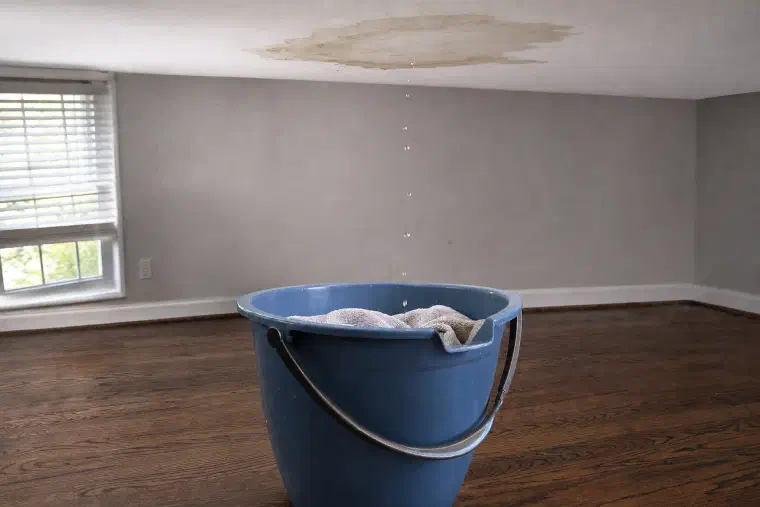
Set a bucket under the drip and put a towel in the bottom so it doesn’t splash. If the ceiling is bulging and you feel safe doing it, a small hole at the lowest point lets the water run into the bucket in a stream, rather than all at once. That’s a call for a small bulge only. For a big one, stay out from under it and call.
Draw a pencil line around the edge of the stain and write the time beside it. If the ring grows, you can see how fast. We walk through the room side of this in what to do about a leak in the ceiling.
How do you find where it’s coming in?
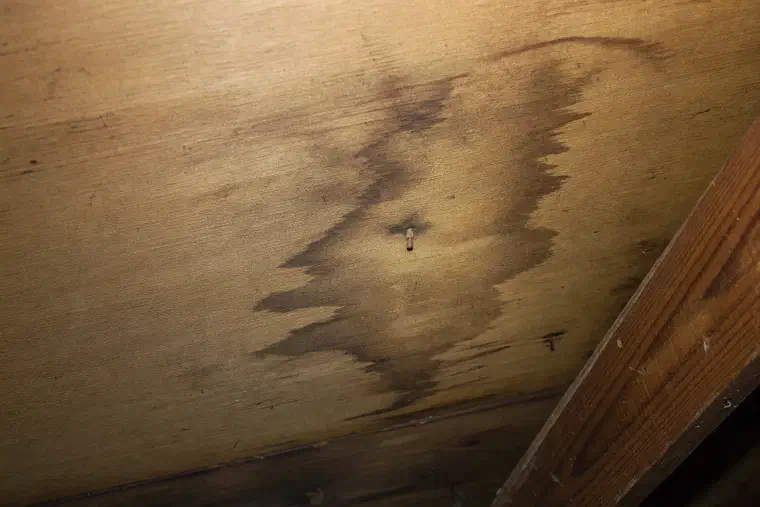
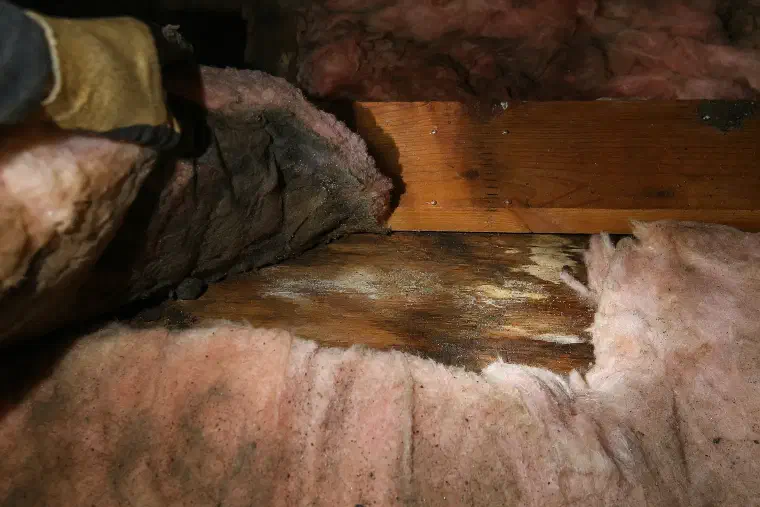
Go into the attic with a flashlight and look at the underside of the roof. This Old House says to look for water stains, dark spots, mold growth, or trails of moisture along the rafters (opens in a new tab) and roof sheathing. Sheathing is the plywood the shingles are nailed to.
The leak usually starts higher than where it shows. The same guide says to follow any signs of water uphill (opens in a new tab) to the source. Walk only on the wooden joists, never on the insulation or the ceiling between them.
Our longer guide to finding a leak in your roof covers the hose test and what to check outside.
Can you patch the roof from the attic?
No, and trying tends to make the repair harder. Sealant or tape on the underside of the decking doesn’t stop rain from getting in. It hides the wet spot, and the water finds another way down.
Caulk is a scheduled leak even on the outside of a roof, since it only lasts 5 to 10 years. On the inside it does less than that, which is nothing. The fix has to go where the water enters: a pipe boot, a bit of flashing, a lifted shingle. Flashing is the metal that seals the joints on a roof.
What do you do about wet insulation and wood?
Dry them fast, but fix the leak first. The EPA says it’s important to dry water-damaged areas (opens in a new tab) within 24 to 48 hours to prevent mold growth. It also says the water problem must be completely fixed (opens in a new tab) before cleanup can be called finished.
For soaked insulation, the Department of Energy says to remove and discard fiberglass batt insulation (opens in a new tab) and cellulose that has been soaked. The same guide says wood should have a moisture content below 20% (opens in a new tab) before it is covered up again.
What does each step cost, and who does it?
These are typical area ranges, not a quote. You can do the first column yourself. The second is a roofer’s job.
| From inside (you) | From outside (a roofer) |
|---|---|
| Bucket, towels, photos: a few dollars | Emergency tarping typically runs $350 to $900 |
| Flashlight check in the attic: free | Active leak diagnosis typically costs $150 to $400 |
| Fans and a dehumidifier for drying | Most small repairs sit near the $350 to $550 minimum service call |
Drywall, paint and insulation inside the house are never part of a roof repair. Plan for those separately, after the roof is dry.
Common questions
Can I stop a roof leak from the attic with roofing cement?
Not for good. Cement on the underside doesn’t stop water entering through the shingles above. It’s also easy to smear it over the real clue, the water trail. Save the flashlight photos and let a roofer repair it from the roof.
Is it safe to go into the attic during a leak?
Often, yes, but take care. Step only on the joists, keep light fixtures and wiring dry and out of reach, and stay out if the attic floor feels soft or wet. If you’re unsure, stay in the room below and describe what you see to the roofer.
Will my insurance cover a roof leak?
Maybe. Your policy and the adjuster decide, not us. Keep your photos and notes, call your insurance company and ask what your policy says before you spend money on anything big.
What to do next
If it’s still raining and water is coming in, the roof needs covering from outside. Our emergency roof repair line is answered around the clock, and a repair visit is usually one to four hours on site. If you’d like to see what tarping a leaking roof involves first, we cover it. Not sure how bad the damage is? A free roof inspection puts someone in the attic and on the roof, with a written report and no obligation.