

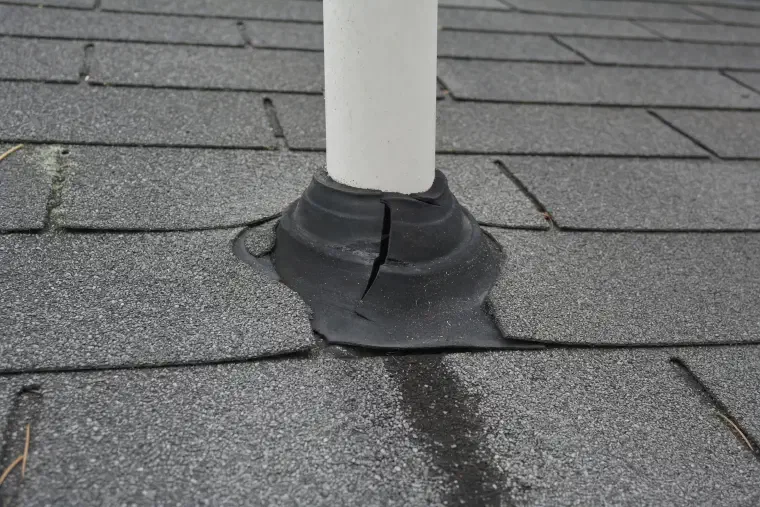
To fix a roof leak, find where the water gets in, then repair that spot, not the stain. Small jobs like a cracked pipe boot or a few lifted shingles are within reach on a dry day. Anything higher than a ladder, or a leak you cannot trace, is a call to a roofer.
The short version
- The leak is usually higher up the roof than the stain, so follow the water uphill.
- Cracked pipe boots, missing shingles and worn flashing cause most leaks.
- A garden hose test can find the entry point, one section at a time.
- Small repairs are for a dry day, a good ladder and a low, gentle slope.
- If you cannot find it, or the decking is wet, bring in a roofer.
How do you find where the leak is?
Start inside, in the attic if you can get in safely, and work out toward the roof. The advice from This Old House is that the leak likely originates higher up (opens in a new tab), so follow any signs of water uphill. Look for dark trails on the wood and wet or flattened insulation.
Then look at the roof from the ground with binoculars. This Old House suggests looking for missing, cracked, or curled shingles (opens in a new tab), especially if the leak showed up after a storm. Also check anything that pokes through the roof: vent pipes, the chimney, a skylight.
Can a hose test find the leak?
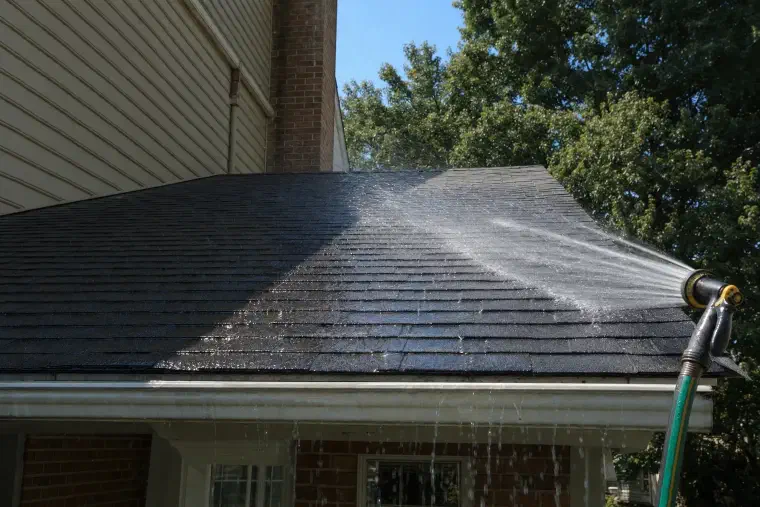
Yes, and it is the cheapest way to narrow it down. Have one person on the ground with the hose and another inside with a flashlight. Start low on the roof and work up, giving each section a few minutes before moving on. This Old House says to start on the lower part of the roof and work your way up (opens in a new tab), so you do not flood a spot above the real entry point and confuse the result.
The annoying part is patience. Water can take a while to show, so wait between sections. If the hose finds nothing, a roofer can do a moisture check, but that is its own paid service and typically costs $150 to $400. Some roofers credit it toward the repair.
What can you fix yourself?
A few jobs are reasonable for a handy person on a dry, calm day. The table shows what they involve and where the limit is.
| The cause | The fix | Where it stops being a DIY job |
|---|---|---|
| Cracked pipe boot | Swap the rubber collar for a new boot | The pipe flashing under it is bent or rusted |
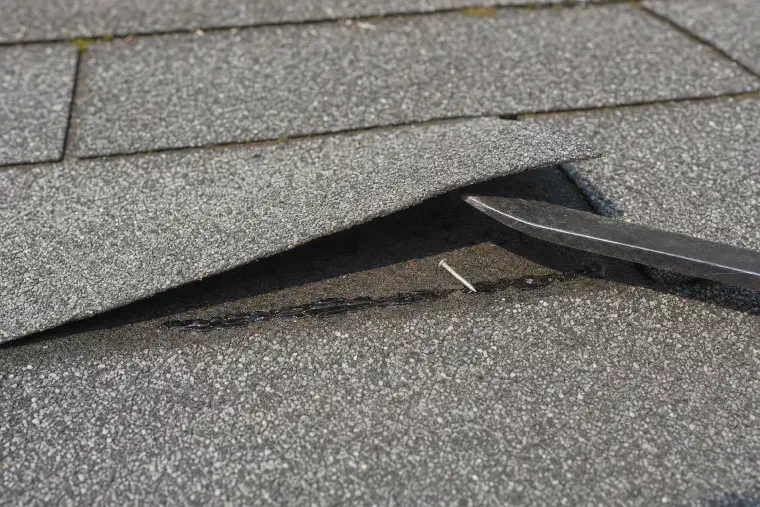
| Missing or lifted shingles | Slide in a new shingle, add roofing cement and nails | Shingles snap when lifted, or the roof is old and brittle |
| Worn sealant at a seam | Clean out the old, apply new | It keeps coming back, because caulk is a consumable |
| Bad flashing at a wall or chimney | Replace the metal | It is up the roof or around masonry |
Take the pipe boot. This Old House lists deterioration of the rubber boot (opens in a new tab) as a cause, and the repair is to clean the pipe, smooth any rough edges, and fit the new boot. We see cheap rubber collars crack in 3 to 5 years. Our piece on the pipe boot on a roof covers what to look for.
For shingles, the same site says to apply roofing cement under the new shingle’s tabs (opens in a new tab) and nail each one into place. Flashing is harder. Where a roof meets a wall, we see it reused or caulked in place more than any other shortcut, so leave that one to a roofer.
How do you stay safe doing it?
Be honest about the ladder before anything else. The CDC’s safety institute says many ladder injuries happen at home (opens in a new tab), and that extension ladders should be set up at about a 75-degree angle (opens in a new tab). This Old House adds that you should work on a dry, clear day (opens in a new tab) with minimal wind and have a helper on the ground.
If the roof is steep, wet or high, or you do not like heights, stop there. A wet ceiling costs far less than a fall.
When should you call a roofer instead?
Call when you cannot find the source, when the leak returns after a repair, or when the roof is old enough that shingles break when you lift them. A brittle roof can turn a small patch into a wide one. Also call for anything that involves chimney masonry, a skylight or a steep slope.
Past a certain point, a patch is the wrong answer. Our look at roof patch vs roof repair explains where that line sits. And never smear tar over a leak. We see this often: tar stops new shingles bonding, traps moisture and hides rotted wood underneath.
What does a professional fix cost?
These are typical area ranges, not a quote. A minimum service call typically runs $350 to $550 for an independent and $550 to $900 for a larger company. A pipe boot typically runs $350 to $750, step flashing $700 to $1,900 and a chimney reflash $800 to $2,200. A single leak diagnosis and repair usually lands between $500 and $1,600. We break the rest down in what it costs to fix a roof leak.
Interior repairs such as drywall and paint are never part of a roof repair. And no honest roofer can promise the leak stops on the first visit, since tracing one is partly detective work.
Common questions
How long can I wait before fixing a leak?
Not long. Wet wood and insulation should be dry within 24 to 48 hours, because the EPA says it is important to dry water-damaged areas (opens in a new tab) in that time to prevent mold growth. Catch the water now and get the roof looked at soon.
Is roof cement or sealant a lasting fix?
Not by itself. Sealant has a 5 to 10 year life, so any detail that relies on it is a leak on a timer. Use it to bed a shingle or seal a seam, and let metal and nails do the real work.
Does a leak only in hard rain matter?
Yes. A leak that shows up only when wind drives the rain usually means a flashing gap, not a minor issue. It wets the wood every time.
What to do next
If you can name the spot and it is a small job, try it on a dry day with the right ladder. If not, our roof repair crew traces the leak and fixes it in place, usually in one to four hours on the roof. Not sure where to start? A free roof inspection puts someone on the roof and in the attic with a written report, and there is no obligation to book work.


