

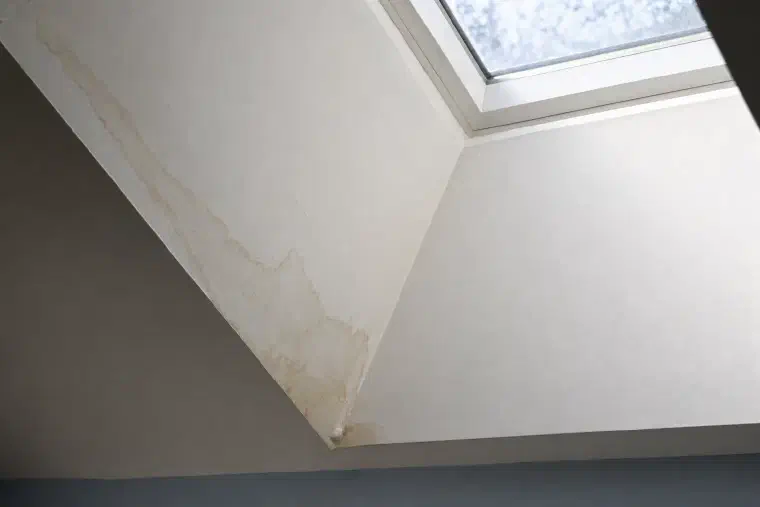
To fix a skylight leak, find out whether the water is coming in through the metal around the skylight or through the skylight itself. Most of the time it is the metal. A loose piece can be put back and a worn bead of sealant can be redone, but a bad set of flashing needs to come off and go back on.
The short version
- Most skylight leaks start at the flashing and the sealant around the frame, not at the glass.
- Fog between the two panes of glass is a different problem, and no amount of sealant will fix it.
- Roofing sealant can slow a leak at a small gap. It does not replace flashing that is bent, lifted or missing.
- A skylight reflash typically runs $900 to $2,000. A replacement typically runs $1,200 to $3,000.
- Do not coat it in roofing tar. Call us if the stain keeps growing.
Is it the flashing, the glass or condensation?
Check this first, because the three need three different fixes. Water on the room side of the glass, showing up on cold mornings and not during rain, is usually condensation. This Old House warns not to overlook condensation as a false alarm (opens in a new tab), and says water that appears only during temperature swings, not in rain, points that way.
Fog trapped between the panes means the sealed glass unit has failed. A stain on the ceiling around the light well that shows up in rain points at the flashing. If you can only see it in a hard, wind-driven rain, that is a flashing clue too.
Where do skylights usually leak?
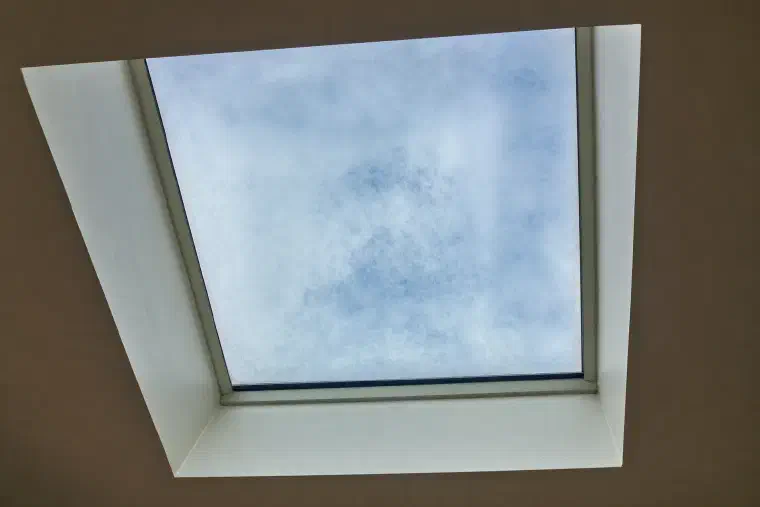
At the edges, because every side of the opening has to shed water. The Department of Energy calls a skylight a weak spot in the roof’s water management (opens in a new tab), since it is a hole cut through the layer that keeps water out.
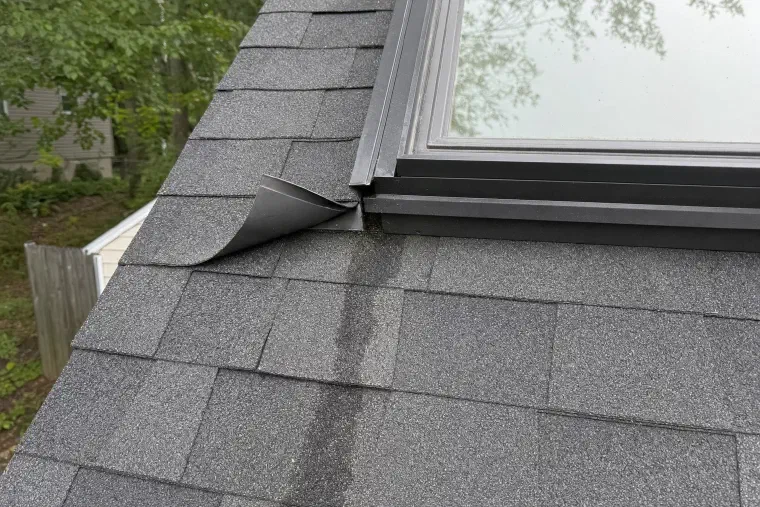
This Old House lists what to look for: cracked or dried-out sealant, lifted step flashing, or gaps where the curb meets the roof deck (opens in a new tab). It calls these the most common entry points for water. Our piece on skylight flashing shows the four pieces and where each one sits.
The annoying part is that the stain is not always under the leak, so the spot on the ceiling and the spot on the roof can be some distance apart. Our guide to finding a roof leak covers how to trace it.
What can you fix yourself?
A few small things, on a dry day, from a safe spot. We would not climb onto the roof for any of them. Here is how the common causes line up:
| What you find | What it needs | Who does it |
|---|---|---|
| Debris piled around the skylight | Clear it by hand or with a soft brush | You, if you can reach it safely |
| An exposed nail head in the flashing | A dab of roofing sealant over the head | A handy person with a ladder, or us |
| A cracked bead of sealant at a seam | Clean out the old, apply new roof sealant | Us, if it keeps coming back |
| A lifted or bent step piece | Lift the shingles, reset or replace the metal | Us |
| Fog between the panes | A new glass unit or a new skylight | Us |
This Old House says to clear any debris from around the skylight (opens in a new tab) so water doesn’t pool there, and that nails securing flashing shouldn’t be exposed (opens in a new tab): if one is, put sealant over the head.
What can sealant do, and what can’t it?
Sealant can close a small gap and buy you time. It cannot fix metal that is out of line. We treat caulk as a consumable with a life of 5 to 10 years, so any detail that depends on it to keep water out is a leak on a schedule.
If you do use it, keep it neat. This Old House says to keep the sealant fairly smooth (opens in a new tab), because big beads or lumps can divert water instead of letting it drain. Use roof sealant, not bathroom caulk.
Skip the tar. A thick coat of roofing tar over a leaking corner traps moisture and stops a proper repair from bonding later. The old tar has to be cleaned off first, and that adds to the job. In our work, tar and caulk over a previous repair often hide soft decking underneath.
When does the flashing need to be replaced?
When pieces are bent, rusted, lifted, or were never layered into the shingles. The Department of Energy describes reflashing a skylight on an existing roof as cutting back the existing shingles as little as possible (opens in a new tab) to do the work, so a reflash does not mean tearing off the whole roof.
It is a job for a roofer. The shingles around the frame come up, the old metal comes out, and new pieces go in from the bottom up, each one overlapped by the shingles above it. That overlap is what keeps water out for years, where sealant alone keeps it out for a season or two.
Our skylight repair work starts with the flashing for this reason. Often the glass is fine and the leak is in the metal and seal around it.
When is the skylight itself the problem?
When the glass unit has failed or the frame leaks. The Department of Energy says a skylight should be replaced if it is damaged, relatively old (opens in a new tab), or falls short of what you need. It lists three signs: the insulated glass fails and fogs between the panes, water leaks through joints in the frame, and, on a skylight that opens, water leaks through the gaskets or weather stripping.
If any of those fit, a reflash will not stop it. Our guide to skylight replacement cost goes through the numbers.
What does it cost to fix a skylight leak?
A skylight reflash typically runs $900 to $2,000. A skylight replacement as a repair typically runs $1,200 to $3,000. These are typical ranges for our area, not a quote.
Two things move the number. Roof pitch and how hard the skylight is to reach both add to it. If the decking under the old flashing turns out to be wet, replacing it is added at $150 to $500 or more. Finding the exact entry point can also be its own paid service, which typically runs $150 to $400.
A repair is not a guarantee that the leak is gone. Leak diagnosis is part detective work, and a second visit is sometimes needed. Interior repairs, like drywall and paint, are never part of a roof repair.
Common questions
Can I fix a skylight leak from the inside?
Not for good. You can put a bucket under it, wipe the frame and keep an eye on the stain. The water is getting in on the roof, so the repair has to be there too. Caulk inside the light well may hide the drip for a while, but it does not stop the water.
Does a leaking skylight always need to be replaced?
No. Often the glass and frame are fine and the leak is in the flashing or the sealant around it. Replacement makes sense when the sealed glass has fogged or the frame joints leak.
How often should I check my skylight?
This Old House suggests inspecting the flashing once in spring and once in fall (opens in a new tab). From a window or the ground, look for streaks on the shingles below it, black sealant that is cracked or peeling, and stains inside the light well.
Is a ceiling stain by my skylight an emergency?
A stain is the last stage of a leak, so water has usually been getting in for a while. It is not a reason to panic, but it is a reason not to wait for the next storm. A bucket and a call to us tonight beats a soaked ceiling next week.
What to do next
If your skylight is dripping, don’t assume it has to come out. Our free roof inspection includes a walk on the roof and a look at the flashing, with photos, and there is no obligation to book work. Call us any time, day or night, and tell us what you are seeing.


