

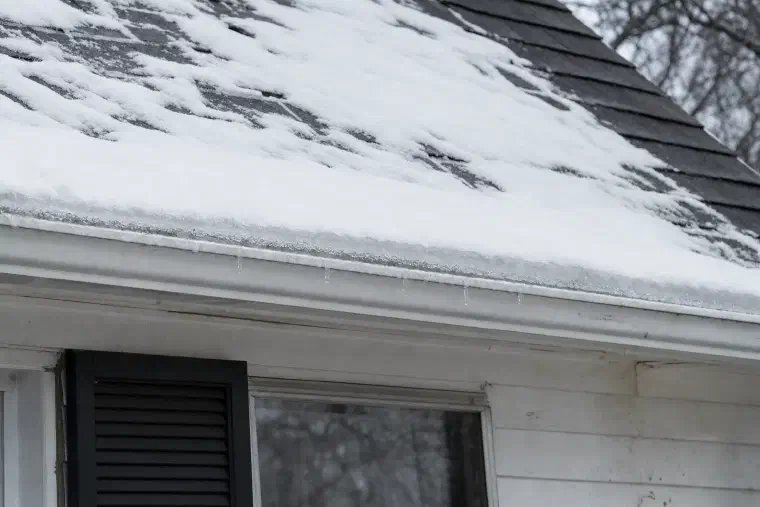
You prevent ice dams by keeping the roof deck cold, and that means stopping heat from your house reaching the attic. Seal the air leaks in the ceiling first, add insulation second, and let air flow in at the eaves and out at the ridge. Everything else only treats the symptom.
The short version
- Ice dams start with heat leaking from the house, not with the gutters or the shingles.
- Seal the ceiling air leaks first. Insulation and vents come after.
- Soffit-to-ridge airflow keeps the roof deck cold, but it cannot beat a leaky ceiling.
- Raking snow off the roof helps. Heat cables and hacking at ice do not.
- Ice and water shield stops the leak. It does not stop the dam.
What causes an ice dam?
An ice dam forms when the upper roof is warm enough to melt snow and the edge is cold enough to freeze the water again. University of Minnesota Extension says nonuniform roof temperatures (opens in a new tab) lead to ice dams: snow melts on the warmer upper roof, and the water refreezes at the cooler edge.
The warmth comes from your house. The Department of Energy’s Building America program explains that when heated air escapes into the attic, it can warm the underside of the roof deck (opens in a new tab) and melt the snow above. It also says a dam can form with as little as 2 inches (opens in a new tab) of snow.
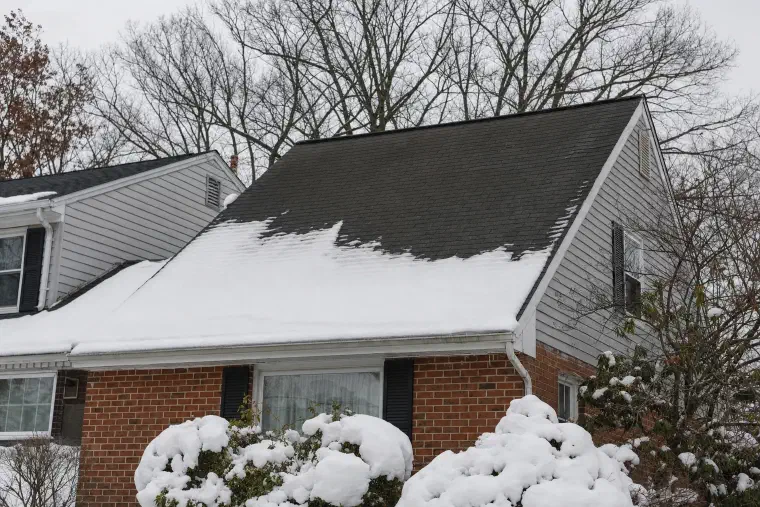
Snow makes it worse. The University of Massachusetts notes that each inch of snow has an R-value of about 0.5 to 1 (opens in a new tab), so a snow blanket acts like extra insulation and traps more of your indoor heat under the roof.
How do you prevent ice dams for good?
Control the heat loss from the house. Minnesota Extension puts the order plainly: first, make the ceiling air tight (opens in a new tab) so no warm, moist air flows from the house into the attic, then consider adding insulation to cut heat loss through the ceiling.
The fixes, in the order that pays off:
| Step | What it means | Why it comes here |
|---|---|---|
| 1. Seal air leaks | Close gaps around recessed lights, the attic hatch, pipes, wires and bath fan housings | Leaking air is the main way heat reaches the attic in many homes |
| 2. Add insulation | Bring the attic floor up to a proper depth | It slows the heat that still gets through |
| 3. Clear the airflow | Keep soffit vents open and insulation off them | Cold air has to reach the underside of the roof |
| 4. Vent at the ridge | Let that air out at the top | It carries off the heat that remains |
Skip step 1 and the rest struggle. The Building America guide calls sealing the leaks from the house into the attic the most important step (opens in a new tab).
Does attic ventilation stop ice dams?
Ventilation helps, but only after the air leaks are sealed. The Building America guide says it is critical to vent the roof in cold climates, and it asks for an air gap of at least 2 inches (opens in a new tab) between the top of the insulation and the underside of the roof deck. It also says baffles and insulation dams should keep insulation out of the soffit vents.
The University of Massachusetts calls a soffit-to-ridge system the most effective ventilation scheme (opens in a new tab) for cooling roof sheathing. In plain terms, that is cold air in low, warm air out high.
This is where we see the usual mistakes. A ridge vent goes on, but the soffits behind it were never cut open. Insulation gets blown right up against the roof edge and blocks the intake. A bath fan or dryer vent ends inside the attic and pours warm, wet air into it. All three keep the roof deck warm. We cover the whole airflow picture in why attic ventilation matters, and our attic venting page explains what we check and fix.
Do gutters cause ice dams?
No. Gutters don’t cause ice dams, but the University of Massachusetts says they concentrate ice and water (opens in a new tab) at a very vulnerable part of the roof. A gutter packed with leaves holds standing water, and standing water freezes into a solid shelf for the dam to grow on.
Clear gutters before the first freeze. They won’t stop a dam that the attic is feeding, but they leave the ice less to hang on to. Our guide to how often to clean gutters has the schedule.
Does ice and water shield prevent ice dams?
No. It protects the roof when a dam forms anyway. The Asphalt Roofing Manufacturers Association recommends a protective layer along the eaves that should extend at least 24 inches (opens in a new tab) inside the interior wall line. Water that backs up behind a dam can find cracks in the roof covering and flow into the attic, as Minnesota Extension points out, and this layer is the second line of defense.
Code minimum is the eave. Full coverage in valleys and low-slope areas is an upgrade on a new roof. We explain the product in what ice and water shield is.
What can you do while the ice is already there?
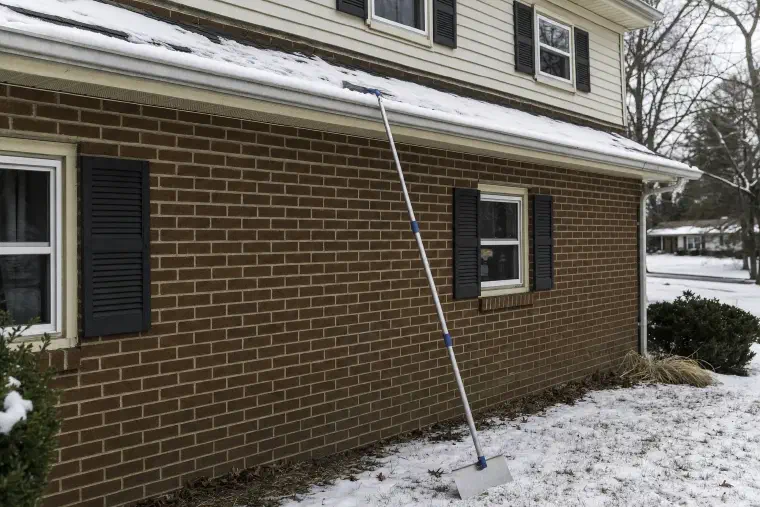
Take the snow off the roof, carefully. The University of Massachusetts says that roof rakes do help (opens in a new tab), though you can scrape some of the mineral surface off asphalt shingles as you pull. Use one from the ground, stay clear of power lines, and don’t climb a winter roof to do it.
Two things to leave alone:
- Heat cables. The same author says heat tape can embrittle shingles and create a fire risk, and that the cable can build an ice dam just above it.
- Hammers, picks and shovels. The author warns that people attack roof ice with tools, including chain saws, and more damage is done to people and roof than to the ice.
For water already coming in, Minnesota Extension describes cutting channels through the dam so the water behind it can drain, and notes that this fix becomes ineffective within days (opens in a new tab). It also advises calling professionals rather than working on a winter roof yourself.
Common questions
How much snow does it take to make an ice dam?
Not much. Building America says a dam can form with as little as 2 inches of snow, and the University of Massachusetts says 1 or 2 inches can start one on a leaky, poorly insulated roof followed by days below freezing.
Is the stain on my ceiling from an ice dam or from condensation?
Where it shows and when tells you which. A stain that shows up after snow rather than rain points to a dam. Frost on the underside of the roof boards on a cold morning points to moisture coming up from the house. Winter is the best time to look at an attic, because that frost gives the problem away.
Will a roof inspection find what is causing mine?
Our free roof inspection covers the roof surface, flashing, gutters and the attic when it is safe to get in, and we write up what we see. We do not run a full ventilation calculation as part of the free visit. Moisture metering or thermal imaging is a paid add-on that typically runs $400 to $700.
Can I fix it myself?
You can keep the soffit vents clear and rake snow from the ground. Sealing a ceiling means working around wiring and fixtures, and cutting new vents into a roof is a job where every hole has to be sealed correctly. Start by finding out where the heat is escaping.
What to do next
If you get ice at the eaves every winter, have the attic looked at before the next snow. We check airflow and fix intake and exhaust problems, and the inspection is free.


