

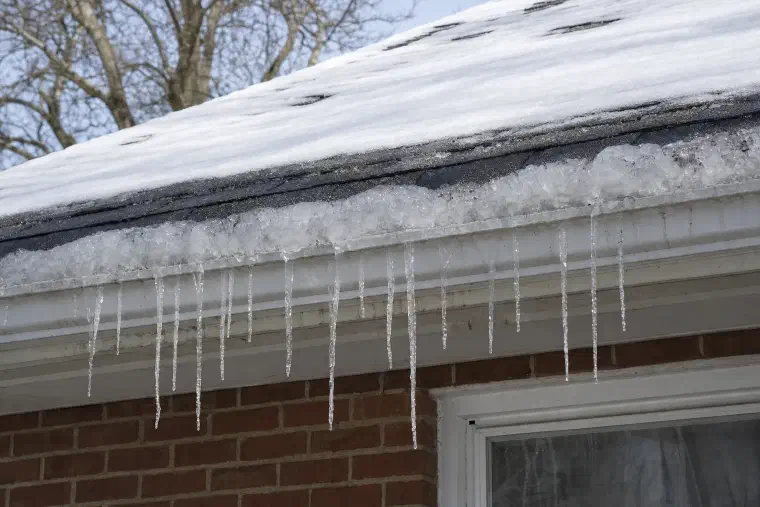
The safest way to remove an ice dam is from the ground: rake the snow off the lower few feet of the roof, and let calcium chloride melt a channel through the ice so trapped water can drain. Do not chip at it with a hammer or climb up to do it. Both can wreck shingles, and one can wreck you.
The short version
- Pull snow off the bottom of the roof with a long-handled roof rake, standing on the ground.
- A stocking filled with calcium chloride, laid across the dam, melts a drain channel. It is a temporary fix.
- Never hammer, chisel or hack at the ice, and never put a flame near it.
- Water coming through the ceiling means call a roofer now rather than wait for a thaw.
- The dam is a symptom. Heat leaking into the attic is the cause, and fixing that is what stops it coming back.
What is an ice dam, and why does it leak?
An ice dam is a ridge of ice along the bottom edge of the roof that traps melting snow behind it. The water has nowhere to go, so it backs up under the shingles and finds a way into the house.
Here is how one forms. Heat loss from the house, snow cover and outside temperature (opens in a new tab) work together to make the roof warm in some spots and cold in others. Snow melts on the warm part higher up, runs down to the cold overhang, and freezes again. Do that for a few days and the ridge grows.
Can you remove an ice dam yourself?
Yes, if you can do it from the ground and the dam is small. Work on or near the roof (opens in a new tab) is risky in winter, and the University of Missouri Extension calls it a job best left to professionals. A wet, icy roof and a ladder do not mix.
So the rule is simple: if you would have to step onto the roof or lean a ladder on the ice, stop. Water already coming into the house is a good reason to stop too, and we cover that below.
How do you get snow off the roof safely?
Use a long-handled roof rake from the ground. This Old House suggests you pull the snow off (opens in a new tab) with a long-handled aluminum rake while you stand safely on the ground. Taking the snow away removes one of the ingredients (opens in a new tab) an ice dam needs.
Two cautions. A rake can scrape the surface off shingles if you drag it hard, so go gently and leave a thin layer of snow behind. And watch for overhead power lines (opens in a new tab), because an aluminum pole and a wire are a bad pairing.
Stay out from directly under the eave while you work. Snow and ice slide off in sheets, and they don’t announce it.
How do you melt a channel through an ice dam?
Fill the leg of an old pair of pantyhose with calcium chloride ice melter, and lay it across the dam so one end hangs over the gutter. This Old House describes the trick of filling the leg of discarded pantyhose (opens in a new tab) with calcium chloride. A pole helps you push it into place from the ground.
The melter eats a narrow channel through the ice, and the trapped water drains out through it. Check on it now and then, because the stocking can slide as the ice softens.
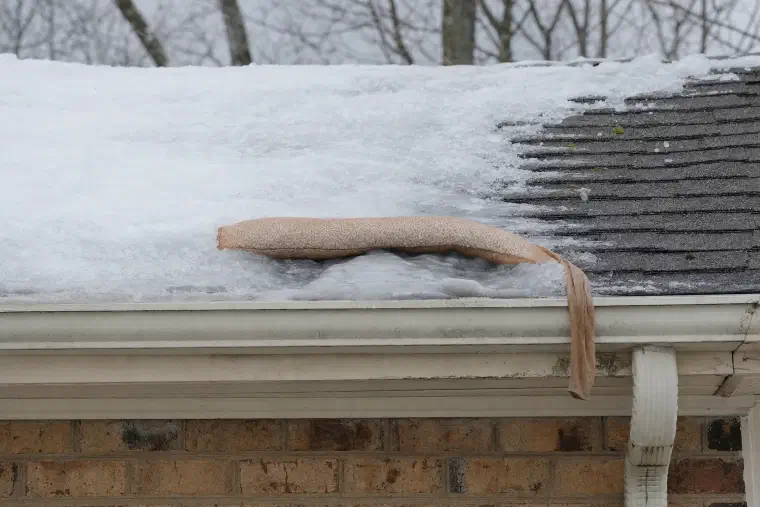
Treat it as a stopgap. The University of Minnesota says a channel like this becomes ineffective within days (opens in a new tab), so it buys you time and nothing more. Keep to calcium chloride and skip plain salt, which does more harm to plantings (opens in a new tab) than to the ice.
What should you never do to an ice dam?
| Don’t | Why |
|---|---|
| Hack at it with a hammer, chisel or shovel | Bad for your roofing (opens in a new tab) and dangerous for you |
| Climb up on icy ground with a ladder | A fall is a much bigger problem than a leak |
| Use a torch or any flame | Fire, and a roof is full of things that burn |
| Throw salt on the roof | It harms the plants below more than the ice |
| Rely on heat cable alone | It treats the symptoms (opens in a new tab), not the cause |
The annoying part is that the tempting methods are the ones that cause damage. A hammer can crack a cold shingle in one swing, and a cracked shingle is a brand new leak.
What if water is already getting inside?
Call a roofer. A dam that is leaking is past the stage where raking helps, and a ceiling stain after snow is the usual sign.
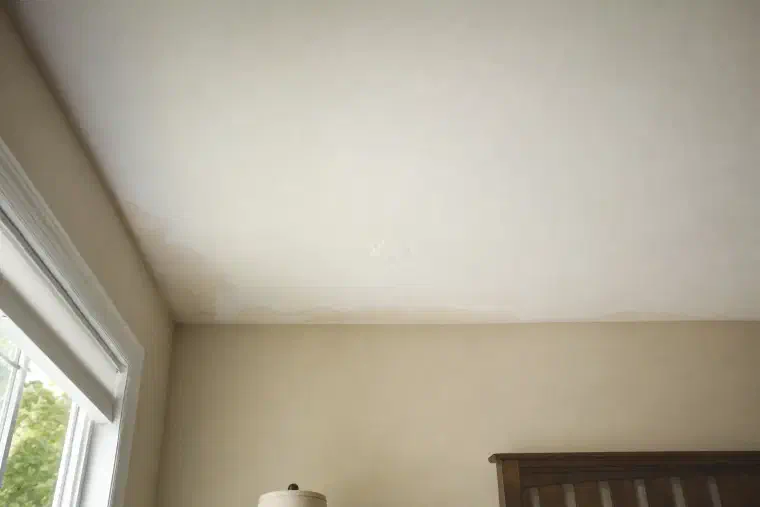
A stain near an outside wall after snow points at an ice dam, but not always. Attic condensation leaves the same mark, and so can other leaks. Mixing them up is how people end up paying for two repairs. Our roof repair starts with a diagnosis for that reason, because finding the real source comes before fixing anything. If water is coming in right now, emergency tarping typically runs $350 to $900, and active leak diagnosis typically runs $150 to $400.
Keep in mind that drywall, paint and insulation are never part of a roof repair. Move anything valuable out from under the stain and take photos of the damage in the meantime.
How do you stop ice dams from coming back?
Stop the heat getting into the attic. The University of Minnesota says ice dams can be prevented (opens in a new tab) by controlling heat loss from the home, and that starts with making the ceiling air tight so no warm, moist air flows up into the attic. Look at recessed lights, the attic hatch and the places where pipes and wires pass through.
Then add the other two pieces:
- Insulation. Extension specialists suggest R-38 to R-49 (opens in a new tab) in the ceiling.
- Airflow. Soffit vents let cold air in low, and the ridge lets it out high. Baffles near the eaves (opens in a new tab) keep insulation from blocking that path.
We see this a lot: a ridge vent installed with the soffits never opened up, so nothing moves. Our attic venting work is about fixing that, and we explain how the pieces fit together in why attic ventilation matters.
Clean gutters help too. A full gutter gives ice something to build on, so it is worth clearing them in the fall. And if the roof is being replaced, ask where the ice and water shield will go, since it keeps a leak out even when a dam forms.
Common questions
Is calcium chloride safe for shingles?
We could not find a roofing or university source that tests it on shingles, so we won’t promise it is harmless. Used in a stocking, in small amounts, it stays on the dam and off most of the roof. Rinse away any that spills.
Should I put heat cables on my roof?
They can melt a path for water, but they do not fix the reason the dam formed. North Dakota State University Extension warns against treating only the symptoms of ice dams (opens in a new tab) with things like heat tape. Fix the attic first.
Will my roof be damaged by an ice dam?
It can be. Water backed up under the shingles soaks the deck and insulation, and the damage stays hidden until a stain shows. We can look at the eaves and the attic at your free inspection.
What to do next
If you have a dam and water in the house, or a dam that keeps returning every winter, have the roof and attic looked at. Our free roof inspection covers the roof edge, gutters and the attic when we can get in. Winter is a good time to look, because frost on the underside of the roof deck shows where moisture is getting trapped.


