

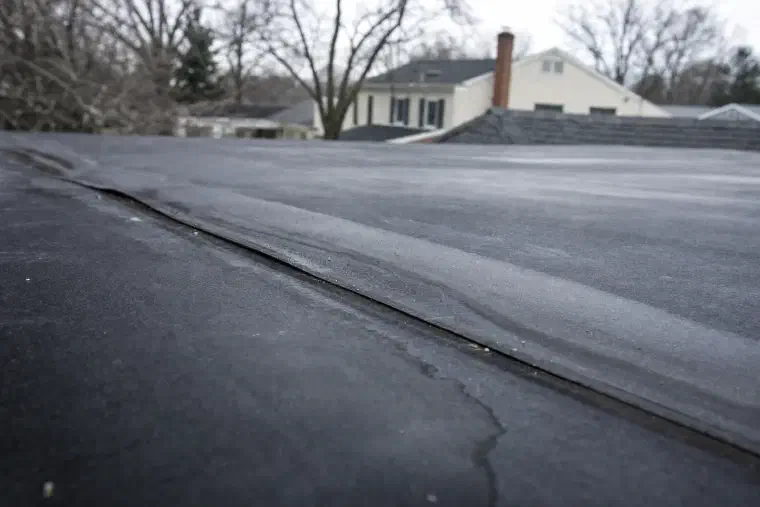
You repair an EPDM roof by cleaning the damaged spot, gluing a rubber patch over it and sealing the patch edge. That works for a small tear, puncture or open seam on a dry roof. It does not work when the roof is wet underneath or leaking in several places.
The short version
- EPDM is the black rubber sheet on many flat roofs, and a small tear can be patched.
- Pick a dry, calm day. Moisture ruins the glue.
- Clean first, glue second. Dirt is why most patches fail.
- Leaks in several places, a soft deck or an old roof mean a roofer, not a patch.
- Keep tar and roof cement off it. They stop a proper repair from bonding.
Can you repair an EPDM roof yourself?
You can patch a small tear, puncture or open seam yourself if the roof is dry and solid underfoot. This Old House says EPDM is flexible and easy to repair (opens in a new tab), and it advises repairing punctures and tears promptly with patch kits made for the material.
Its own repair guide also draws the line. It says to call a professional for damage across a large area (opens in a new tab), multiple leaks, damage to the roof deck, or a roof that is 30 years old or older. It also says to call if you are not comfortable working at height.
Keep in mind that a rubber roof is slick when it is damp. If you have any doubt about standing on it, stay off and look from a ladder.
How do you patch a tear in an EPDM roof?
You patch a tear by cleaning the area, gluing a rubber patch over it and sealing the edge. The steps follow the This Old House method (opens in a new tab):
- Work on a dry, calm day. The guide says this keeps moisture from interfering with adhesion, the glue’s grip.
- Cut a patch of EPDM rubber that reaches about 12 inches past the damage on every side.
- Clean the roof around the repair, and the underside of the patch, with membrane cleaner. That is a cleaner made for rubber roofs, not household spray.
- Roll rubber-to-rubber contact cement onto half the repair area and half the patch. Let it dry for about 10 minutes.
- Line the patch up and press it down without stretching it. Then glue and press the other half.
- Run a bead of lap sealant around the whole edge of the patch.
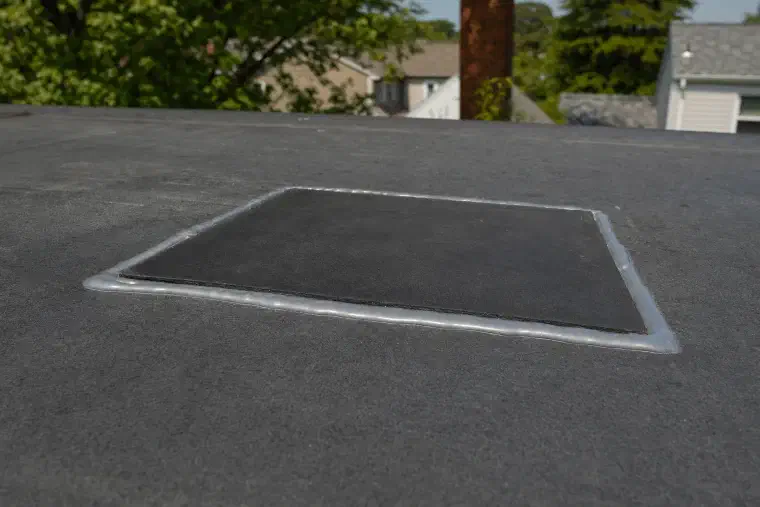
The guide also covers cutting out a wet or damaged board under the rubber and replacing it. If the board under your leak is wet or soft, that is where a homeowner job turns into a roofer’s job. We add decking found wet to a repair at typically $150 to $500 or more.
Why do EPDM seams leak?
EPDM seams leak because the glue or tape that holds them ages. This Old House says seams rely on adhesives that may degrade (opens in a new tab) over time if the roof is not maintained. A seam is where two sheets meet, and it is the first place we look on a rubber roof.
An open seam is a different repair from a tear. The old edge has to be cleaned right back to sound rubber and sealed again, and that is the part that goes wrong in a rush job. If a seam has lifted along a long stretch, one patch will not hold it.
What should you never put on an EPDM roof?
Never smear tar or roof cement over a rubber roof. We see this on repaired roofs all the time: tar prevents a proper bond, traps moisture and often hides rotted decking underneath. The next roofer then has to clean off or cut out the tar before doing the real fix, which costs more than the first repair would have.
Plain caulk is the other trap. Caulk is a consumable that lasts about 5 to 10 years, so any fix that depends on it alone is a scheduled leak. Lap sealant on the edge of a glued patch is fine. Sealant on its own over a split is not.
When is a patch not enough?
A patch is not enough when the roof is wet underneath, soft underfoot, leaking in several places or old. In those cases you are paying to delay a bigger job.
| What you see | What it usually means | Typical area cost |
|---|---|---|
| One small tear, roof dry and solid | A patch can hold | A small reseal typically runs $400 to $850 |
| Leak you cannot find | The entry point is somewhere else | Leak tracing typically costs $150 to $400 |
| Several leaks or long open seams | The roof is wearing out | A low-slope membrane repair typically runs $2,500 to $6,000 |
| Soft or spongy spots | Wet insulation or rotted deck | Decking found wet is typically added at $150 to $500 or more |
These are typical area ranges, not quotes. Most small repairs land near the minimum service call, which typically runs $350 to $550 with an independent roofer, because getting a crew out costs more than the rubber.
Age matters too. Repairs on a roof more than 15 to 20 years old usually come with no warranty. If the repair bill keeps growing, our guide to roof patch vs roof repair helps you weigh it.
How do you stop it leaking again?
Look at the roof twice a year and fix small things early. The NRCA calls maintenance the single most important factor (opens in a new tab), after proper installation, in a roof’s life span and cost. It also says maintenance is often the most neglected part of looking after a roof.
On a rubber roof that means three jobs:
- Check the seams and the edges along walls for lifted glue
- Clear branches and debris, which can puncture the sheet
- Keep tools and ladders from dragging across the rubber
This Old House makes the same points. Wooded lots like many around Ellicott City drop a lot onto a flat roof, so fall is the look that matters most.
Common questions
How long does an EPDM roof repair take?
A repair is usually one to four hours on site, but the whole job takes one to two weeks from your call in normal conditions. A storm can stretch that to three to six weeks. Glue needs a dry roof, and winter repairs may not bond until spring.
Can you repair an EPDM roof in the rain or cold?
No. The roof has to be dry, and This Old House says to pick a calm, dry day so moisture does not stop the glue from bonding. A patch put on a wet roof can look fine and let go a month later.
Does a repair stop the leak for good?
We would never promise that. Leak tracing is a matter of odds and sometimes needs a second visit. A new leak two feet from the repair is a new call, because a repair only covers the spot it was made.
What to do next
If you cannot find the leak, or the roof feels soft, start with a free roof inspection. We walk the roof, check the seams and edges, and tell you plainly whether a repair will hold. We would rather repair than replace when the roof allows it. Our flat roof repair page covers what that work involves.


