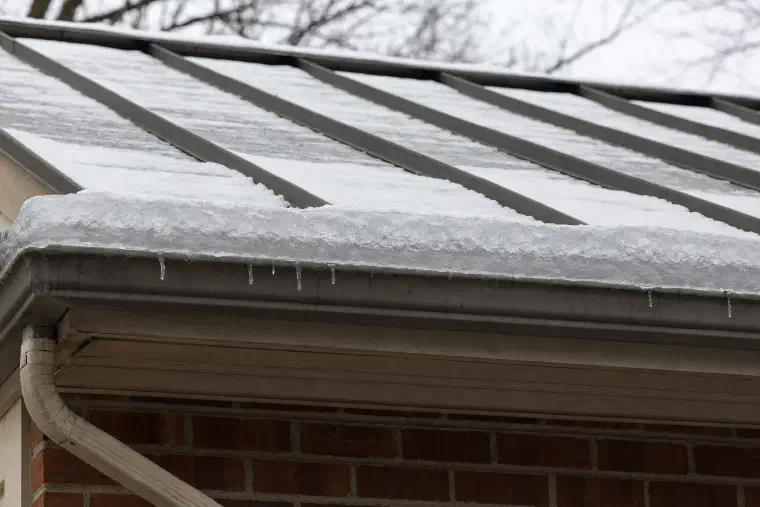
Yes. A metal roof can get an ice dam, because ice dams come from heat leaking out of the house, not from the roofing on top. Metal sheds snow better than shingles, so dams are less common, but a warm attic and a cold roof edge will still make one.
The short version
- Metal helps because snow slides off before it can melt and refreeze, especially on a steep roof.
- Metal does not fix the cause. Heat from the house still melts snow from underneath.
- A dam on metal can still push water into the house through any opening it finds.
- Sealing attic air leaks, adding insulation and clearing the vents are the real cure.
- Snow guards hold snow on the roof, which can help or hurt, depending on the attic.
Do metal roofs get ice dams?
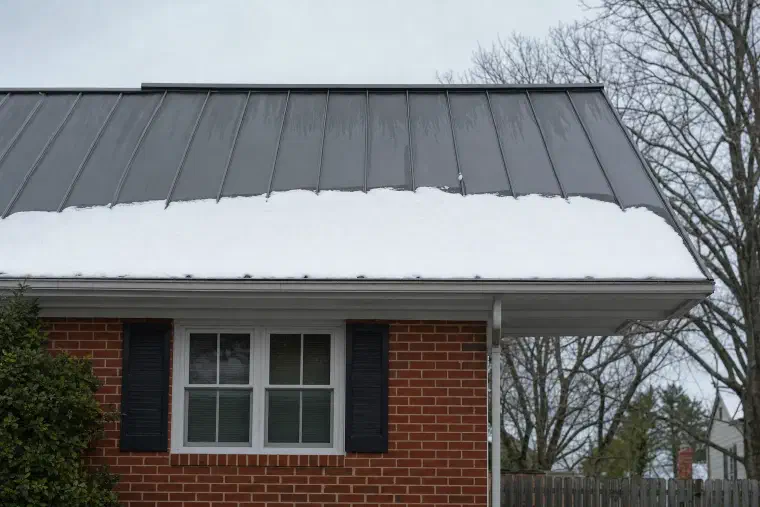
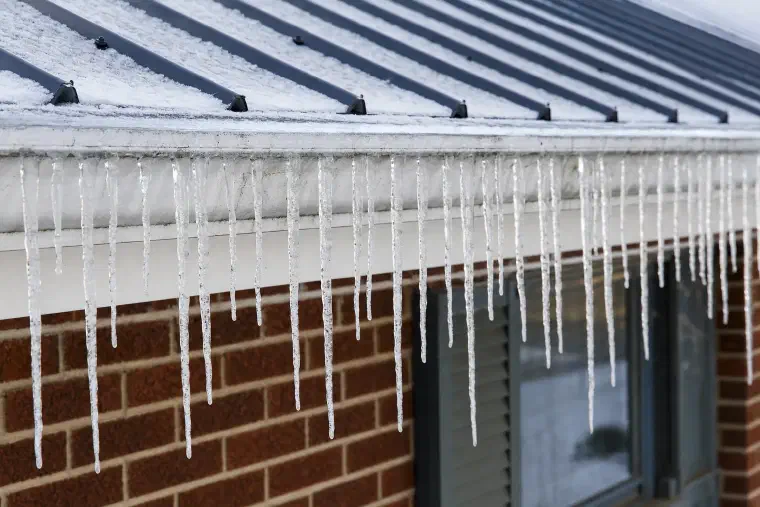
Metal roofs get ice dams when the roof has the same problem every ice dam has: the upper roof is warm and the eave is cold. The University of Massachusetts explains that ice dams develop as snow melts (opens in a new tab) on the upper part of the roof, which sits above freezing, while the lower part along the eaves is below freezing.
The material on top doesn’t change that. Heat rises from the house into the attic, warms the roof deck, and melts the snow above it. The water runs down to the overhang, where there’s no heated room underneath, and freezes.
The same university piece puts the good news about metal this way: steeply pitched metal roofs thumb their nose (opens in a new tab) at ice dams. The catch, in the same piece: metal roofs are expensive and don’t replace proper insulation.
Why do metal roofs get fewer ice dams?
Metal gets fewer dams mostly because snow doesn’t stay put on it. The surface is slick, so a layer that starts to melt underneath often slides off before it refreezes into a ridge. We covered the same slipperiness in our guide to snow guards on a metal roof.
That only works on a roof with enough slope and a clear drop. A low-slope metal roof, or one where snow stops at a wall, a dormer or a porch roof, holds snow long enough to melt and refreeze. A gutter packed with leaves also gives the ice a shelf to grow on, which we see on wooded Ellicott City lots.
Where does the water go when a dam forms on metal?
It goes wherever the roof lets it in. Minnesota Extension says water backed up behind a dam finds cracks and openings (opens in a new tab) in the roof covering and flows into the attic, and from there it can reach walls and ceilings.
Metal is a tight roof covering, but water backed up behind ice still looks for the weak spots:
| Where | Why it can leak under a dam |
|---|---|
| Panel ends at the eave | Water pools right where the ice sits |
| Roof penetrations such as vents and chimneys | Every one is a seal that can age |
| Exposed screw heads on screw-down panels | The washer is the only thing keeping water out |
| Seams and joints on low slopes | Water sits there instead of running off |
Leaks like these are hard to place, because a stain on the ceiling after snow looks the same as one after rain. If the stain shows up in winter and not in summer, think ice first.
Sliding is the other risk. The National Roofing Contractors Association warns that sliding snow and ice (opens in a new tab) can damage property, hurt people and overload lower roofs. A dam that lets go on a metal roof can take a gutter with it.
Is it the metal, or the attic?
It’s almost always the attic. The Department of Energy’s Building America program says ice dams need snow, freezing temperatures and a poorly air sealed or poorly insulated attic (opens in a new tab), and it calls sealing the air leaks from the living space into the attic the most important step.
We see this constantly: no airflow at the eaves, insulation blocking the vents, a bath fan that ends inside the attic. Poor ventilation is the most underrated roof problem we run into, and it drives ice damming in winter. New metal over the same leaky attic gets the same ice, just less of it.
Winter is the best time to look. Frost on the underside of the roof boards on a cold morning means warm, damp air is getting up there. Our guide to preventing ice dams walks through the order of fixes.
What should go under the metal at the eaves?
Ask your installer what protects the eave, because that’s where a dam does its damage. The Asphalt Roofing Manufacturers Association recommends a self-adhering layer along the eaves that extends a minimum of 24 inches (opens in a new tab) inside the interior wall line. That page is written about asphalt roofs, so treat the 24 inches as the standard to ask about, not a rule for every panel system.
The University of Massachusetts calls this kind of waterproof layer a second line of defense (opens in a new tab). It catches leaks but doesn’t stop the dam. What goes under metal panels is its own topic, and we cover it in what underlayment goes under a metal roof.
Common questions
Do snow guards cause ice dams?
Not by themselves. A snow guard holds snow on the roof so it melts in pieces. If the attic is warm, though, that held snow has more time to melt and refreeze at the eave. So it’s worth sorting out the attic before or along with adding guards.
Will a metal roof stop ice dams in Howard County?
It lowers the odds but won’t end them. Our winters swing above and below freezing, which is exactly the cycle that builds a dam. On a metal roof the cure is still a sealed, insulated, vented attic.
Should I knock the ice off a metal roof?
No. Chipping at ice with tools damages the roof, and a winter roof is slick. Minnesota Extension advises calling professionals rather than working on a winter roof yourself. A roof rake from the ground is the safer way to pull snow off before it melts.
What to do next
If you’re planning a new roof, our metal roofing installation page covers what we do. If ice already forms on yours, our free roof inspection includes a look at the attic when it’s safe to get in, and the visit costs nothing.