

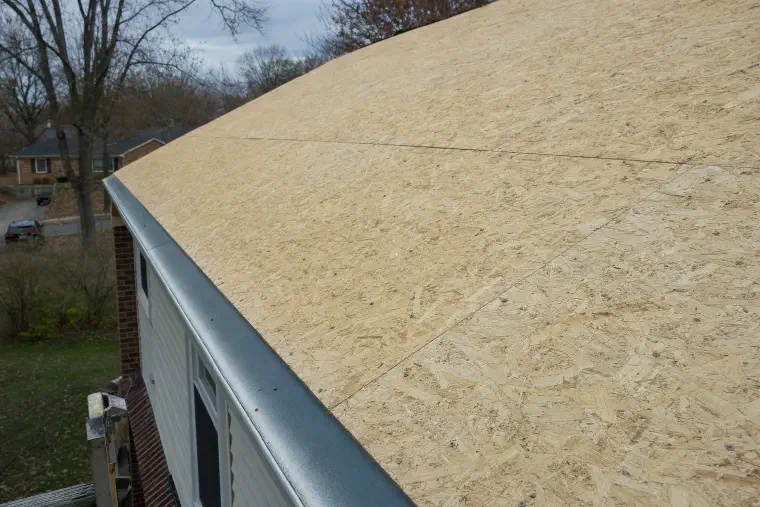
Both are fine for most roofs. Plywood and OSB (oriented strand board, a panel pressed from wood strands) are the two decking materials nearly every house gets, and either one will hold shingles when it is installed right and stays dry. The real difference shows up when the deck gets wet.
The short version
- Plywood is thin layers of wood glued together. OSB is wood strands pressed into a sheet.
- Most roofs are decked in one or the other, so neither is a red flag.
- OSB tends to hold more moisture, and one insurance research group recommends plywood.
- Keeping the deck dry matters more than which panel you pick.
- Decking is not in a standard replacement price. It is priced per sheet if it needs replacing.
What is roof decking, and what is it made of?
Roof decking, also called sheathing, is the layer of wood the shingles are nailed to. It sits on top of the rafters and under the underlayment. According to This Old House, the sheathing is usually plywood or oriented strand board (opens in a new tab), although older houses may have boards instead.
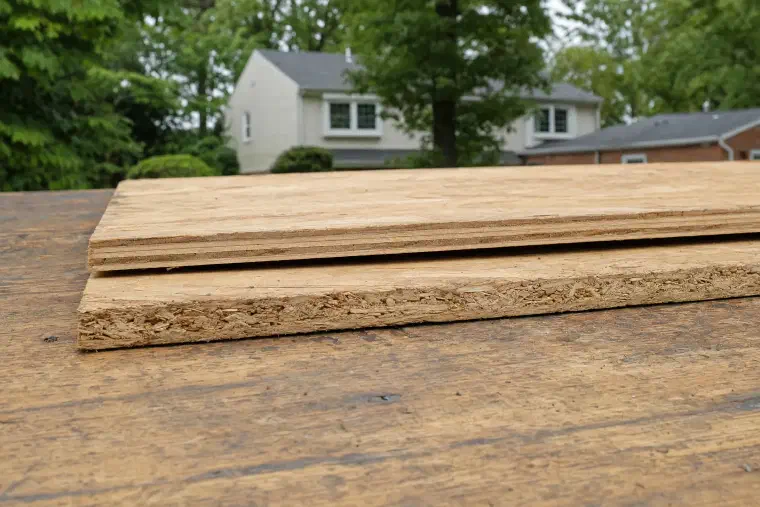
Plywood is made of thin sheets of wood glued in layers. OSB is made of wood strands pressed and glued into a flat panel. From the ground you cannot tell them apart, and under the shingles they do the same job: carry the roof’s weight and give the nails something to hold.
| Plywood | OSB | |
|---|---|---|
| Made of | Thin wood layers glued together | Wood strands pressed into a panel |
| Allowed for shingle roofs | Yes | Yes |
| Holds moisture | Less | More |
| Recommended by one wind research group | Yes | No |
Is plywood or OSB better for roof decking?
Plywood has a small edge on moisture, and OSB is still a normal, accepted choice. The Insurance Institute for Business and Home Safety (IBHS) sets a minimum of 7/16 inch plywood or OSB (opens in a new tab) for roof sheathing, so both clear the bar. That same guide, published by a U.S. Department of Energy lab, adds that IBHS recommends plywood instead of OSB (opens in a new tab). That advice comes from IBHS’s high-wind program, so it matters most where hurricanes are the worry.
For Howard County, the practical answer is less dramatic. Either panel works. What you want to avoid is a deck that stays wet, because that is when the choice starts to matter.
Does OSB hold more moisture than plywood?
Yes, it tends to. In a Building Science Corporation study of roofs with spray foam under the deck, OSB sheathing kept the highest moisture levels (opens in a new tab) among the setups tested. The same study found every roof it modeled stayed within the safe range for wood sheathing.
Read that both ways. OSB holds more water, and a dry, ventilated roof deck is still nowhere near a problem. A leak or a wet attic is a different story, because a deck that soaks and cannot dry is where rot starts.
What actually kills a roof deck?
Water that does not leave. We see it come from two directions.
From above, it is a failed flashing, a cracked pipe boot or a gutter that backs up at the eave. We cover how the same stain can start far from where you see it in our piece on what happens if a roof leak is left untreated.
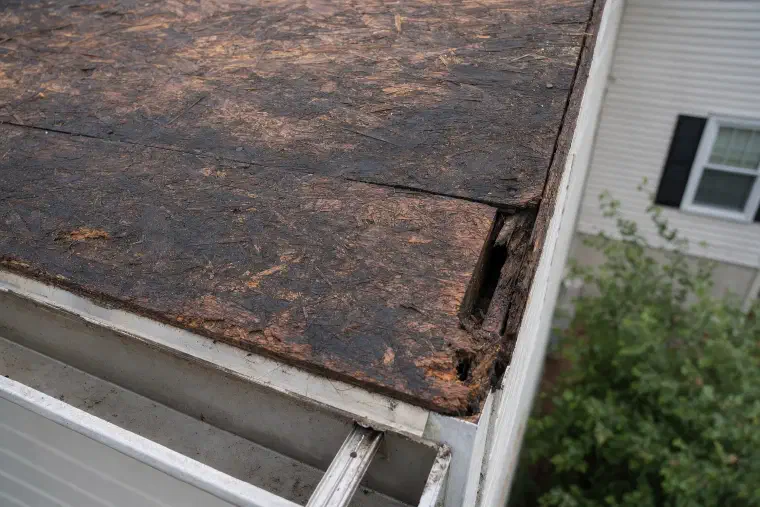
From below, it is warm, humid indoor air leaking into the attic through ceiling gaps like can lights, bath fans and the attic hatch. In winter it condenses on the cold underside of the deck. The decking soaks up that moisture, dries, and soaks it up again through dozens of cycles until it comes apart. It can ruin a deck without one drop coming in through the shingles. The tell is frost on the underside of the sheathing on a cold morning, which is why winter is the best time to look at an attic.
That is also why attic airflow matters more to your deck than the panel type. Our article on why attic ventilation matters explains how a vented attic keeps the deck dry.
Does decking come with a new roof?
Not in the sense most people expect. Our roof replacements include the full tear-off, underlayment, flashing and cleanup, but decking replacement is not in the base price. After the old shingles come off, we can see the wood for the first time, and any sheet that is wet or soft gets swapped. That is priced per 4x8 sheet, and replacing a sheet typically runs $70 to $150 installed.
On a repair, decking found wet under the patch is added at $150 to $500 or more. A bigger fix, a decking section plus new shingles, typically runs $1,500 to $5,000. The details of what a full replacement covers are on our roof installation page.
Two reasons we price it per sheet. Nobody can see the wood from the attic or the ground, and a quote that guessed the number would be either padded or wrong.
What should you ask your roofer about decking?
Ask the questions below before the old roof comes off.
- Is the deck plywood or OSB, and is that what you plan to put back?
- What do you charge per sheet if you find bad decking?
- Will you show me photos of any sheet you replace?
- Do you nail it to the right spacing? IBHS calls for 8d ring-shank nails (opens in a new tab) every 4 inches within 4 feet of the roof edges and either side of the ridge, and every 6 inches elsewhere.
The nail spacing is a high-wind recommendation, but it shows how much of a deck’s strength comes from how it is fastened rather than which panel it is.
Common questions
Is a ceiling stain a sign the deck is bad?
It can be, and it is usually late. A stain is the last stage of a leak: water has often been getting in for a long time, wetting the decking and insulation before anything shows inside. No stain does not mean no leak, either.
Does the deck need to be replaced on every reroof?
No. Only sheets that are wet, soft or damaged get replaced, and most of a sound deck stays. We look at it when the old roof is off, which is why it is priced per sheet.
How do I know what my deck is made of?
You can usually tell from the attic, looking up at the underside of the roof. Plywood shows thin layers along its cut edges and OSB shows flat wood strands. A free roof inspection can check the attic side and tell you what shape the deck is in.
What to do next
If your roof is due for replacement, ask for the decking terms in writing before the tear-off, so a surprise sheet count never becomes a surprise bill. We are glad to walk you through our process when you ask for a quote.


