Radiant barrier roof decking is worth it in a few homes and not worth chasing in most. It is plywood or OSB board with a thin foil layer on one face, and it only cuts cooling costs in a noticeable way in hot climates. Around Ellicott City, a vented attic with clear intake does more for your roof than the foil does.
The short version
- Radiant barrier decking is roof board with a foil face, put in with the foil side down.
- The savings numbers you see online come from hot climates, not Maryland.
- It does nothing for a roof with blocked soffits or a bad attic. Fix the airflow first.
- It makes the most sense when the deck is being replaced anyway.
- Dust on the foil, and foil touching the insulation, both cause trouble.
What is radiant barrier roof decking?
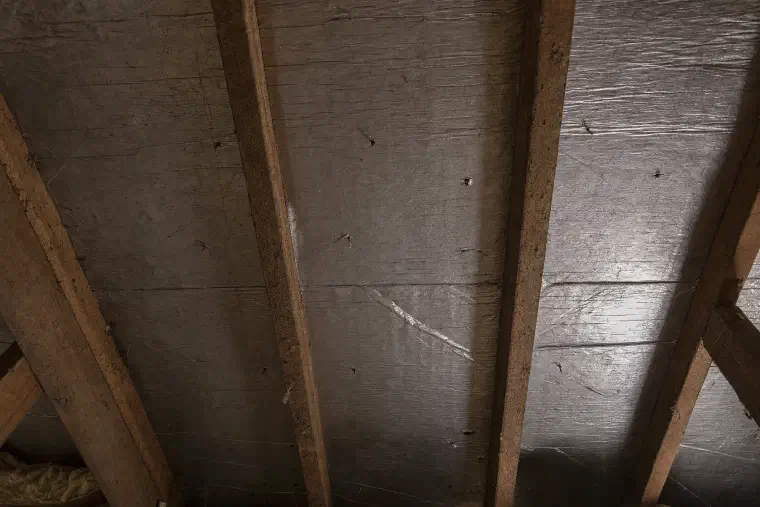
It is roof sheathing, the boards under your shingles, with a foil layer already bonded to one side. The foil faces down into the attic. The idea is simple: the sun heats the shingles, the shingles heat the boards, and the boards radiate that heat down toward your attic floor. Foil is shiny, so it sends much of that heat back up instead of passing it along.
The Department of Energy’s Building America program explains that when a roof deck is being replaced, you can choose OSB sheathing (opens in a new tab) with a foil underside, and that it should go in with the foil side facing down. The Florida Solar Energy Center adds that many decking makers now sell roof decking with a radiant barrier (opens in a new tab) already on it, which saves the cost of putting a barrier in as a separate job.
How much does a radiant barrier save?
In hot climates, about 8 to 12 percent of the cooling bill. The Building America brief says radiant barriers can cut cooling costs 8% to 12% (opens in a new tab) in hot climates. The Florida Solar Energy Center gives a similar figure for the Southeast: 8 to 12 percent of your annual cooling costs (opens in a new tab).
Keep in mind where those numbers come from. They are for homes in places with long, hard cooling seasons, and the Florida center’s payback figure of six to seven years (opens in a new tab) comes from a typical Florida home. Howard County has hot summers, but it also has winters, and a barrier does little to help a heating bill.
Does it make sense in a Maryland winter?
Not really. The Building America brief says radiant barriers are seldom cost-effective (opens in a new tab) in cold climates, where thick attic insulation already limits heat transfer. The Florida center puts the other side of it plainly: the more of your energy bill (opens in a new tab) that goes to heating, the less appealing a radiant barrier becomes.
Maryland has both seasons. You will feel the foil on a July afternoon, and not at all on a January night. So the question is whether the summer saving is big enough to be worth the extra cost on the deck, and we cannot promise it is for your house.
What matters more than the foil?
Airflow. A radiant barrier works with a vented attic, not instead of one. The Florida center says that ventilation from soffit to peak (opens in a new tab) improves how a radiant barrier system performs. The Asphalt Roofing Manufacturers Association says a balanced ventilation system is best (opens in a new tab), with intake at the eaves matched at or near the ridge, and that poor ventilation can lead to premature deterioration (opens in a new tab) of shingles and the roof deck.
This is the part we see go wrong most. An unvented or badly vented attic cooks shingles from below and can cut a roof’s life nearly in half. Common versions are a ridge vent with the soffits never cut open, insulation stuffed against the eaves, and a mix of vent types fighting each other. A foil layer on top of that mess does not fix it.
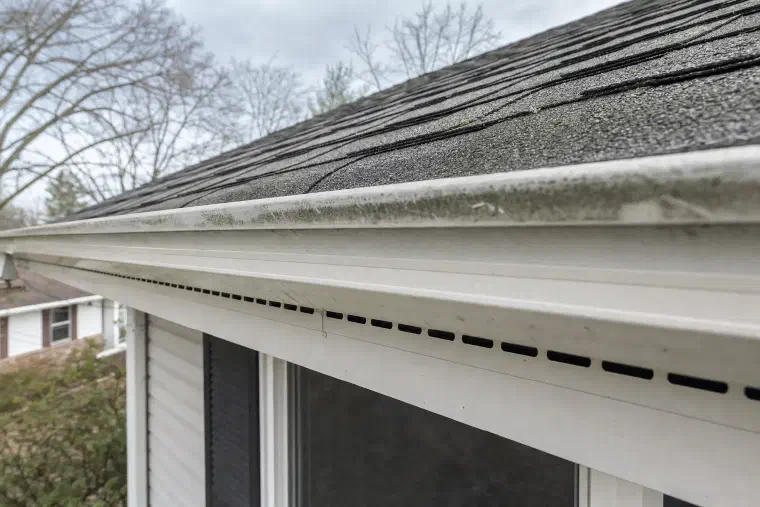
ENERGY STAR is blunt about one piece of it: never cover attic soffit vents (opens in a new tab) with insulation. Our attic venting page covers how a healthy attic moves air, and how to calculate attic ventilation walks through the sums.
When is radiant barrier decking worth paying for?
When you are already replacing the deck, the attic breathes well, and cooling is most of your energy bill. That is a short list, and the first item matters most. Foil-faced boards are installed like ordinary decking, so the extra cost is the price difference between the two, not a whole new job.
A full replacement does not always include new decking. On our installs, decking is priced per 4x8 sheet and only replaced where the boards turn out to be bad once the old roof is off, so you may be replacing a handful of boards, not the whole roof. Foil on a few patched boards does very little. The barrier needs to cover the slope to work.
| Your situation | Foil-faced decking |
|---|---|
| Whole deck being replaced, vents clear, big cooling bills | Worth asking about |
| Only a few boards being replaced after tear-off | Not worth it |
| Soffits blocked or attic is damp | Fix the airflow first |
| Attic is mostly a heating problem | Skip it |
| Deck is sound and you are only reshingling | Skip it, or look at a separate barrier |
What can go wrong with a radiant barrier?
Dust and moisture. The Florida center warns that dust on the foil reduces the radiant barrier effect (opens in a new tab) because the foil starts absorbing heat instead of reflecting it. That is one reason the foil goes face down on the underside of the deck, where dust settles less than on a flat surface facing up.
Moisture is the bigger risk when someone adds a barrier later. The Building America brief says a contractor should not install a radiant barrier in contact with attic floor insulation (opens in a new tab), because moisture is trapped under it and that risks mold and wood rot. Foil-faced decking avoids that trap because the foil is on the roof boards, not lying on the insulation.
Winter condensation is its own subject. Warm indoor air leaking into the attic can frost the underside of the deck on a cold morning, and a foil face does not change that. Sealing ceiling gaps does.
Common questions
Is a radiant barrier the same as insulation?
No. Insulation slows heat as it passes through a material. A radiant barrier reflects heat that is radiating across the attic. The Building America brief notes that installing a radiant barrier does not change the amount of attic insulation (opens in a new tab) your code requires.
Does foil-faced decking change how shingles are put on?
Not in a way you will see from the street. The shingles, underlayment and flashing go on as usual. Check with the shingle maker’s warranty paperwork if you want to be sure, since we do not quote warranty terms for products we have not seen.
Can I add a radiant barrier to an attic I already have?
Yes, as sheeting stapled to the rafters, foil side down. It has to be a perforated product with gaps for air, and it has to stay off the insulation. The Building America brief says to buy a perforated product (opens in a new tab) because it is less likely to trap vapor. It is a job for someone who has done it before.
Will it stop my attic being hot?
It helps, but a hot attic usually points at intake vents that are blocked or missing. Look there first.
What to do next
If you are heading toward a new roof and wondering about the deck, have someone look at the attic first. Our free roof inspection covers the roof, the vents and the attic when we can get in safely. We will tell you plainly whether the airflow needs work before you spend on foil, and a ridge vent that works is explained in what is a ridge vent.