Sealant on chimney flashing is a fix for a small gap, not for failed flashing. If the metal is sound and only one corner has opened up, a bead of sealant can hold for a few years. If the metal is loose, rusted or was never set into the brick, sealant only hides the problem for a season or two.
The short version
- Sealant is a patch. It is not a replacement for metal that overlaps.
- It works when the flashing is in good shape and the gap is small.
- Caulk is a consumable. We plan on it lasting roughly 5 to 10 years, and less on a bad spot.
- Tar and thick globs of sealant tend to make the next repair harder.
- A chimney reflash typically runs $800 to $2,200 around Ellicott City.
When is sealant a fair fix?
Sealant is a fair fix when the flashing itself is sound and one small spot has opened. That is how This Old House frames it (opens in a new tab): if the flashing looks to be in good condition, recaulking should take care of the problem.
Even a well-built chimney leaves one small spot where the metal cannot overlap. The same article says that spot should be sealed with a high-quality urethane caulk, and that this caulk can work itself loose over time. So a bead of sealant is part of a normal job. It just is not the part holding the water out.
When is sealant the wrong fix?
Sealant is the wrong fix when the water is getting past the metal rather than through one tiny gap. That means flashing that is rusted, lifted, bent or loose, flashing that was only stuck to the brick face, or brick and mortar that are crumbling.
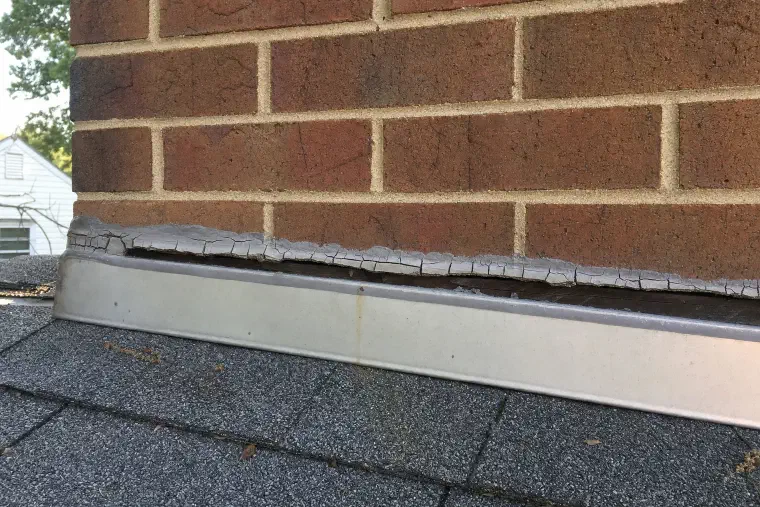
Here is the annoying part. A fat bead of caulk along the top of the metal looks sealed from the ground. The leak stops for a while. Then the caulk dries, shrinks and pulls away, and the first hard wind-driven rain finds the gap again.
We see this one a lot: chimney flashing caulked to the brick instead of metal set into a cut slot in the mortar. We call any flashing detail that depends on sealant a scheduled leak, because the sealant has a finite life.
What is chimney flashing supposed to do without sealant?
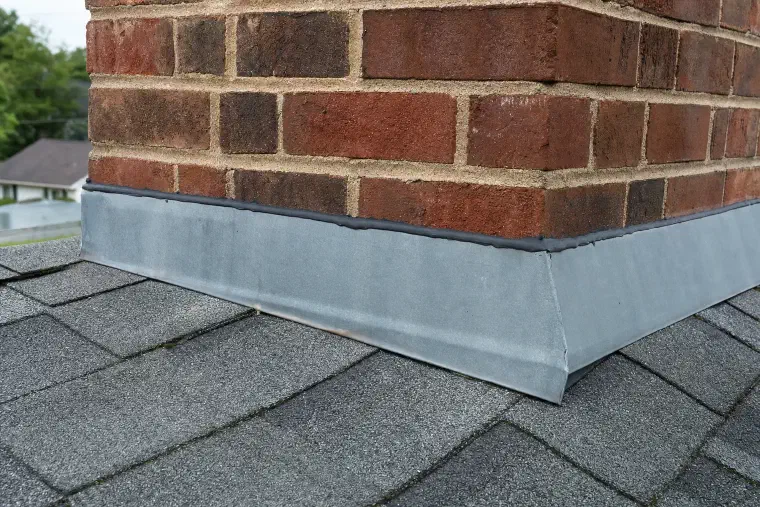
A chimney is built to shed water with two layers of metal and no sealant doing the main job. This Old House describes it (opens in a new tab) as two layers: step flashing woven into the shingles, and counterflashing set into the chimney mortar joints above it.
The shingle makers’ manual explains why. A chimney and a roof move at different rates, so the counter flashing slides over the apron flashing (opens in a new tab) without affecting water runoff. Sealant between the two layers cannot slide. It stretches until it tears.
The U.S. Department of Energy’s building guidance says the same about the top layer: counterflashing is embedded into the mortar joints (opens in a new tab) of the brick. Our piece on counter flashing goes into the cut slot in more detail.
How long does sealant on chimney flashing last?
Plan on roughly 5 to 10 years for a sealant bead, and treat that as the best case. That is our experience-based rule of thumb, and it is shorter on a chimney that sees full sun, a lot of wind or a lot of movement.
A chimney in a wooded Ellicott City lot is also working against it. Freeze and thaw cycles open and close small gaps all winter. A bead that was fine in October can be cracked by March.
There is a second catch. This Old House says repairing damaged flashing with sealant is only a stopgap (opens in a new tab) until the flashing can be replaced. Treat a sealed chimney as a chimney with a countdown on it.
Can you put too much sealant on?
Yes. Big beads or lumps of sealant (opens in a new tab) can divert water and stop it draining properly, according to This Old House. A smooth, thin bead does the job. A thick smear does not, it just gives water a new ledge to sit on.
Roofing tar is worse. It prevents new materials from bonding, it traps moisture, and it often hides rotted decking underneath, so a simple reseal turns into a bigger repair. Shingle makers also warn that excessive roofing cement may cause blistering (opens in a new tab) in the shingles.
Sealant or new flashing: which one do you need?
This table is a quick way to sort it out. If you are in the right-hand column, sealant is buying time, not solving the leak.
| What you see | Sealant can be enough | Flashing needs work |
|---|---|---|
| The metal | Flat, tight, no rust | Rusted, lifted, bent or loose |
| The gap | One short hairline at a corner | A long gap, or caulk along the whole edge |
| The old caulk | Cracked in one spot | Cracked all over, or layers of old caulk |
| The brick | Solid mortar | Crumbling mortar or spalled brick |
| The leak | Rare, only in wind-driven rain | Comes back after every repair |
| Roof age | Fairly new | Old roof near replacement |
A small sealant reseal typically runs $400 to $850, and a chimney reflash typically runs $800 to $2,200. Those are typical ranges around Ellicott City, not a quote. If the masonry has to be repaired first, a chimney rebuild with new flashing typically runs $3,500 to $8,000.
Common questions
Can I seal chimney flashing myself?
If the metal is tight and you are comfortable on a ladder, a small touch-up is a reasonable DIY job. Use a roof sealant made for the purpose rather than latex caulk, and keep the bead thin. Stay off a steep or wet roof, and call a roofer if you would have to climb onto the roof itself.
Will sealant stop a chimney leak for good?
No. Sealant on chimney flashing is a repair with an end date. Expect it to need redoing, and have the flashing checked each time.
How often should I check chimney flashing?
This Old House suggests (opens in a new tab) looking once every year or two for loose or missing flashing and cracks in the masonry. After a big storm is a good extra time to look.
Is the leak really the flashing?
Often, but not always. Brick can wick water, and a cracked top of the chimney can let it in too. Our article on the chimney crown covers that other source.
What to do next
If you have already re-caulked once and the stain came back, the metal is probably the problem. Our chimney flashing repair work replaces the flashing and sets the top layer into the brick, and our guide to what it costs lays out the range. A free roof inspection will tell you whether you need a bead of sealant or new metal.