

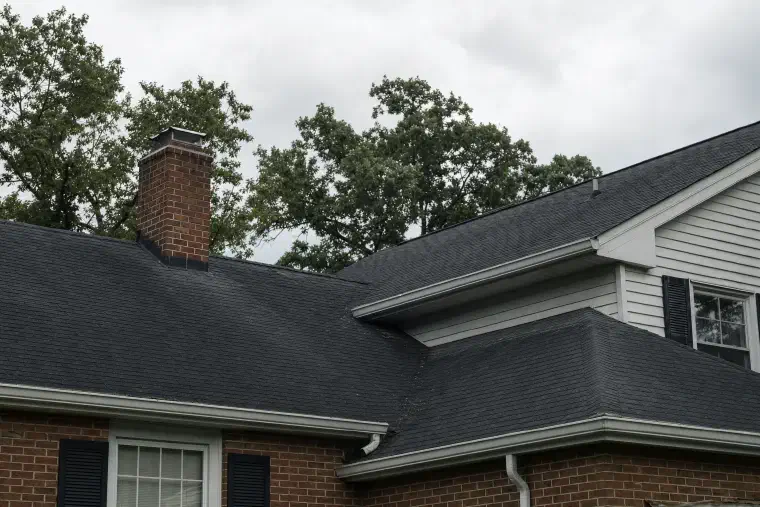
A roof is a stack of layers with a handful of edges, joints and openings. The parts you can see from the yard are the shingles, the ridge, the valleys, the edges and the gutters. The parts you cannot see are the decking, the underlayment and the flashing, and they decide whether the roof leaks.
The short version
- The big shapes are the ridge at the top, hips and valleys where slopes meet, and the eaves and rakes at the edges.
- Under the shingles sit the underlayment and the decking, which carry the roof when a shingle lets water through.
- Flashing is the thin metal at chimneys, walls, valleys and pipes, and it is where roofs leak most.
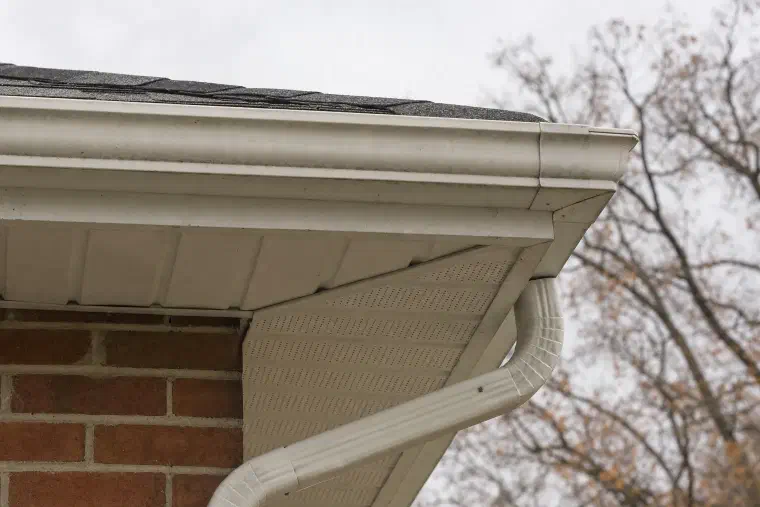
- The overhang has three parts that get mixed up: fascia, soffit and gutter.
- A free roof inspection from us names every one of these on your own house.
What are the parts of a roof?
Think of a roof as three groups: the shape, the layers and the edges. The shape is the slopes and the lines where they meet. The layers are everything stacked from the rafters up to the shingles. The edges are the overhang, the trim and the gutters.
Most leaks do not come from the big flat slopes. They come from the places where one part meets another, which is why the names are worth learning.
What are the ridge, hip and valley?
These are the three lines where roof slopes meet. The ridge is the top line, where two slopes meet at the peak. A hip is the sloping line where two slopes meet at an outside corner, the way a hip roof comes down at the ends. A valley is the opposite: the low line where two slopes meet at an inside corner, and where rain from both slopes runs together.
The valley is the one to watch, because rain from two slopes runs through it. That is why it gets its own metal: valley flashing directs water away (opens in a new tab) from the meeting point of two slopes. Leaves and grit make it worse by damming the flow. If you want the difference between a hip roof and a gable roof, we cover it in hip vs gable roof.
What are the eaves and the rakes?
The eaves are the bottom edges of the roof, where it overhangs the walls. This Old House describes eaves as the entire overhanging edge (opens in a new tab) of the roof that extends beyond the exterior walls. The rakes are the sloped edges on the gable end, running from the eave up to the ridge.
Both edges get a thin strip of bent metal called drip edge, which sheds water off the wood underneath. We explain it in what drip edge is.
What is the decking?
The decking, also called sheathing, is the flat wood layer that the whole roof sits on. It is usually plywood or oriented strand board (OSB), nailed to the rafters or trusses. Rafters are the sloped beams, and trusses are the prefabricated triangle frames that do the same job.
Virginia Tech says the sheathing serves as a basic water barrier (opens in a new tab) and supports a distributed load such as snow or workers. It is also what a roofer nails into, so soft or rotted decking means the nails have nothing to hold. Decking is not part of a standard replacement price. After tear-off we price it per 4x8 sheet, typically $70 to $150 installed, only where it needs replacing.
What is the underlayment?
The underlayment is a sheet that goes over the decking and under the shingles. It is the backup layer. Virginia Tech describes it as the layer that sheds water that seeps through (opens in a new tab) the roofing. Felt and synthetic sheets are the two common kinds, and we compare them in what roof underlayment does.
A sticky, self-sealing sheet called ice and water shield goes at the eaves, in valleys and around penetrations. A new roof from us includes it at code minimum in those spots.
What are shingles for?
Shingles are the outer skin, and they shed most of the water. Each row overlaps the one below it, the way scales do, so water runs down the slope and never meets a gap. Ridge cap shingles are the bent ones that cover the peak and the hips.
Shingles are the part everybody asks about and the part that matters least for leaks. Where the nails go and how the flashing is done decide how long a roof lasts, more than the brand does. The same shingle can last 25 years or 9, depending on where the nail went.
What is roof flashing?
Flashing is thin metal, or sometimes plastic, that guides water around anything that sticks up through the roof or runs into a wall. This Old House calls it a thin strip of sheet metal (opens in a new tab) installed around the edges of roof features such as chimneys, vents and flue pipes.
It comes in a few forms. Step flashing is a row of L-shaped pieces that goes under the shingles and bends up (opens in a new tab) against a wall or chimney. Counterflashing is a second layer that sits on top of step flashing (opens in a new tab). Valley metal lines the valley.
| Flashing | Where it goes | What goes wrong |
|---|---|---|
| Step flashing | Where a roof meets a wall | Reused from the old roof |
| Counterflashing | Over the step flashing at a chimney | Caulked on instead of set into the brick |
| Valley metal | Down the valley | Left out, or buried in debris |
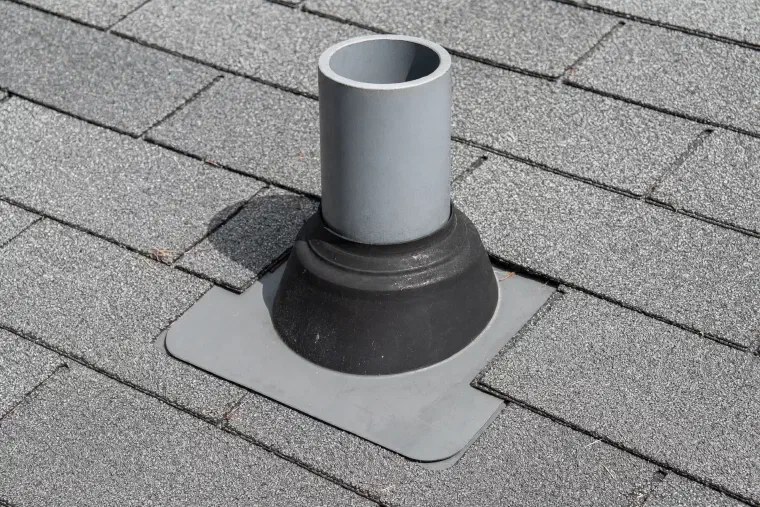
| Pipe boot | Around plumbing vent pipes | Rubber collar cracks |
Flashing is where roofs actually leak. Caulk is a consumable with a life of 5 to 10 years, so any flashing detail that depends on caulk is a leak with a date on it. Cheap bids often reuse old flashing, and a new roof from us includes new flashing at chimneys, walls, valleys, skylights and penetrations unless you ask us to reuse it. Metal lasts a long time: This Old House says aluminum and galvanized steel last 20 to 40 years (opens in a new tab) and copper can last 100 years or longer.
What are the vents and the pipe boots?
Anything that pokes through the roof is a penetration, and each one needs its own seal. The plumbing vent pipes get a pipe boot, which is a metal base with a rubber collar. Cheap rubber collars crack in 3 to 5 years, which is why a cracked pipe boot is one of the most common small leaks. A pipe boot repair typically runs $350 to $750.
Then there are the attic vents. The Asphalt Roofing Manufacturers Association explains that intake vents at the eaves or soffit (opens in a new tab) let air in, and heated air rises and leaves through exhaust vents at or near the ridge (opens in a new tab). That steady flow keeps the attic dry in winter and cool in summer. Ridge vents and box vents are the exhaust side. An attic with no way for air to enter cooks the shingles from underneath.
What are the fascia, the soffit and the gutter?
These three sit at the overhang and are easy to mix up. The fascia is the board along the lower edge of the roof. This Old House says it connects the roof to the outer walls (opens in a new tab). The soffit is the panel on the underside of the overhang, and the gutter hangs on the fascia to carry water away.
Many soffits have small holes or slots, because that is where fresh air enters the attic. The fascia is wood, so it rots when gutters overflow or water runs behind them. We sort out the two in soffit vs fascia.
Common questions
Which part of a roof leaks most often?
Flashing, by a wide margin. Chimneys, wall joints, valleys and pipe boots all depend on small metal and rubber parts doing their job for years. The large slopes of shingles rarely leak until they are worn out or damaged.
What is the difference between the roof deck and the roof structure?
The structure is the frame: rafters or trusses. The deck is the plywood or OSB nailed on top of that frame. Shingles and underlayment go on the deck, never straight onto the frame.
Do I need to know all of these parts to hire a roofer?
No, but a few names help you read a quote. Look for new drip edge, new flashing, underlayment and a note on the decking. If a quote says nothing about flashing, ask whether it is new or reused.
What to do next
If you want somebody to point at each of these parts on your own roof, a free roof inspection is a walk across the roof and a look in the attic, with a photo report after. If the roof is due for replacement, our roof installation page lists what a full job covers.


