

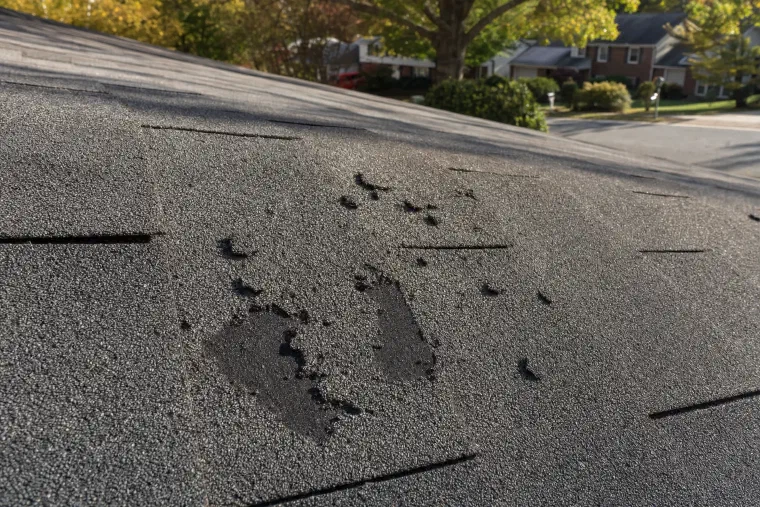
Roof blistering and hail damage both leave round, pitted spots on asphalt shingles, but hail leaves a bruise you can feel and a blister does not. Hail also hits in a random pattern and dents soft metal nearby. Blisters come from heat and trapped moisture.
The short version
- Press the spot with a thumb: hail leaves a soft bruise, a blister does not.
- Hail falls in a random pattern with marks of different sizes. Blisters come from heat inside the shingle, not from weather.
- Dented gutters, vents and the air conditioner point to hail. No dents anywhere points away from it.
- Poor attic airflow is linked to blistering, so the fix may be the attic, not only the shingles.
- Our roof inspection is free, and it includes telling the two apart.
How can you tell a blister from a hail hit?
A hail hit has a bruise and a blister does not. The Nebraska Department of Insurance says a blister has no bruise (opens in a new tab) like the one you can feel in a shingle struck by a hailstone. NRCA, the national roofing trade group, explains that those soft spots are called bruises (opens in a new tab) because they feel like a bruise on an apple.
Here is the plain test. Press the spot with your thumb, or better, have someone press it who is up there anyway. Soft and spongy under a bare patch means hail. Rough, pitted and firm means something else.
Keep in mind that you should stay off the roof yourself. A wet or steep roof is easy to slip on, and a boot can crack a brittle shingle.
What does a blister look like?
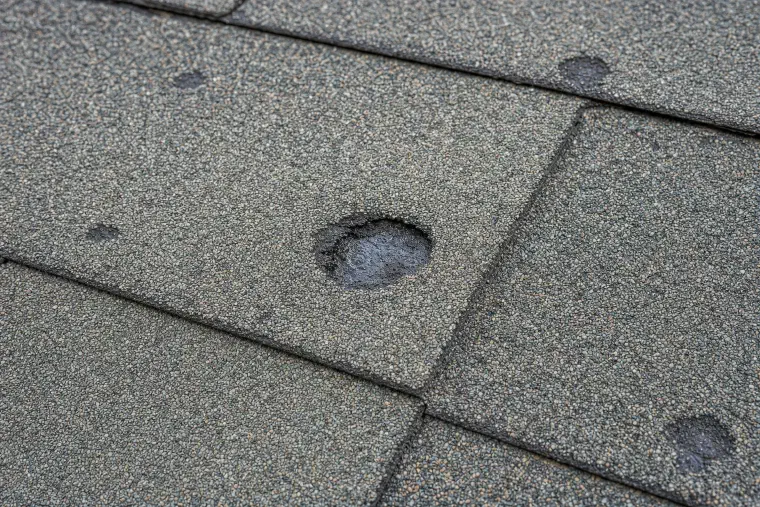
A blister is a small raised bump on a shingle, and when it pops it leaves a pitted crater. This Old House says that when blisters pop, the granules can loosen (opens in a new tab) and fall off, and that popped blisters leave the roof open to sun and water. Granules are the gritty coating that shields the asphalt from sunlight.
An unpopped blister is easy to miss. A popped one can look a lot like a hail crater from the ground, which is why the two get mixed up.
What causes roof blistering?
Heat and trapped moisture cause blistering. This Old House says blistering can occur on asphalt shingle roofs (opens in a new tab), especially those with inadequate attic ventilation. The asphalt gets too hot, gas or moisture inside it expands, and a bump forms.
We would not call the attic the only cause, and sources disagree on how much a factory flaw plays a part. But we see an unvented attic cook shingles from underneath, and we think poor ventilation is the most underrated cause of early roof failure. The Asphalt Roofing Manufacturers Association says ventilation moves heat and moisture out (opens in a new tab) of an attic and helps prevent early shingle wear.
A blistered roof is often an old, hot roof. Hail can hit any roof, new or old.
How does hail damage look different?
Hail damage lands in a random pattern, in different sizes, and usually leaves a bruise. The Nebraska Department of Insurance says hail makes a random pattern of strike marks (opens in a new tab) in various sizes, and that damage following a pattern was likely not caused by hail.
NRCA adds a detail that surprises people. A hail fracture starts on the shingle’s underside and works up, so a hit that knocks off granules (opens in a new tab) from a shingle in good shape will also leave a detectable bruise. Granules missing with no bruise point away from hail.
What other signs separate the two?
Look around the house, because hail rarely hits only the roof. The Insurance Institute for Business and Home Safety says hail can also damage siding, windows, fences, lawn furniture and vehicles (opens in a new tab). Dented gutters, dented air conditioner fins and dinged metal vents are the usual clues.
Its guide lists blisters among the look-alikes, along with mechanical marks and general granule loss on shingle edges. This table sums up the differences.
| What you check | Hail | Blistering |
|---|---|---|
| Press with a thumb | Soft bruise | No bruise |
| Dents on metal nearby | Usually yes | No |
| Other items hit | Often siding, fences, cars | No |
| Likely cause | A storm | Heat and trapped moisture |
Does granule loss mean hail?
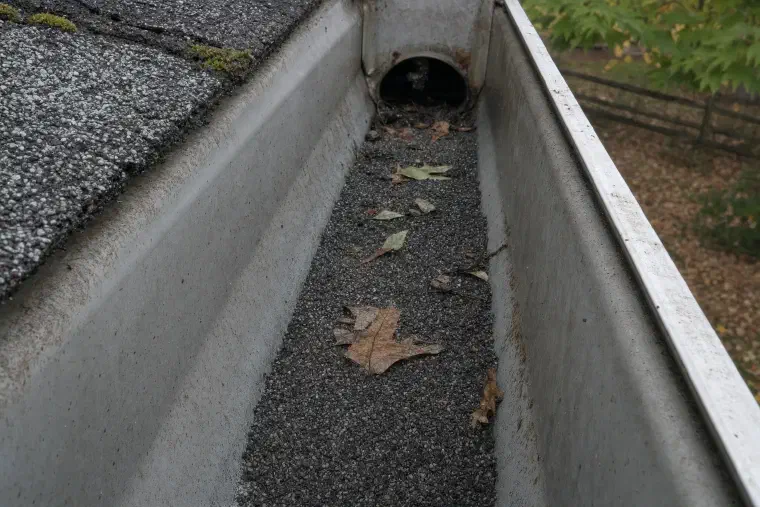
No. Granules in the gutter are a clue, not proof. The Nebraska Department of Insurance says plainly that granule loss does not prove damage (opens in a new tab). NRCA says shingles that lose granules without a fracture are usually already near the end of their lives (opens in a new tab).
Heavy grit at the end of a downspout does mean something is wearing the shingles. It just does not tell you whether the cause was a storm, popped blisters or plain age.
Does it matter for an insurance claim?
It can, because a claim turns on what caused the damage. We cannot say what your policy covers or what a claim will pay, because the policy and the adjuster decide.
What we can say is that telling the two apart takes a hands-on check. Hail assessment is subtle. It takes a thumb press for the bruise, a count of hits in test squares and a look for blistering and mechanical marks, and a drone photo alone is not enough. For a claim, a Haag-certified inspector is the kind we recommend. Our article on how a roof is inspected for hail damage walks through the steps.
Common questions
Can a hailstorm cause blisters?
Not directly. Hail bruises and fractures the shingle. Blisters come from heat and moisture inside the shingle. Still, a hailstorm and a blistered roof can show up on the same roof, and that is where a careful look matters.
Do blisters mean I need a new roof?
Not by themselves. How many there are, how old the roof is and whether the shingles still shed water all matter, and the attic airflow should be checked too. Our roof repair page covers what a repair includes.
Is blistering covered by my warranty?
We can’t say. Warranty terms vary by shingle maker and by roof, and we do not know yours. Read the paperwork from the original install, and ask the manufacturer.
How do I know if my attic is the problem?
A roofer has to look at the vents and the airflow from inside. If you suspect it, see our page on attic venting, or read why attic ventilation matters.
What to do next
Write down the date of any storm, photograph what you can see from the ground, and have the roof looked at by someone who will press the shingles. Our free roof inspection includes a walk on the roof and a written report with photos. The phone is answered 24/7.


