

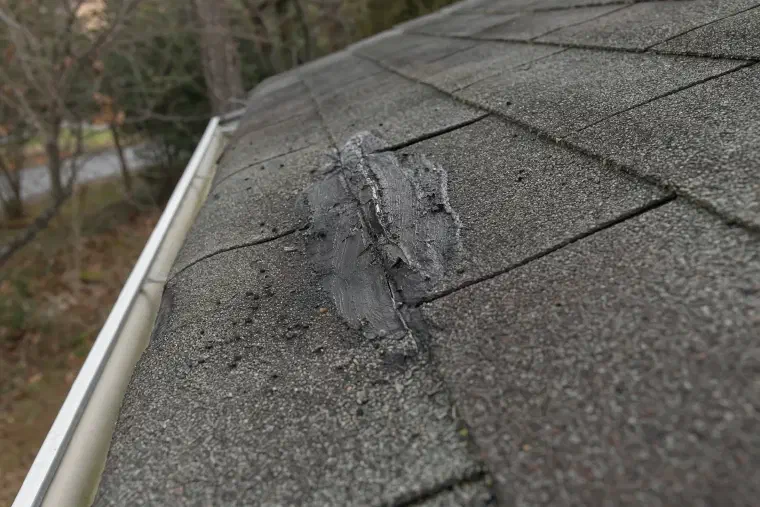
A roof patch covers the spot where water is getting in, and a roof repair finds out why it got in and fixes that. The patch is the quick, cheap part. The repair is the part that keeps the same leak from coming back, and that gap is what this article is about.
The short version
- A patch is a stopgap, usually sealant or tar over a hole or crack. A repair takes out the failed part and puts in a new one.
- Roofing cement can work for a short time on a small puncture, but it is not a long-term repair (opens in a new tab).
- Tar on flashing is the classic bad patch, because it can trap moisture against the metal (opens in a new tab).
- Most small repairs cost close to the minimum service call, so a patch rarely saves much money.
- A new shingle will look different from old ones at first, and that is normal.
What is a roof patch?
A roof patch is a fast fix that stops water at the spot you can see, without replacing the part that failed. Think of a dab of sealant on a cracked shingle, a smear of roofing cement over a nail head, or a tarp over a hole until the weather clears.
Patches have a real job. A roofer may have to make a temporary repair to stop water coming in while the right materials are ordered (opens in a new tab). That is a sensible use of a patch. The trouble starts when the patch is the end of the story.
What is a roof repair?
A roof repair removes the part that failed and puts in a new one, then checks that water now has a clear path off the roof. That might be a pipe boot (the rubber collar around a plumbing vent), a few shingles, a run of step flashing (the bent metal pieces where a roof meets a wall), or a valley.
Our roof repair work starts with a look at the roof and the attic. What we replace depends on what we find, and the work is scoped to one location. If we see something else wrong on the way, that is a separate estimate, not a surprise on the bill.
How do a patch and a repair compare?
The main differences are what gets done, how long it lasts, and what it costs. This table puts the usual versions side by side.
| Patch | Repair | |
|---|---|---|
| What happens | Sealant, tar or a tarp goes over the problem | The failed part comes out and a new one goes in |
| Fixes the cause | Rarely | Usually, if the leak was traced right |
| How long it holds | A season, sometimes less | As long as the rest of the roof around it |
| Typical cost | Low, but a service call still applies | A pipe boot typically runs $350 to $750; replacing 1 to 3 shingles typically runs $300 to $650 |
| Warranty | None worth counting on | Typically 30 days to 1 year on the repaired area |
Two notes on that. A warranty on a repair usually covers only the spot we worked on, and there is typically none on a roof over 15 to 20 years old. And a new leak two feet away is a new call, not a failed repair.
Why is tar a bad patch?
Tar is a bad patch because it hides a problem instead of fixing it, and it can make the problem worse. On flashing, This Old House warns that tar can speed up corrosion (opens in a new tab) by trapping moisture between the tar and the metal.
On shingles, we see the same pattern after a bad earlier fix. Tar stops new material from bonding, holds water against the roof, and often covers rotted decking (the wood boards under the shingles). Fixing it properly means replacing every shingle it touched, and often the wood under them.
One thing to keep in mind: caulk is a scheduled leak. Any detail that depends on sealant to stay dry has a life of about 5 to 10 years, so a caulked flashing joint is a patch with a countdown.
Does a patch cost less than a repair?
Not by much, and often not at all. Most small repairs land at or near the minimum service call, because the cost is getting a crew to your house, not the parts. That minimum typically runs $350 to $550 with a smaller independent roofer and $550 to $900 with a larger company.
In practice, a small repair typically costs the same as a patch from a roofer, and it holds for years. The savings from a patch come from doing it yourself, and that has its own risks on a wet, steep roof. For the full price list, see what a roof repair costs.
Will a repair show on my roof?
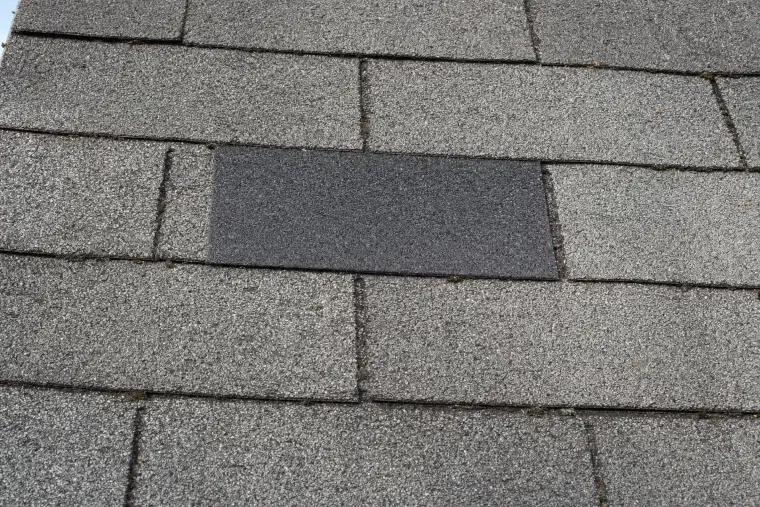
Yes, for a while. Even with matching shingles, a repair may look different at first (opens in a new tab) because the new material has not aged the way the old roof has. Sun and rain close most of that gap over time.
The bigger issue is a discontinued shingle. If we cannot find the color, the fix may grow into a larger repair or a whole slope. That can add 1 to 3 weeks to sourcing the shingle too. It is one of the few cases where a repair costs noticeably more than you hoped, and we would rather tell you before the work than after.
When is a patch the wrong choice?
A patch is the wrong choice when the leak has come back, the roof is old, or the source is flashing. In each case the patch only hides a failure that is still going on.
- The same spot leaks again. Something under the patch is still failing.
- The roof is past 15 to 20 years old. Old shingles can crack when lifted, so a small fix can grow into a much bigger one.
- The leak is at a chimney, wall or skylight. That is flashing, and tar is not a cure for it. Our roof flashing repair page covers what a proper fix involves.
- You are not sure where the water comes from. Water moves in unexpected paths (opens in a new tab), so the stain is rarely under the hole.
Locating the exact entry point with a hose test or a moisture meter is a paid service, typically $150 to $400, and it is often credited toward the repair. It costs less than paying for two repairs in the wrong place.
If the roof is old and the patches are stacking up, the better question is repair versus replacement. We wrote about when to repair a roof rather than replace it.
Common questions
Can I patch my own roof?
You can, for something small like one cracked shingle on a low, dry roof. Keep the sealant smooth, because big lumps can divert water (opens in a new tab) the wrong way. A roof that is steep, wet or high is not a place to learn, and a fall costs far more than a repair.
How long does a roof patch last?
It depends on the material and the weather, but expect a season, not years. Roofing cement on a puncture is a short-term fix, and sealant, like caulk, typically gives out in 5 to 10 years at best. If it has to last through winter, have it done properly.
Is a repair worth it on an old roof?
Sometimes. A repair is worth it when the problem is isolated and the rest of the roof is sound. On a roof past 15 to 20 years, shingles may crack when we lift them, and the repair can spread. We would rather tell you that after a look than sell you either a patch or a new roof.
Will insurance pay for a patch or a repair?
Policies differ, and the policy and the adjuster decide. Sudden damage, like a branch through the roof, is treated differently from wear and age. Check your policy before you start work, and keep photos of the damage.
What to do next
If you are looking at a stain or a missing shingle, the first step is finding out what failed. Our free roof inspection includes a walk on the roof and a written report with photos, and there is no obligation to book work. If water is coming in now, call us any time, day or night.


