

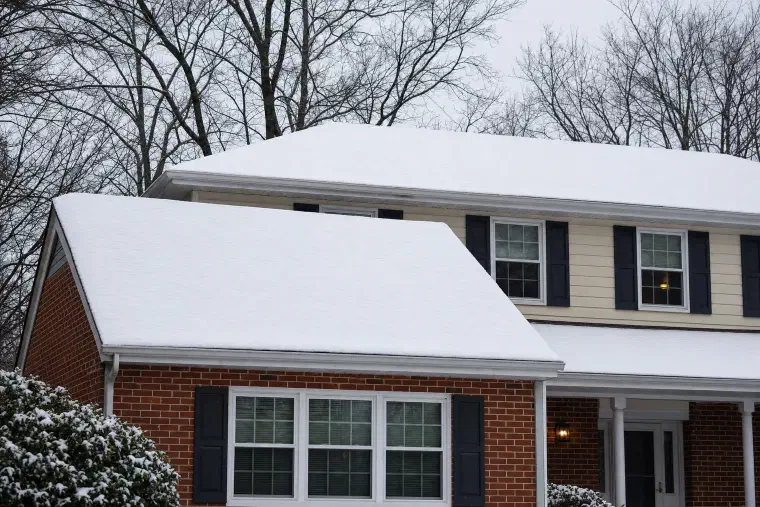
Usually no. Most roofs are built to carry a normal winter’s snow, so a few inches or even a foot can stay where it is. Raking from the ground makes sense when the snow is deep and packed, or when the roof shows signs of strain.
The short version
- Most roofs are designed to handle the snow of a typical winter, so a light covering needs no help.
- Deep, packed snow, or a roof that sags or creaks, is the time to act.
- If you rake, do it from the ground with a roof rake, and leave a thin layer on the shingles.
- Do not climb up or lean a ladder on snow and ice.
- Sagging, cracked wood or doors that stick mean get out and have the house checked.
Do you need to clear snow off your roof?
No, not for most storms. North Dakota State University Extension says most roofs are designed to handle the snow load (opens in a new tab) of a typical winter, and that one roof failing does not mean every roof nearby is in danger.
Snow load is the weight of the snow, counted in pounds per square foot. The Insurance Institute for Business and Home Safety estimates the typical roof can handle 20 pounds per square foot (opens in a new tab) of extra weight, as relayed by Maine’s emergency agency. An older roof or one with past problems may carry less.
When is there too much snow on a roof?
When it is deep, packed and heavy. NDSU says that if the roof has more than a couple of feet of compacted snow (opens in a new tab), the load may be too much. It also suggests watching for deep drifts built up by nearby buildings or trees.
Flat and low-pitched roofs deserve a closer look. Maine’s agency says they are the ones at the greatest risk (opens in a new tab) of buckling under heavy snow and ice.
Here is a rough guide:
| What you see | What to do |
|---|---|
| A few inches of fresh snow | Leave it. It will melt or slide off |
| Several inches that is turning to ice at the eave | Rake the bottom few feet from the ground |
| Two feet or more, packed down | Rake carefully, or hire a pro |
| Sagging, cracks or sticking doors | Leave the house and get it checked |
What are the warning signs of an overloaded roof?
Look for sagging roof sections, severe leaks, cracked wood members, and doors that pop open or become hard to open. Maine’s agency says if you see these, evacuate the building immediately (opens in a new tab) and get it inspected.
Don’t take that as a reason to panic over every creak. Houses make noise in the cold. It is the combination, a lot of snow plus a visible change, that matters.
How do you remove snow from a roof safely?
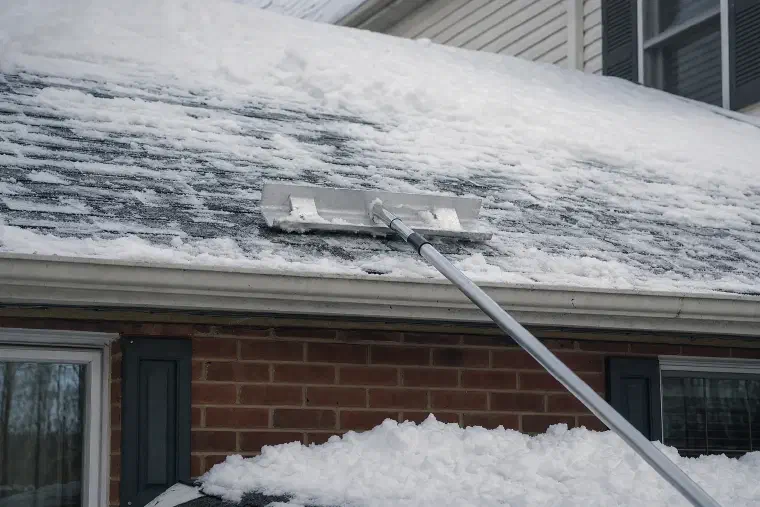
Use a roof rake from the ground. NDSU recommends a rake that lets you remove snow while standing on the ground (opens in a new tab), and says some have rollers that keep the head slightly above the shingles.
Start at the edge and work up in small sections. Maine’s agency advises that any snow you pull down can come down on you (opens in a new tab), so stand well back and rake small amounts at a time. Leave a thin layer of snow on the shingles rather than scraping to bare roof, because scraping can damage the roofing material.
Two more cautions:
- Power lines. An aluminum rake conducts electricity. Check where the lines reach the house and keep well away from that spot.
- Ladders. Maine’s guidance is blunt: say no to climbing (opens in a new tab) on ladders, because snow and ice build up on the rungs and on your boots.
Can raking snow damage your roof?
Yes. The University of Minnesota Extension says a roof rake or push broom can remove snow, but may damage the roofing materials (opens in a new tab). It also warns that anyone working on the roof in winter risks injury (opens in a new tab) and may harm the roof and house.
That is why a light hand matters. The annoying part is that a scrape you can’t see from the ground can turn into a leak later. If you do rake, look the roof over from the ground once the snow is gone.
Does clearing snow help with ice dams?
It can. The University of Minnesota says removing snow eliminates one of the ingredients (opens in a new tab) needed for an ice dam to form. That is a good reason to rake the bottom few feet after a heavy storm, since that is where the ridge builds.
It does not fix the cause, though. Heat leaking into the attic is what melts the snow from underneath. If you already have a ridge of ice, our guide on how to remove an ice dam covers what to do and what to skip, and how to prevent ice dams covers the attic side.
When should you hire someone?
When you aren’t sure you can do it from the ground. NDSU puts it plainly: people who are not agile and comfortable (opens in a new tab) working on a roof should hire someone to remove the snow. Maine’s agency calls the combination of height and ice one of the more dangerous household chores.
A steep roof, a second story, a roof covered in ice or a pile near power lines are all good reasons to skip the DIY. A flat roof with a lot of snow on it is another.
Common questions
Should I remove snow from my roof every time it snows?
No. A few inches does no harm, and raking too often risks scuffing the shingles for no gain. Save it for deep, packed snow or a heavy pile at the eave.
Is it better to let snow melt on its own?
For a light covering, yes. Melting snow is a problem only when it refreezes at the eave and forms a dam. If that is happening, take the bottom few feet off from the ground.
Can I use a ladder to reach the snow?
We wouldn’t. Ladders slide on frozen ground, and ice builds up on the rungs. A roof rake from the ground, or a pro with the right gear, is the safer choice.
What to do next
If a storm has left your roof sagging, leaking or worrying you, have it looked at. Our free roof inspection checks the roof surface, flashing, gutters and attic when we can get in. And if snow has already done damage, our roof repair work starts with finding where the water is getting in.


