

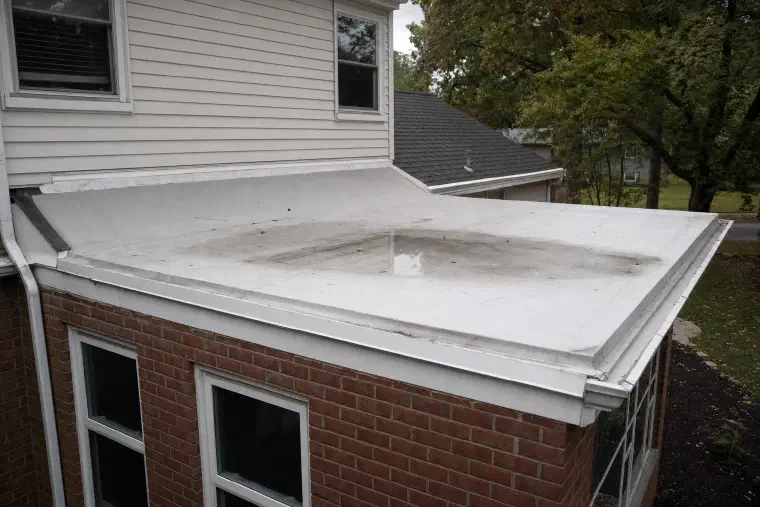
For most houses, the better flat roof is the one that fits the roof and the installer who will put it on, but the two do differ. TPO is a white membrane with heat-welded seams. EPDM is a black rubber sheet with glued or taped seams, and it is the tougher of the two against scuffs.
The short version
- TPO is white and reflects summer sun. EPDM is black unless you pay for a white or coated version.
- TPO seams are welded with hot air. EPDM seams are glued or taped.
- EPDM is rubber and takes foot traffic and scuffs well. TPO is stiffer and leans on its welds.
- Either one can last for decades, but the seams and edges decide it.
- Pick by what sits on the roof, how often someone walks it, and how it drains.
What is the difference between TPO and EPDM?
TPO and EPDM are both single-ply membranes, which means one large factory-made sheet rolled over the roof. The Department of Energy describes single-ply membranes as prefabricated sheets (opens in a new tab) attached with fasteners, glue, or ballast, which is gravel, stones or pavers holding the sheet down.
The real difference is the material. TPO stands for thermoplastic polyolefin, a plastic-based sheet that softens with heat. EPDM stands for ethylene propylene diene M-class, which is a synthetic rubber. That one fact explains most of what follows, because plastic can be melted together and rubber cannot.
How are the seams different?
TPO seams are welded and EPDM seams are glued or taped. The Insurance Institute for Business & Home Safety says thermoplastic membranes have seams formed by heat or chemical welding, and that these seams are as strong as or stronger (opens in a new tab) than the membrane itself. A good weld turns two sheets into one.
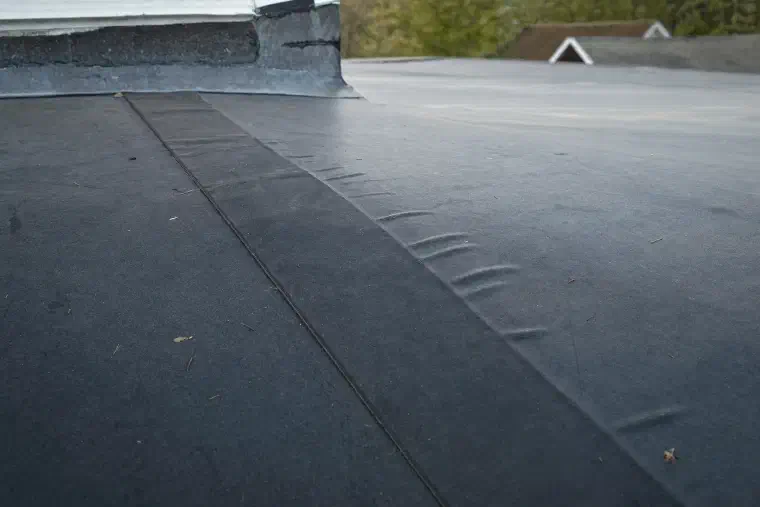
EPDM comes in wide sheets, so a small roof may have few seams or none. This Old House says its seams can be sealed with adhesive or tape, but they rely on adhesives that may degrade (opens in a new tab) over time if not maintained. Fewer seams is a real advantage, and a glued seam that gets checked is fine. A glued seam nobody ever looks at is where we would start hunting for a leak.
Either way, the seam is the weak spot. The Department of Energy points out that manufacturer warranties of up to 30 years usually do not cover the seams (opens in a new tab), where early failure tends to happen. Read what a warranty leaves out before you read its number.
Which one handles heat better?
TPO handles summer sun better because it is white. The Department of Energy says TPO and PVC membranes are usually white and reflective (opens in a new tab) with no extra coating, while EPDM is black but can also be made white or coated to reflect.
A black roof soaks up heat. This Old House lists that as the main drawback, saying black membranes absorb heat (opens in a new tab) and may raise cooling costs. Over a garage you will never feel it. Over a bedroom addition in July, you might.
One thing to keep in mind with glued EPDM: the Department of Energy notes that membranes attached with adhesives must reach a minimum temperature (opens in a new tab) to bond. That is one more reason a cold-weather flat roof job needs a crew that watches the thermometer.
Which one is tougher?
EPDM is tougher against scuffs and tears. This Old House calls it highly resistant to scuffs, tears, and punctures (opens in a new tab), though it adds that sharp tools or debris can still puncture it if the roof is walked on often. Rubber gives a little under a boot. A hard sheet shows the footsteps.
That matters more than people expect. We see roofs wear out from the traffic: the satellite installer, the HVAC tech, the gutter cleaner. Every one of them is a chance for a scuff or a puncture, whichever membrane is under their feet. If someone will be up there often, say so before you choose.
How long does each one last?
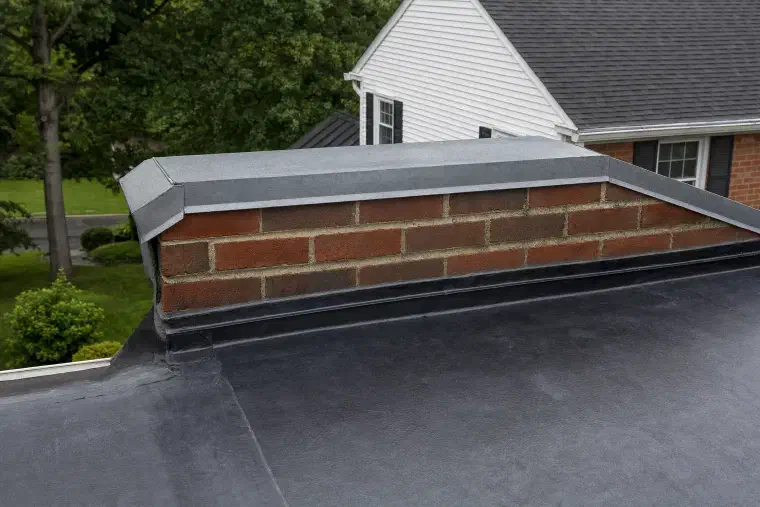
EPDM has a published number and TPO, in the sources we can cite, does not. This Old House says EPDM roofs often have the longest lifespan at up to 50 years (opens in a new tab), and in the same guide it gives 20 to 30 years or more with maintenance as the advantage. Both numbers say the same thing: it depends who put it on.
We would not pick a roof on a lifespan chart. Water gets into a flat roof at seams, edges and anything that pokes through, such as pipes, vents and skylights. The flat sheet in the middle is rarely the problem.
How do TPO and EPDM compare side by side?
Here is the short comparison, using the sources above.
| TPO | EPDM | |
|---|---|---|
| Material | Plastic-based sheet | Synthetic rubber |
| Usual color | White | Black, or white and coated by order |
| Seams | Heat-welded | Glued or taped |
| Heat | Reflects sunlight | Black absorbs heat |
| Scuffs and punctures | Depends on the weld and the sheet | Highly resistant, but not puncture-proof |
| Cold-weather install | Welds with hot air | Glue needs a minimum temperature |
For cost, This Old House lists EPDM at $9 to $13 per square foot (opens in a new tab) in its guide. Our own work gives a different kind of number: a low-slope section that cannot take shingles is often subcontracted at a minimum of $2,500 to $5,000, and a low-slope membrane repair typically runs $2,500 to $6,000 in our area. Those are typical ranges, not a quote.
Which should you choose for your roof?
Choose TPO when heat matters and the roof will be left alone. Choose EPDM when the roof gets walked on, or when a large sheet with few seams suits the shape. On a small porch or addition either can be the right answer, which is why we look at the roof first.
Also check the slope. The building code asks single-ply membranes for a design slope of not less than 1/4:12 (opens in a new tab), a gentle fall of a quarter inch for every 12 inches. A flat roof is never perfectly level, because water needs somewhere to go. Standing water wears out any membrane fastest. Our article on what a TPO roof is goes deeper on the white side, and the one on the best material for a flat roof adds modified bitumen and metal.
Common questions
Is EPDM the same as rubber roofing?
Yes. EPDM is a synthetic rubber, so people often call it a rubber roof. It is usually black.
Can a leaking TPO or EPDM roof be repaired?
Often, yes. If the sheet is sound and the trouble is one seam or edge, a repair can keep the roof going for years. If it has leaked in several places, we will tell you so. Our flat roof repair page covers where flat roofs fail.
Does a white roof save money?
It can, over rooms you cool in summer. A white roof sends more sunlight back, so less heat reaches the space underneath. How much you save depends on the rooms below and how often you run the air conditioning, so over a garage it will not matter much.
What to do next
If you are choosing between the two, the best first step is to have someone walk the roof and look at the slope, the drains and the edges. Our free roof inspection includes a walk on the roof and a written report with photos. When it is time for a new one, our flat roof installation page explains what we put on and where.


