

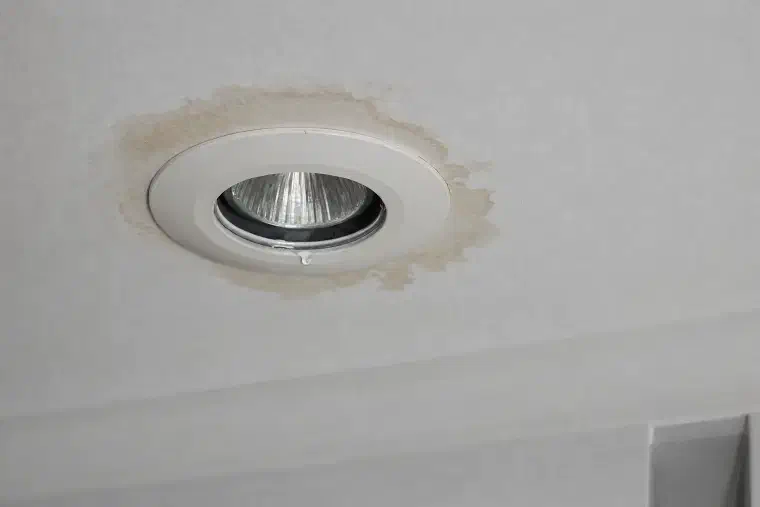
Water leaking from a ceiling light is an electrical emergency first and a roof problem second. Turn the power to that room off at the breaker, keep people away from the fixture, and don’t touch it while it’s wet. Once the power is off, you can work out where the water is coming from.
The short version
- Switch the power off at the breaker box, not just the wall switch.
- If you’d have to stand in water to reach the panel, call an electrician instead.
- Leave the power off until an electrician has checked the wiring and fixture.
- The water usually comes from the roof, a pipe above, or damp air from inside the house.
- Fix the source before you fix the ceiling.
What should you do first when water drips from a ceiling light?
Turn off the power to that room at the breaker box, then keep everyone out from under the fixture. A wall switch only stops the light. The wires above it can still be live, and water and live wires are a bad mix.
The Federal Emergency Management Agency says to never turn power off at the breaker box (opens in a new tab) if you have to stand in water to do so, and to call an electrician. So if the floor under the panel is wet, or the panel is in a flooded basement, stop there and call.
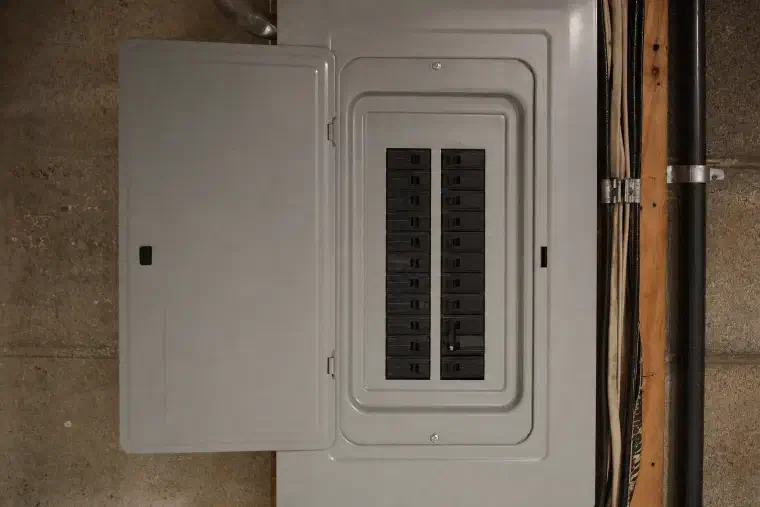
If it’s safe, set a bucket under the drip and move furniture out of the way. Don’t unscrew the fixture or poke at it. A bulb full of water, or a trim ring that’s soaked through, is not a job for a ladder and a screwdriver.
Is water coming out of a light fixture dangerous?
Yes. Water gets into the box above the fixture and can touch the wires inside, which is a shock and fire risk. A ceiling can also fill up with water and then let go all at once, and a light fixture is often the lowest point in the way out.
FEMA says to leave the electricity off (opens in a new tab) until a licensed electrician has inspected and repaired the wiring or equipment. That applies even after the water stops and the ceiling looks dry. A fixture that was wet is a fixture to have checked.
Why does a ceiling light leak at all?
Water follows the easiest path down, and a light is a hole in the ceiling. Whatever is above it, the water finds the opening and comes through. The usual sources, roughly in order of how often we see them, are in this table.
| What you notice | Likely source | Whose job |
|---|---|---|
| Drips during or right after rain | A roof leak, often at flashing or a pipe boot | Roofer |
| Drips in cold weather with no rain | Warm, damp air turning to water in the attic | Roofer, plus air sealing |
| Drips under a bathroom or kitchen | A pipe, a drain or a fan duct | Plumber or fan duct fix |
| Drips on a hot day, no rain | An air conditioner drain that has backed up | Heating and cooling company |
| Water around a chimney or wall | Flashing at the joint | Roofer |
The roof is the most common source, and the one that gets missed, because water can run along a rafter for several feet before it drops. The light isn’t under the leak. It’s just where the water ended up.
Can a roof leak make water come out of a recessed light?
Yes. Water that gets past the shingles soaks the roof boards and insulation, then follows wood or wiring down to the lowest opening. A recessed light, often called a can light, is a metal cylinder set into the ceiling, and it’s an easy exit for that water.
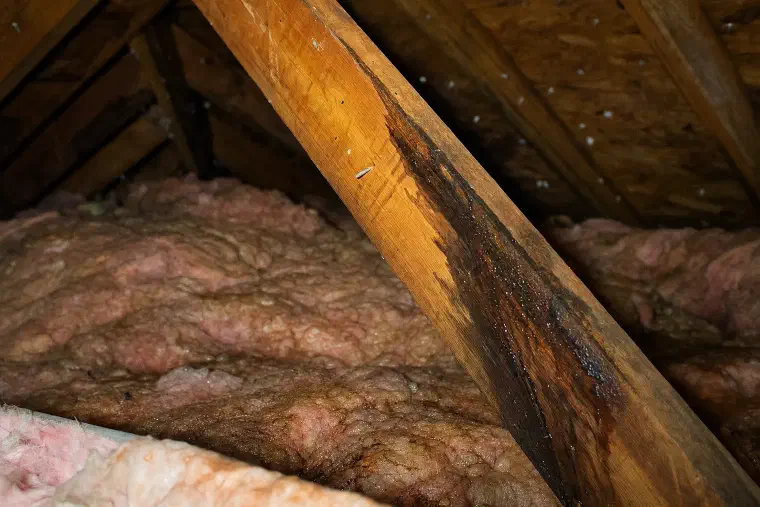
We see the same pattern over and over: a ceiling stain is the last stage of a leak, not the first. Water has usually been getting in for a long time, wetting the roof boards and insulation, before anything shows inside. And a roof that only leaks in hard, wind-driven rain often has a flashing problem, which is a bigger deal than it sounds.
If the leak is the roof, the fix is a roof repair. Finding the exact entry point is its own job, typically $150 to $400, and it isn’t part of our free inspection. A single leak diagnosis and repair typically runs $500 to $1,600.
Can a ceiling light leak when the roof is fine?
It can, and the cause is often the light itself. Can lights leak air. Recessed can lights can be major sources of air leaks (opens in a new tab) in ceilings, according to Colorado State University Extension, and the same page says air leakage is a leading cause of moisture damage in otherwise well-insulated homes.
Here is how that turns into a drip. Warm, damp air from the house slips up through the can and meets cold roof boards or cold insulation in winter. It turns to frost, then melts on a warm day and runs back down the easiest way, which is often right out through the fixture. We see warm, humid air leaking up through can lights, bath fans and the attic hatch all the time, and a ring around a light with no rain in the forecast is the tell.
Our guide to ceiling water spots with no roof leak walks through how to tell that kind of stain from a real leak.
Do you need to check the attic?
Yes, if you can get up there safely, and not while the power is still on near wet wiring. A look above the light tells you more than anything on the ceiling. You’re looking for a dark water track on the wood, wet or flattened insulation, frost on the underside of the roof boards in winter, and a duct or pipe that’s dripping.
The U.S. Department of Energy says to turn off electricity (opens in a new tab) before assessing damage and starting repairs. It also says wet insulation must be removed for the ceiling to dry properly.
One more thing about can lights. Some are not rated to sit under insulation, and they need clear space around them so they don’t overheat. The Department of Energy’s job aid calls for 3 inches of clearance (opens in a new tab) between the lamp and the insulation on all sides. So don’t just stuff wet insulation back around a fixture. Have the electrician tell you what that light needs.
How do you stop the leak for now?
If it’s raining and the roof is the source, a tarp is the short-term answer. Emergency tarping typically costs $350 to $900, and you should ask whether it’s credited toward the repair. Our guide to tarping a leaking roof explains what a tarp does and why it isn’t a fix.
For a leak that needs help tonight, our emergency roof repair page covers how it works. The phone is answered 24/7. Keep in mind that nobody can promise one visit stops a leak. Diagnosis is probabilistic, and a second trip is sometimes needed.
What to do next
Power off, bucket under the drip, and an electrician for the fixture. Then get the roof looked at. Our free roof inspection includes the attic when it’s safe to get in, and it often points straight at the source.
We fix the roof. Drywall, paint and insulation inside the house are never part of a roof job, and neither is electrical work.
Common questions
Can I turn the light switch off and leave it?
No. A switch only breaks the circuit to the bulb, and the wires above can still carry power. Use the breaker, and leave it off until an electrician says it’s fine.
Is it safe to change the bulb in a leaking light?
No. Wet sockets and trim rings are a shock risk even with the switch off. Leave the bulb alone until the power is off at the breaker and the fixture has been checked.
Why does the light only leak when it rains hard?
Heavy, wind-driven rain pushes water behind flashing or under shingles that stay dry in a gentle rain. That points to the roof, and it isn’t a minor sign. Have it looked at soon.
Will the ceiling dry out on its own?
Sometimes, if the source is fixed and the area is aired out. Sagging, bulging or soft drywall is a different story, and wet insulation above it has to come out. Stay out from under a bulge.


