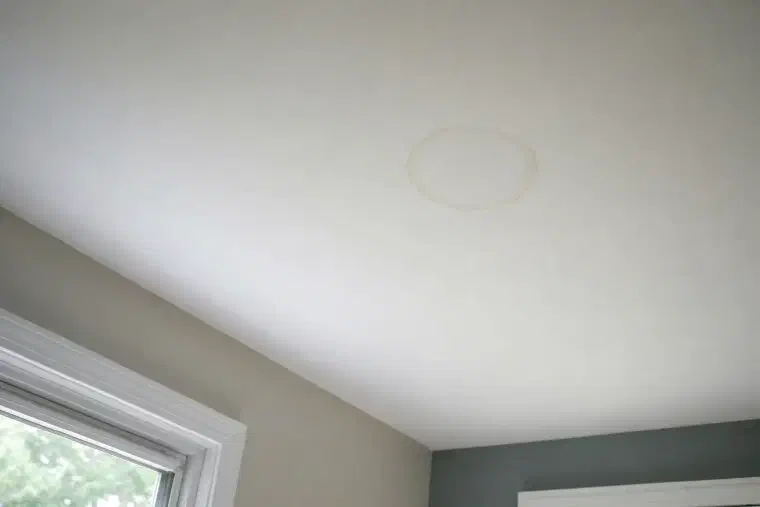
A ceiling can show water spots without a roof leak because water also comes from inside the house. The usual causes are warm, damp air condensing in the attic, a bath fan duct that drips, or a stain left by water that dried long ago. A roof leak is still possible, so check before you rule it out.
The short version
- Moisture from your own house can stain a ceiling when it turns to water in a cold attic.
- Winter is the clue. Condensation spots tend to show up in cold weather, not only after rain.
- A bath fan duct that sags or isn’t insulated is a common culprit.
- An old stain can sit dry for years. A new, spreading one means something is still wet.
- The attic tells you more than the ceiling does.
Why would a ceiling stain if the roof isn’t leaking?
A ceiling stains when water soaks into the drywall, and that water doesn’t have to come from the roof. It can come from damp indoor air that turns to liquid on a cold surface above the ceiling. In our repair work, the usual look-alikes are attic condensation, air conditioner condensation, siding or window leaks, and ice dams.
The EPA says condensation (opens in a new tab) can be a sign of high humidity. Your house makes a lot of water vapor just by being lived in, and the vapor goes looking for somewhere cold. The attic is the coldest place with a lid on it.
Can attic condensation cause water spots on a ceiling?
Yes. Warm, damp air leaks from the house into the attic, lands on cold roof boards and freezes into frost, then melts and drips onto the insulation below. The Department of Energy’s building science lab says that when warm moist air from the house (opens in a new tab) escapes into the attic, condensation often occurs as frost in cold conditions. The same page says that when the weather warms, the moisture returns to a liquid state.
Asphalt Roofing Manufacturers Association says typical home activities generate moisture vapor (opens in a new tab) that migrates to the attic. Cooking, showers and laundry all count. Enough of it, over enough winters, soaks the insulation, and the damp spreads to the ceiling below.
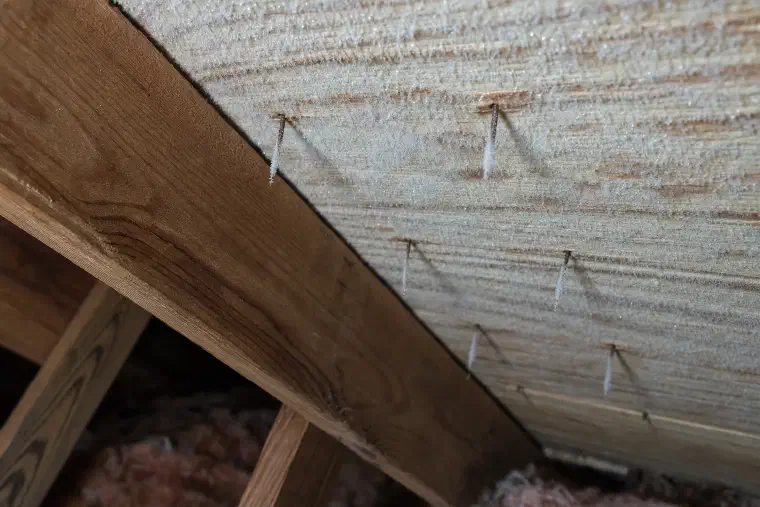
We see this a lot. Warm, humid air slips through can lights, plumbing chases, bath fan openings and the attic hatch, condenses on the cold underside of the roof boards in winter, and the boards soak and dry through dozens of cycles. It can ruin a roof deck without a drop of rain coming in from above. If you can safely get a look on a freezing morning, frost on the underside of the roof boards is the tell. Winter is the best time to inspect an attic.
Can a bath fan duct stain the ceiling?
It can. Moist air travels through the fan duct, meets the cold of the attic and condenses inside it. If the duct sags or runs uphill, the water has nowhere to go but back toward the fan, and the stain shows up on the ceiling under the bathroom or just beside it.
The building science lab recommends you insulate the duct (opens in a new tab) to minimize condensation, and slope it down and away from the fan so any condensation is directed away from it. It also says to vent the fan outdoors, not into the attic.
A duct that ends in the attic is worse. It dumps warm, wet air under the roof all winter, and that is how a ceiling stain turns into mold in the attic. A dryer vent that ends there is the same story, with more water.
What else stains a ceiling when nothing is dripping?
Several things do, and they look alike from below. This table sorts them by what you would notice.
| What you see | Likely cause | Where to look |
|---|---|---|
| A stain that grows in cold weather, with no link to rain | Attic condensation | Frost or damp insulation in the attic |
| A stain under or beside a bathroom | A bath fan duct that drips | The duct: sag, gaps, no insulation |
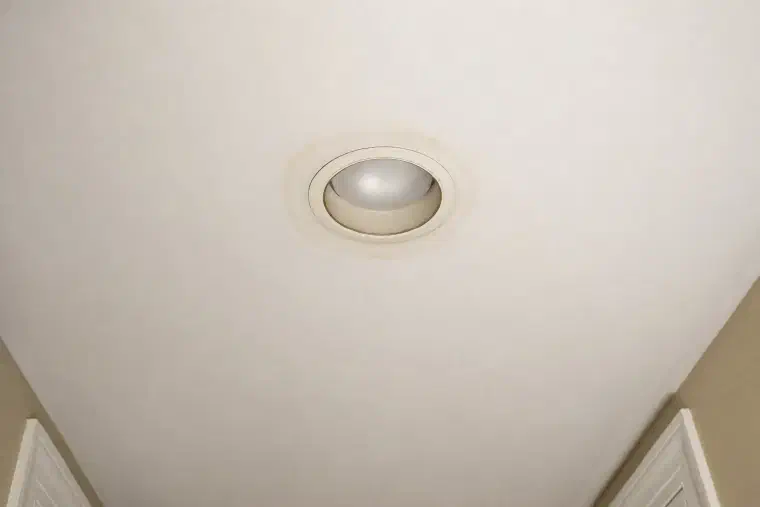
| A ring around a recessed light or the hatch | Warm air leaking up through the gap | The attic side of the ceiling |
| A stain that appears after rain, and after hard, wind-driven rain in particular | A flashing leak | Chimney, walls and vent pipes on the roof |
| A stain that never changes | Water from long ago, now dry | Check the attic once to confirm |
Air conditioner condensation can do it too. A blocked drain line makes the water back up and overflow. That is a heating and cooling job, not a roof job, which is why misdiagnosis gets expensive: people pay for several roof repairs on a roof that was never leaking.
How can you tell a condensation stain from a roof leak?
Look at the timing first. A condensation stain tends to track cold weather and indoor humidity, while a roof leak tends to follow rain. Neither rule is perfect, so use them as a first guess and not a verdict.
One point from our repair work matters here: a roof that only leaks in hard rain often has a flashing problem that depends on wind direction, which is not a minor one. So if your spots show up with storms, treat it as a roof question. If they show up on cold, dry mornings, look at the attic and the fans first.
One thing to keep in mind: finding the exact spot where a roof leak gets in is a separate paid job, typically $150 to $400, and a free roof inspection doesn’t include it. The inspection does look at the attic when it’s safe to get in, which is often enough to point you the right way.
Is a dry water spot still a problem?
A dry spot with no change over a year or two is usually old news, but you can’t tell that from the floor. A stain is often the last stage of a problem, not the first. Water can damage roof boards and insulation for a long time before it ever shows on a ceiling, and no stain doesn’t prove there’s no leak.
The EPA says to dry water-damaged areas within 24 to 48 hours (opens in a new tab) to prevent mold growth. A new spot that is soft, damp, growing or coming back is the one to act on. For what to do with the stain itself, see our guide to getting rid of ceiling water stains, and note that fixing the source comes first. Paint over a wet spot only hides it.
If the spots only appear when the rain has stopped, our piece on why a roof leaks after the rain stops explains how that happens.
What to do next
Start in the attic. Look for frost or damp insulation, a loose duct, a hatch that doesn’t seal and gaps around lights. Then ask whether the spots follow rain or follow cold. Our free roof inspection includes a look at the attic when it’s safe, and if the cause is the roof’s airflow, our attic venting repairs page covers what we fix.
Keep in mind that we fix the roof and the venting. Drywall, paint and insulation inside the house are never part of a roof job. A bath fan duct is worth correcting even if the roof is fine.
Common questions
Can humidity alone stain a ceiling?
Humidity alone rarely leaves a spot, but humidity plus a cold surface can. Damp air that touches a cold ceiling or cold roof boards turns to water, and that water is what stains. Keeping the bath fan running and the vents clear helps.
Why is there a water spot on my ceiling but the attic looks dry?
The water may have dried before you looked, or it may be coming from a duct or pipe you can’t see from the hatch. Condensation comes and goes with the weather, so one dry visit proves little. Check again on a cold morning.
Should I worry about a brown ring that hasn’t changed?
Probably not about the ring itself, but have the attic checked once anyway. A stain that stays the same size and stays dry is likely old, and an inspection can confirm nothing is still wet above it.
Will painting over the spot make it go away?
It will cover it for a while. If the cause is still active, the spot comes back through the paint. Fix the source, let it dry, then paint.