

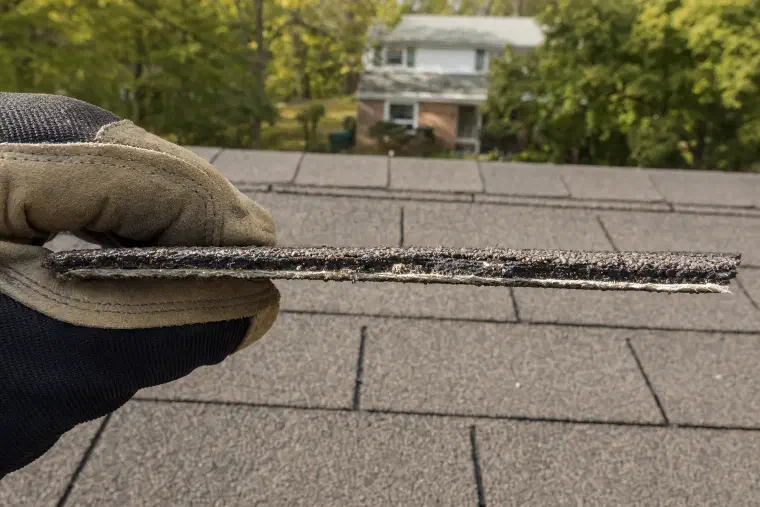
Asphalt shingles are made of three main things: a glass fiber mat for strength, asphalt to keep water out, and a top coat of crushed rock granules that gives them color and shades the asphalt from the sun. Each layer does one job, and the roof only lasts as long as all three keep doing it.
The short version
- The core is a mat of glass fibers, and it holds the shingle together.
- The asphalt on both sides sheds water and glues the granules in place.
- The gritty top is crushed rock, and it gives shingles their color and sun protection.
- Most shingles use a glass mat. Older ones used a paper-like mat.
- Loose granules in the gutter are the usual sign a shingle is aging.
What is the inside of an asphalt shingle?
The inside of an asphalt shingle is a glass fiber mat, which the Asphalt Roofing Manufacturers Association calls the backbone of the shingle (opens in a new tab). It is not what stops water, though.
The mat gives the shingle its strength, so it does not tear while it is made, carried up a ladder or nailed down. Everything else gets built on top of it. Pull a shingle apart and the mat is the pale layer in the middle.
What is the black, sticky part?
The black part is asphalt, and its job is to shed water and hold the granules in place. The same association says asphalt serves as a water-shedding agent (opens in a new tab), and it also holds the granules on the surface.
The mat gets coated with asphalt on both sides. Finely ground rock is mixed into the asphalt too, which the association says helps it resist fire (opens in a new tab). The EPA adds that the asphalt in shingles is considerably harder (opens in a new tab) than the asphalt used on roads.
What are the gritty bits on top?
The gritty bits are granules: crushed rock with a ceramic coating, pressed into the asphalt on the face of the shingle. They do two jobs. They give the shingle its color, and they protect the asphalt from UV light (opens in a new tab) that would otherwise break it down.
Think of them as the sunscreen. Without them the sun reaches the asphalt directly, which is exactly what the granules are there to stop.
What happens when the granules wear off?
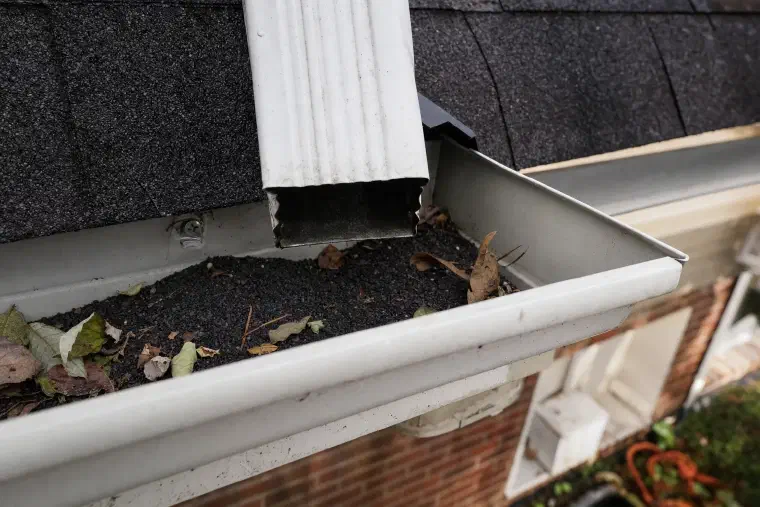
When the granules wear off, the asphalt underneath is out in the sun, and the shingle starts to age faster. Loose granules in your gutter or at the bottom of a downspout are the clue. A steady pile on an older roof is worth a look.
We see this most on roofs under heavy tree cover, where branches sweep the surface and strip the granules off. Foot traffic does it too. Every satellite installer or gutter cleaner who walks across the shingles scuffs a little more away.
Bald patches, bare dark asphalt and a mat showing through are signs the shingle is near the end. We cover how long that takes in a 30 year shingle’s real lifespan.
Fiberglass or paper: does the mat matter?
Yes, but you likely have a glass mat. The US Forest Service describes two kinds of shingle: organic ones with a cellulose mat (opens in a new tab) (paper-based) and fiberglass ones with a glass mat. Both are soaked in asphalt and covered in granules. When the EPA looked at the market, it found 82 percent of residential shingles (opens in a new tab) were fiberglass and that the share was growing.
The two behave a little differently:
| Glass fiber mat | Paper-based mat | |
|---|---|---|
| Fire rating | Better (opens in a new tab) | Lower |
| Cold weather | Stiffer | More flexible (opens in a new tab) |
| Typical life | 15 to 25 years (opens in a new tab), shorter in cold climates | 10 to 15 years (opens in a new tab) for a three-tab type |
The life figures come from the Forest Service’s own cost table, so treat them as a rough guide. On a roof in Maryland we tell homeowners that asphalt shingles realistically last 18 to 25 years.
What else is in a shingle?
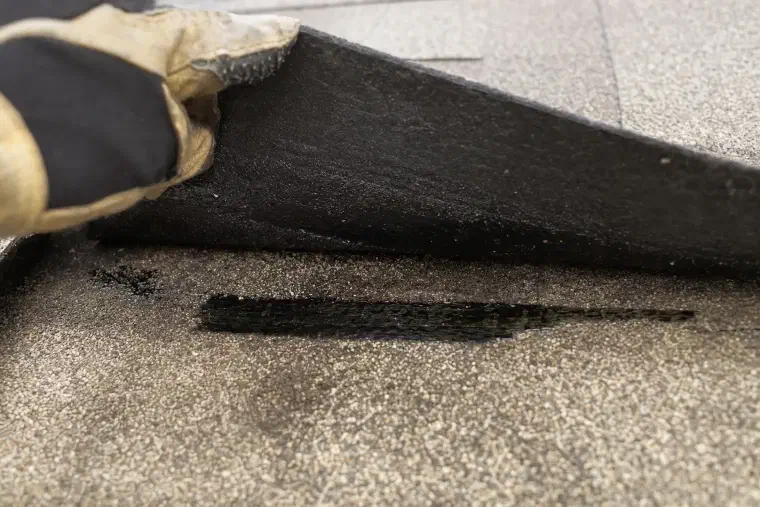
Each shingle also has a strip of sealant on its underside that bonds it to the row below. It needs warmth to set: shingles need more than 40°F to seal, which is one reason we do not tear off a roof with cold or rain in the forecast.
Rock, asphalt and glass add up to a heavy pile when a roof comes off. The EPA says the US makes and throws away an estimated 11 million tons of shingles a year (opens in a new tab).
Does the brand of shingle matter more than what is in it?
Not much. Every major shingle is built from the same three layers, and the real difference between a roof that lasts and one that does not is how it goes on. The same shingle can last 25 years or 9, depending on where the nail went. The installer is the deciding factor.
Nails placed too high miss the shingle below, so the sealant strip alone holds the shingle down until a gust peels it. Poor attic ventilation cooks the shingles from underneath, and that can cut a roof’s life nearly in half.
Common questions
Do asphalt shingles contain asphalt?
Yes, but asphalt is only part of it. In shingles it is a coating over a glass fiber mat, with crushed rock pressed into the top. The EPA says that depending on the type of mat, asphalt cement makes up 19 to 36 percent (opens in a new tab) of a shingle by weight.
Do shingles still have real fiberglass in them?
Yes. The glass fibers are in the mat inside, which is why most shingles are called fiberglass shingles. You never touch the glass, because it is sealed in asphalt on both sides.
Are the granules only for color?
No. Color is a side effect. Their main job is to block the sun from reaching the asphalt, and that is why losing them matters.
Can I tell what my shingles are made of from the ground?
Mostly no. You can see the color and the shape, and that is about it. The mat and the nailing are hidden. A roofer on the roof can lift a tab and check both.
What to do next
If you are seeing granules in the gutter, bare patches or curling edges, we will walk your roof for free and tell you what we see in a written report with photos, with no obligation to book work. Start with a free roof inspection. If it turns out you need a new roof, we can talk through roof installation, which uses standard architectural shingles, after that.


