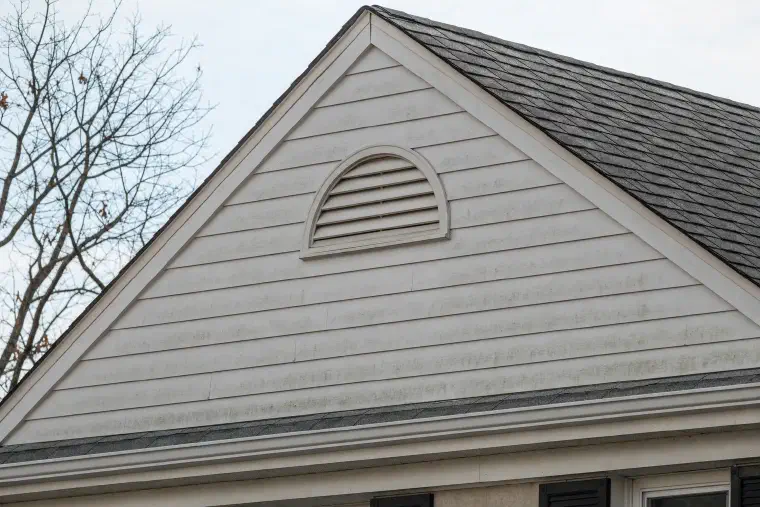
Gable vents are louvered openings high in the end wall of a house, just under the peak of the roof. They let air move through the attic from one end to the other. On their own they can work fine. Next to a ridge vent, they often get in its way.
The short version
- A gable vent is an opening in the triangle of wall at the end of a gable roof. Wind pushes air in one side and out the other.
- They work in a pair, one at each end of the attic.
- Add a ridge vent and the two can pull air from each other, leaving the middle of the attic still and hot.
- If you have both, the fix is usually to close off the gable vents, not to add more vents.
- We can check which setup your attic has during a free roof inspection.
What do gable vents do?
A gable vent lets air pass through the attic without a fan. Air goes in one vent and out the one at the other end. This Old House says gable vents must work in sets of at least two (opens in a new tab), so that warm, damp air can leave one while cooler air comes in the other.
That only works while the path between them stays clear. Insulation, boxes and framing in the way can stop the flow. It also depends on wind. A calm day moves very little air through a gable vent.
What do gable vents look like?
They are rectangles, triangles or half circles with slats, set in the siding or brick of the end wall. Most are painted to match the house, and some have a screen behind the slats to keep out birds and wasps.
You will find them on a gable roof, the kind with two sloped sides that meet at a peak and a flat triangle of wall at each end. A hip roof, which slopes on all four sides, has no triangle to put one in. That is why hip roofs lean on other kinds of vents, and we compare them in the different types of roof vents.
Can you have gable vents and a ridge vent?
You can, but they work against each other. The Pacific Northwest National Laboratory’s building guide says gable vents next to a ridge vent are likely to short-circuit attic airflow (opens in a new tab). Short-circuit means the air takes the easy route: in the gable vent and straight out the ridge vent. The air along the low edges and the middle of the attic barely moves.
The same guide says a gable vent in an attic with a ridge vent can render soffit venting ineffective (opens in a new tab). The soffit vents are the ones under the roof edge that are meant to feed the whole system. This Old House puts it more bluntly: ridge and gable vents don’t work well together (opens in a new tab).
We see this setup a lot: a ridge vent, gable vents and sometimes box vents on one attic. It is one of the most common reasons an attic is still hot after someone paid to fix the ventilation.
Why is mixing vents a problem?
Every exhaust vent pulls air from the nearest opening. The Asphalt Roofing Manufacturers Association says mixing different exhaust vents above one attic should be avoided, because an exhaust vent can pull air from another exhaust vent (opens in a new tab) instead of from the intake vents.
It can also let weather in. The association warns that gable end vents with a ridge vent and too little soffit intake can pull moisture into the home (opens in a new tab) during heavy rain or snow.
| Setup | How it goes |
|---|---|
| Gable vents only | Works with wind. Little help on calm days. |
| Soffit vents and a ridge vent | Air enters low and leaves at the peak. The usual choice for a shingle roof. |
| Gable vents plus a ridge vent | Air can skip the soffits. The middle of the attic stays still. |
| Gable vents, ridge vent and box vents | Three exhausts competing, and usually the worst airflow. |
What should you do with gable vents when you have a ridge vent?
Close them off from the inside. This Old House advises that anyone putting in a ridge vent should block their gable vents (opens in a new tab) to get the most from the new system. That is a quick job for a piece of rigid board and sealant behind the louvers, and the outside of the house looks the same.
Do that only if the soffit vents are open. A ridge vent with blocked soffits has nothing to pull from. Energy Star says to never cover soffit vents (opens in a new tab) with insulation, and to use rafter vents, also called baffles, to keep the air path open. Our piece on what attic baffles are shows what that looks like.
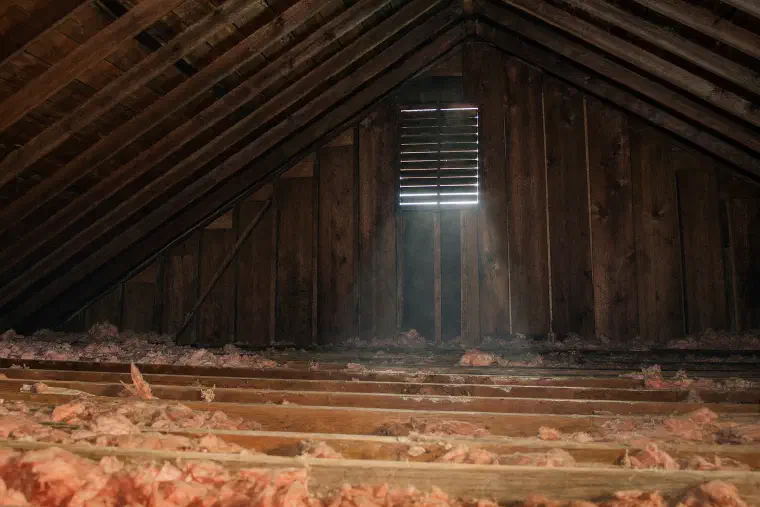
How much vent area does an attic need?
The Asphalt Roofing Manufacturers Association gives a minimum of 1 square foot for every 300 square feet (opens in a new tab) of attic space, and calls 1 for every 150 the preferred ratio. That counts the open area of the vent, not the size of the box. We walk through the math in how to calculate attic ventilation.
Keep in mind that the area gets split between intake and exhaust. The association says a balanced system has intake at the eaves matched (opens in a new tab) at or near the ridge. A house can have plenty of vents and still fall short on intake.
Common questions
Do gable vents let rain in?
They can. Wind-driven rain can blow through the slats, and the PNNL guide notes that gable vents can let in wind-driven rain and wildfire embers (opens in a new tab). Stains on the attic floor under a gable vent are a sign.
Are gable vents bad?
No. On a house with no soffit vents and no ridge vent, they may be all the ventilation the attic has. They go wrong when another exhaust vent is added on top of them.
Can I add soffit vents later?
Often, yes. That is what we look at first when an attic runs hot, because intake is the part most roofs are missing. Whether it works depends on the roof edge and how the attic is built.
Do gable vents help with a hot attic?
A little, on a breezy day. They do not pull air along the low edges of the attic, so they leave the hottest spots near the roof boards alone.
What to do next
If you have gable vents and a ridge vent, or you are not sure what is up there, have the attic looked at. Our attic venting page explains what we check. The inspection is free, and you can read more about it on our roof inspection page.