

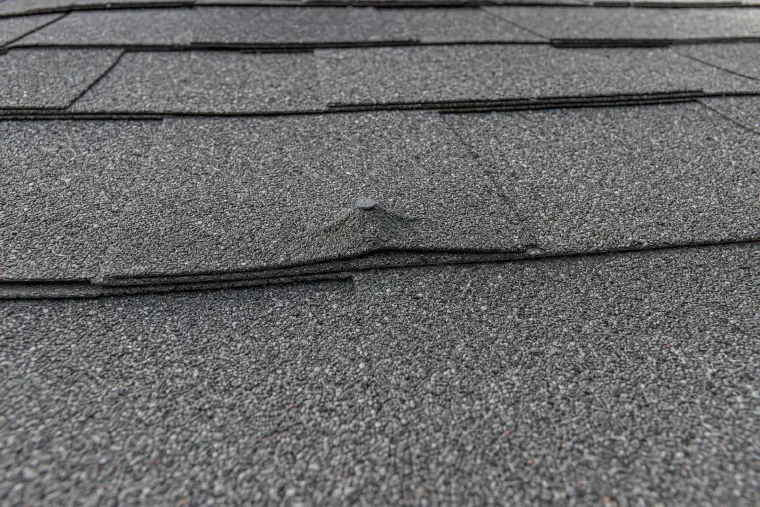
A nail pop is a roofing nail that has worked its way up out of the roof deck, so its head pushes against the shingle above it or sticks through it. One or two are a small fix. A roof covered in them is telling you something about how it was put on or how the attic behaves.
The short version
- A nail pop is a shingle nail that has backed out, or was never driven in flush.
- Nails that sit too high, or were set wrong, are the usual cause. Roof deck movement is the other.
- One pop is rarely a leak yet. It is a weak spot that can turn into one.
- The fix is to pull the nail and replace it, not to hammer it back in or smear tar on it.
- Many pops across a slope point to a bigger problem, such as a hot, damp attic.
What is a nail pop on a roof?
It is a nail head that no longer sits flat against the shingle. Instead of disappearing under the shingle course above, it lifts that shingle into a small bump, or pokes up bare through the surface.
You can often spot them from the ground in low sun, because each bump throws a tiny shadow. A bump the size of a dime, repeated in a line, is the classic look.
Why do nails pop up on a roof?
Most pops come from how the nail went in. The Asphalt Roofing Manufacturers Association says nails should not be underdriven, overdriven or driven crookedly (opens in a new tab), and that the whole head should bear tightly against the shingle. A nail left standing a little proud on day one is a nail pop waiting for a hot afternoon.
The second cause is the wood. The roof deck is a layer of plywood or similar boards under the shingles, and it swells a little when it is damp and shrinks when it dries. Over many cycles, a smooth nail can be eased upward. The third is the attic. The Asphalt Roofing Manufacturers Association says condensation in a poorly vented attic can cause the deck to swell (opens in a new tab), leading to waviness and buckling of the deck and the shingles. A deck that keeps swelling and drying is a deck that keeps pushing on its nails. Our attic venting page covers how air should move through the space.
What does a nail pop mean for your roof?
Most of the time it means one nail was set badly, and the shingle over it is a little weaker than its neighbors. Sometimes it means the nailing is wrong across the whole slope.
We treat improper fastening as the most consequential mistake in a new roof. The same shingle can last 25 years or 9, depending on where the nail went. Nail pops are one of the few places where that mistake shows from outside. Our guide to how many nails per shingle explains where they belong.
| What you see | What it usually means | What to do |
|---|---|---|
| One or two small bumps | A single nail set badly or eased up | Have it fixed on the next repair visit |
| Bumps in a neat row | A line of nails driven too high or too shallow | Get it looked at soon |
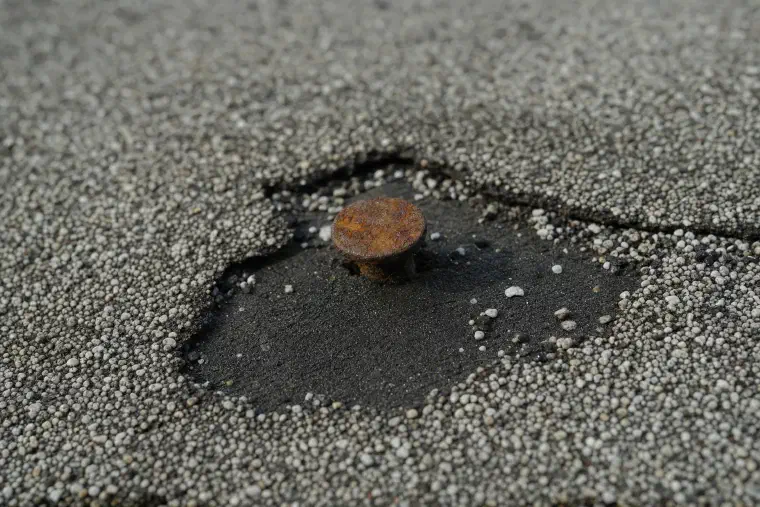
| Bare nail head showing through | The shingle has worn through over the nail | Fix it before the next hard rain |
| Bumps across a whole slope | Nailing or attic problem on the whole roof | Book an inspection |
| Bumps plus a ceiling stain nearby | Water is probably getting in | Call us and mention the stain |
Can a nail pop cause a roof leak?
Yes, over time. The raised head presses up under the shingle above it, and the sun, foot traffic and weather can wear that shingle through. Once the nail shows, rain can run down the nail and into the deck.
Nails that are badly placed or driven can also hurt the shingles around them. The Asphalt Roofing Manufacturers Association links poor nailing to sealing failures, blow-offs, raised tabs and buckling (opens in a new tab). A shingle that is not stuck down is easy prey for a gust.
Keep in mind that a pop is a warning, not proof of a leak. If you have a ceiling stain, the stain is the later stage. Our piece on leaks that last after the rain stops explains why.
How are nail pops fixed?
You pull the nail and put in a new one, then seal the old hole. For a nail that is only a little high, the Asphalt Roofing Manufacturers Association says underdriven nails can be tapped down. A nail that has cut into the shingle, or is crooked, comes out, and the hole is filled with asphalt roof cement.
A repair crew lifts the shingle carefully, pulls the nail, and sets a new nail in solid wood close by, driven flush. The Pacific Northwest National Laboratory says to drive nails straight and flush (opens in a new tab), not overdriven, underdriven or angled, and to keep them in the nailing zone of the shingle.
Two things we would skip. Hammering a loose nail back into its old hole holds for a season at best, because the hole is already worn. And a blob of sealant over the head hides the problem without fixing it. Sealant is a consumable that lasts about 5 to 10 years, so any fix that leans on it is a leak on a schedule.
Can you fix a nail pop yourself?
You can, but it means climbing onto a sloped roof and lifting brittle shingles. On an older roof, shingles can crack when you bend them, and a cracked shingle is a second repair.
If the roof is low, dry and not very old, a nail that is only slightly high can sometimes be tapped flat. Anything more is a job for someone who walks roofs for a living. We would rather you stay on the ground and look with binoculars.
What does it cost to fix nail pops?
A small repair like this usually lands at or near the minimum service call, which typically runs $350 to $550. Most of that price is the trip and the setup, not the nails. Replacing one to three shingles typically runs $300 to $650, and that can come into play if a shingle has worn through.
Price goes up if there are many pops, if the deck underneath is wet and needs replacing, or if the shingles are too old to lift without breaking. Those are the cases where we would talk to you about whether a patch still makes sense.
When are nail pops a sign of something bigger?
When you see them across a slope, or they keep coming back after repair. Then the nails are not the real problem. The attic, the deck or the whole nailing job is.
Heat and moisture are the usual suspects. We find that a hot, badly vented attic can cut a roof’s life nearly in half. A free roof inspection includes a walk on the roof and a look at the attic when we can get in. It is the cheapest way to find out whether you have a few stray nails or a pattern.
Common questions
Are nail pops covered by a roof warranty?
It depends on the warranty and on who installed the roof. Shingle makers often cover the shingle itself and not the labor, and an installer’s warranty is a separate paper. Read both before you assume, and ask what they say about fasteners.
Do nail pops mean I need a new roof?
Usually not. A few nail pops on a roof with years of life left are a repair job. We lean toward repairing whenever the rest of the roof is sound. A new roof comes up when the pops are everywhere and the shingles are already worn out.
Should I put roofing tar on a nail pop?
We would not. Tar over a raised nail covers the symptom and leaves the nail pushing up underneath. It also makes the area harder to repair properly later.
Can I see nail pops from the ground?
Sometimes. Low morning or evening sun on a clean slope shows the bumps best. A pair of binoculars helps. If you cannot tell a bump from a granule patch, that is what an inspection is for.
What to do next
Check your roof from the ground on a clear day, and note any slope with a line of small bumps. If you find some, or you have a stain on a ceiling below, we can look at the nails and the shingles around them as part of roof repair.


