

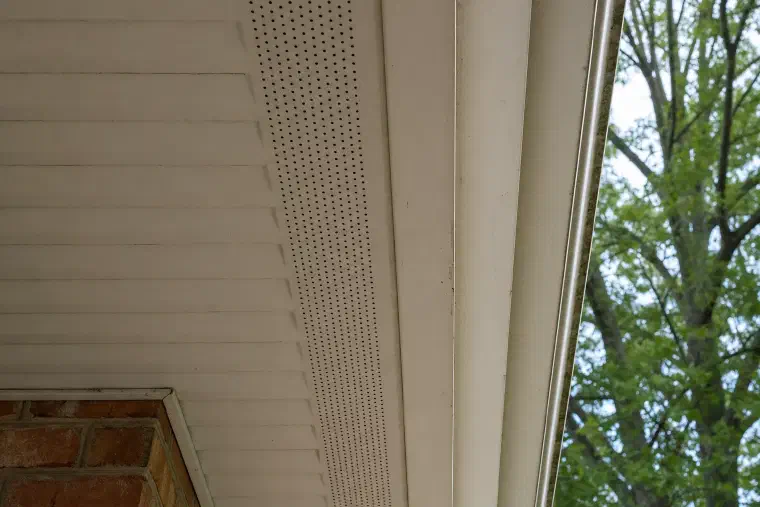
Soffit vents are small openings in the underside of your roof overhang that let fresh air into the attic. That air rises under the roof and leaves through vents higher up. Without the way in at the bottom, the vents at the top have nothing to pull.
The short version
- The soffit is the panel under the edge of your roof. A soffit vent is the slotted or perforated part of it.
- Soffit vents bring air in low. Ridge vents and other roof vents let it out high.
- The basic rule is 1 square foot of open vent area for every 150 square feet of attic floor, split between intake and exhaust.
- If the two sides cannot be equal, more intake is the better mistake.
- A vent that is painted over, buried in insulation or never cut open does nothing.
What does a soffit vent do?
It is the front door for your attic’s air. The Asphalt Roofing Manufacturers Association says the intake belongs at the eaves, soffit or lower part (opens in a new tab) of the roof, where cooler, drier air can come in. The Pacific Northwest National Laboratory puts it plainly: the lower soffit vents supply air to the attic space (opens in a new tab).
Then the air does the rest on its own. It warms up, rises along the underside of the roof deck and leaves at the ridge or another high vent. In summer that carries off heat. In winter it carries off the damp that drifts up from the house. The soffit vent is only half of a pair, and the pair only works if both halves are open.
How do you tell if you have soffit vents?
Stand in the yard and look up at the underside of the overhang. A vented soffit is either a panel with rows of tiny holes, a panel with long narrow slots, or a solid panel with a strip of perforated metal set into it. Some houses have small round discs spaced every few feet. Our guide to continuous vs round soffit vents shows how the two styles compare.
A smooth, solid soffit with no holes at all is a bad sign, though not a sure one. Some homes get their intake somewhere else. Most of the time, though, a solid soffit means the attic has no way for air to get in at the bottom.
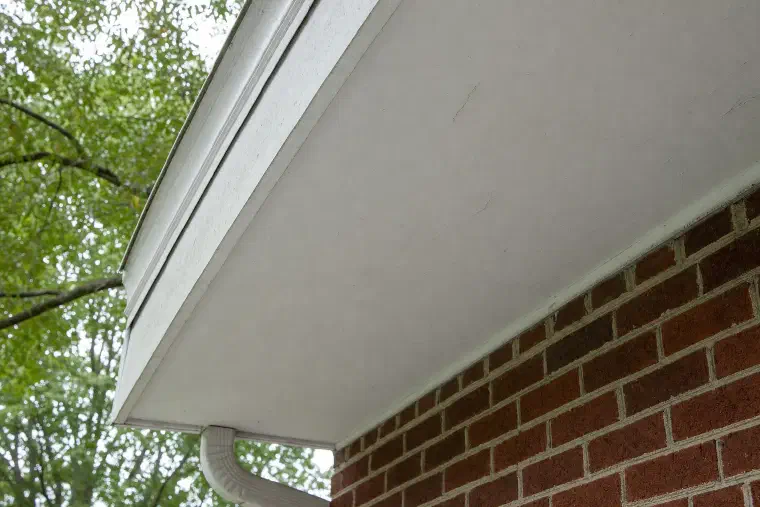
Why do some roofs have soffit vents that were never opened?
Because a vent that looks right from the yard is easy to fake by accident. We see the same pattern again and again: a ridge vent goes on at the peak, but the soffit below it was never cut open, or insulation was added later and now covers the intake. On paper the roof is vented. In real life the ridge vent is trying to pull air through a closed box.
This is one of the most overlooked causes of early roof wear. An attic with no intake cooks the shingles from underneath and can cut a roof’s life nearly in half. It does not feel like damage, so almost nobody looks. Our article on why attic ventilation matters covers the heat and moisture side.
How many soffit vents do you need?
Enough to hit a total, and the total comes from your attic floor. The Asphalt Roofing Manufacturers Association gives the basic rule as 1 square foot of net free area for every 150 square feet (opens in a new tab) of attic floor. Net free area is the part of a vent that air can pass through, which is always smaller than the vent itself, because the screen and the holes take up room.
Here is what that looks like for a 1,200 square foot attic floor. Divide by 150 and you get 8 square feet, which is 1,152 square inches in total. Aim for about half of that, roughly 576 square inches, as intake, and the other half as exhaust. Your vent’s box states its net free area, so you can add up what you have.
Two things keep this from being a simple count:
- A continuous strip is rated per foot of length. A round vent is rated per disc, so you need more of them than you would think.
- The same ARMA page says that if the two sides cannot be balanced, more intake than exhaust (opens in a new tab) is better than the other way round.
What blocks a soffit vent?
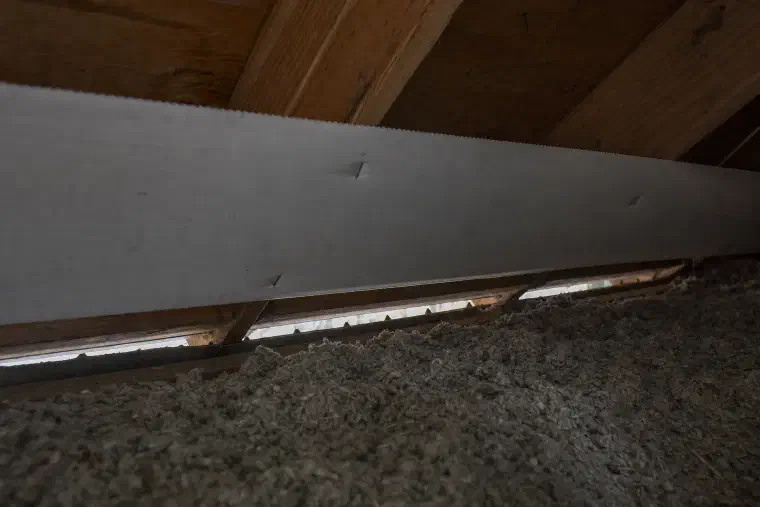
Mostly paint, insulation and time. Paint fills small holes quickly. Dust and cobwebs build up behind the screen. The worst blocker is insulation, because you cannot see it from outside. Energy Star’s rule is short: never cover attic soffit vents with insulation (opens in a new tab), and blown-in insulation may need an extra block to keep it from sliding into the soffit.
The fix is a baffle, a thin channel that holds the insulation back and keeps a lane open for air. We explain them in what are attic baffles.
Can soffit vents let rain or pests in?
Sometimes. PNNL notes that wind-driven rain and wildfire embers (opens in a new tab) can enter an attic through the soffit vents. A torn or missing screen makes it easier, so a broken vent is worth a look.
Can you add soffit vents to a house that has none?
Often, yes. If the soffit is a vented-panel style, a strip can go in its place. If it is solid wood, someone has to cut a slot or swap out the panels, which is a carpentry job as well as a venting one. On a full roof replacement, fascia, soffit and trim carpentry is not in the base price, and rotted wood is billed as time and materials or left out. Ventilation upgrades past the code minimum, such as adding intake at the soffits, are their own line.
That is the work on our attic venting installation page.
Common questions
Do I need soffit vents if I have a ridge vent?
Yes, in almost every case. A ridge vent only moves air that gets in somewhere else, and the soffit is the usual place. A ridge vent with a closed soffit is the most common version of a vented roof that is not.
Are soffit vents the same as fascia?
No. The soffit is the panel under the overhang, and the fascia is the board on the front edge, where the gutter hangs. Vents go in the soffit.
Can I put insulation over a soffit vent?
No. Keep a clear path from the vent up to the roof deck, and use a baffle to hold the insulation back.
Will the free inspection check my soffit vents?
We look at the attic when we can get in safely, and we tell you if the eaves look blocked or short of intake. We do not run a full ventilation calculation on the free visit.
What to do next
If your attic runs hot, shows frost in winter, or you have never seen a vent in your soffit, have it looked at. A free roof inspection is the easy first step, and winter is the best time to see frost on the underside of the roof boards, which points straight at a moisture problem.


