

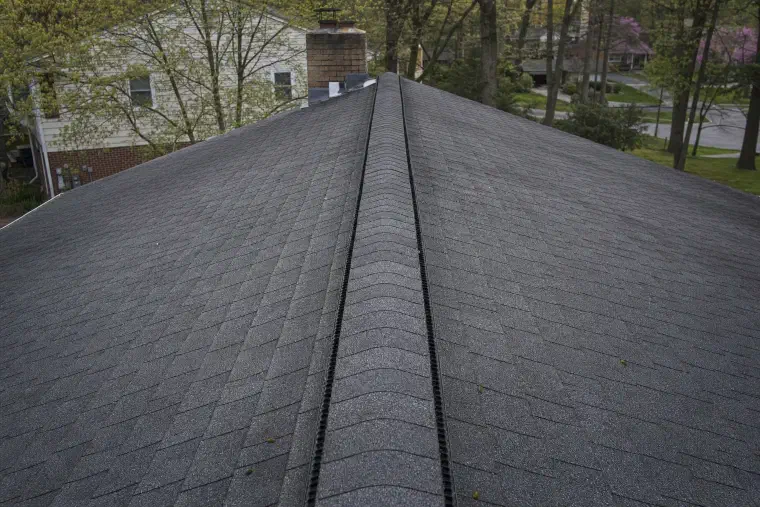
Roof vents come in two jobs and about five shapes. Intake vents, such as soffit vents, let outside air into the attic. Exhaust vents, such as ridge, box, gable, turbine and powered vents, let hot, damp air out. A roof needs both, and it is usually best to pick one kind of exhaust.
The short version
- Soffit vents under the roof edge bring cool air in. Everything on the roof or gable pushes air out.
- Ridge vents run along the peak and are the most common exhaust on newer roofs.
- Box, gable and turbine vents work, but each one is a single spot, not a long line.
- Powered fans use electricity and are not the first choice.
- Mixing two kinds of exhaust on one attic can make the air go in circles instead of through the attic.
What is the difference between intake and exhaust vents?
Intake vents sit low and exhaust vents sit high. Outside air comes in at the bottom of the roof, warms up, rises, and leaves at the top. That slow stream of air carries summer heat and winter moisture out before they can hurt the roof boards and shingles.
The Asphalt Roofing Manufacturers Association says the goal is a balanced-airflow approach (opens in a new tab) that lets air wash the whole underside of the roof deck from low to high. Intake is most often a soffit vent, which is a vent in the flat panel under the edge of your roof. We cover that side in continuous vs round soffit vents.
What is a ridge vent?
A ridge vent is a low, continuous strip along the peak of the roof, covered with ridge-cap shingles so it looks like part of the roof. A slot is cut along the top of the roof boards, and warm air escapes through it along the whole length of the house.
Virginia Tech’s extension service says most homes should have a continuous ridge vent (opens in a new tab) along the peak and continuous soffit vents at the eaves. It is the vent we put in on most replacements. Our standard roof installation includes a ridge vent or box vents per the ventilation plan.
What are box vents?
Box vents are small square caps on the roof slope, usually near the top. They have no moving parts. Each one covers a hole cut in the roof boards, and hot air rises out of it. They are also called static vents or low-profile vents.
Because each one sits in one spot, a roof needs several of them spread along the upper part of the slope to move the same air as one ridge vent. On a roof with a very short ridge, such as a small hip roof, box vents are often the better fit. Each one is also another hole in the roof with flashing around it, and flashing is where roofs tend to leak.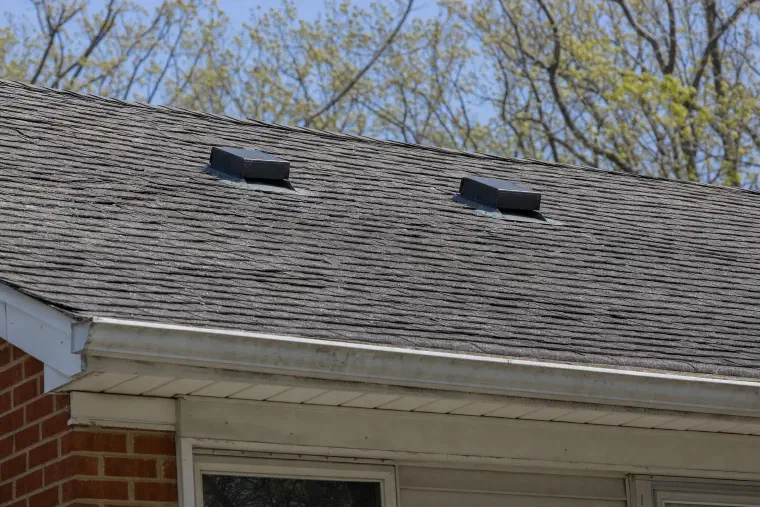
What are gable vents?
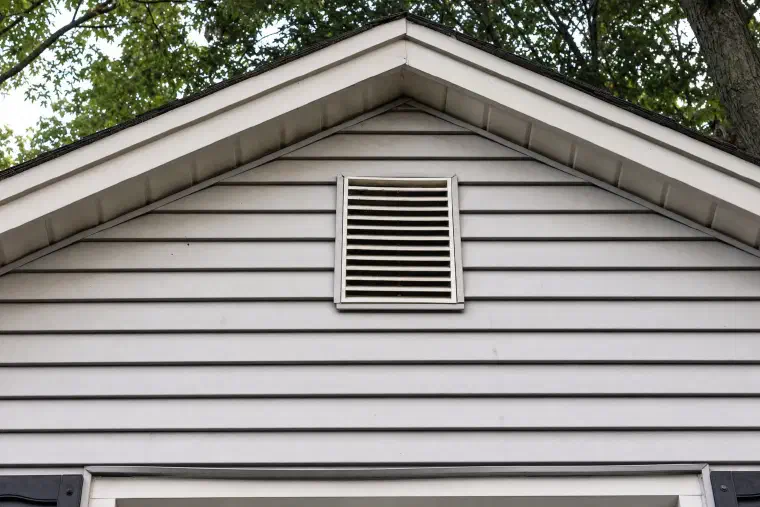
A gable vent is a louvered opening in the triangle of wall under the roof peak, on the end of a gable roof. Air can move in or out of it depending on the wind and what other vents the attic has.
They are common on older houses and they do not touch the roof surface, so there is no hole to flash. The weak point is that air tends to flow straight from one gable to the other and skip the rest of the attic. The Asphalt Roofing Manufacturers Association also warns that gable end vents used with ridge vents, without enough soffit intake, can pull moisture into the home (opens in a new tab).
What are turbine vents and powered fans?
A turbine vent is a metal globe that spins in the wind and pulls air out of the attic. A powered vent has an electric fan, sometimes run by a small solar panel. The Asphalt Roofing Manufacturers Association groups wind turbines (opens in a new tab) with ridge vents and roof louvers as non-motorized vents, which tells you something about how many types are out there.
The Building America program at the Pacific Northwest National Laboratory says passive ventilation is generally recommended over attic fans (opens in a new tab) because of the many issues fans can bring. Energy Star adds a warning: if your attic has blocked soffit vents and is not well sealed from the house, fans will pull cool air up out of the house (opens in a new tab) and into the attic. We go deeper in are attic fans worth it.
How do the types compare?
Here is how they line up for a typical Howard County house.
| Type | Job | Where it goes | Good fit | Watch for |
|---|---|---|---|---|
| Soffit vent | Intake | Under the roof edge | Nearly every roof | Paint, dust or insulation blocking it |
| Ridge vent | Exhaust | Along the peak | Gable and hip roofs with a decent ridge | Needs open soffits to pull from |
| Box vent | Exhaust | Upper slope, several needed | Short ridges | More holes to flash |
| Gable vent | Either | Gable end wall | Older houses | Short-circuits the airflow |
| Turbine vent | Exhaust | Upper slope | Windy spots | Does little on calm days |
| Powered fan | Exhaust | Slope or gable | Special cases | Power use, and it can pull house air up |
Can you mix different types of roof vents?
Not on the exhaust side, if you can help it. The Asphalt Roofing Manufacturers Association says that as a general rule, combining different types of exhaust vents (opens in a new tab) above one attic space should be avoided, for example a ridge vent with a roof fan. The reason is a short circuit: one exhaust vent pulls air from another exhaust vent instead of from the intake at the eaves.
We see this a lot. A house ends up with a ridge vent, a pair of gable vents and a few box vents added over the years, each one put in by a different roofer. The air takes the shortest path between them, and the lower part of the attic gets none. Mixed exhaust is one of the ways an attic ends up under-vented even when it looks like it has plenty of vents.
Which type does your attic need?
It depends on the roof shape and, more than anything, on whether air can get in at the bottom. A ridge vent over solid soffits does very little. A few box vents over open, clear soffits can work fine.
The signs that something is off are the ones the attic tells you: heat that lingers late into the evening, frost on the underside of the roof boards on a cold morning, a musty smell, or shingles curling early. Our attic venting page lists what we look at. Ridge vent repair typically runs $700 to $1,600, and extra ventilation beyond the code minimum is priced as its own line on a new roof. See why attic ventilation matters for what happens when the air stops moving.
Common questions
Do I need both a ridge vent and soffit vents?
Yes, in most cases. The ridge vent can only pull air that has somewhere to come from. Without open soffit vents, it has nothing to draw on, and it may pull air from the attic floor or the house instead.
How many roof vents does my house need?
It depends on the size of the attic and the net free area of the vents you choose. The Asphalt Roofing Manufacturers Association gives the basic rule as 1 square foot of net free area (opens in a new tab) for every 150 square feet of vented space. The count on the package changes the answer, so we do not guess a number without looking at the attic.
Are gable vents bad?
No, but they work best on their own, with soffit intake. Gable vents and a ridge vent on the same attic is the pairing to avoid.
Will the free inspection check my roof vents?
We look at the vents on the roof and at the roof edge, and at the attic when we can get in safely. We do not run a full vent-area calculation on the free visit. If something looks wrong, we explain what a fix would involve.
What to do next
If your roof has a mix of vent types or you cannot tell if the air has a way in, have it looked at. A free roof inspection is the easy first step, and our crew can walk you through what we see.


