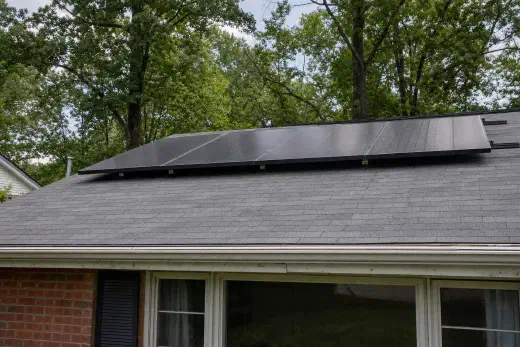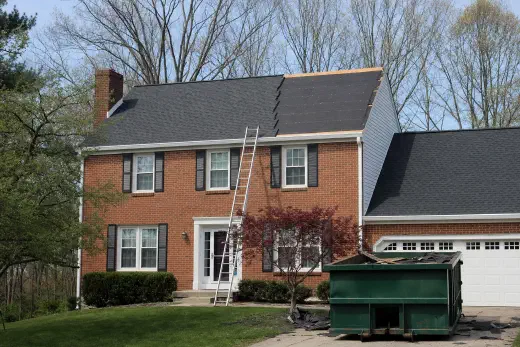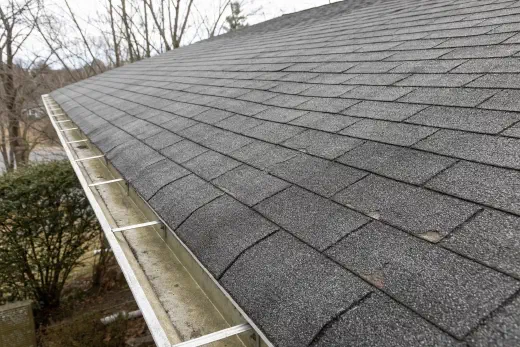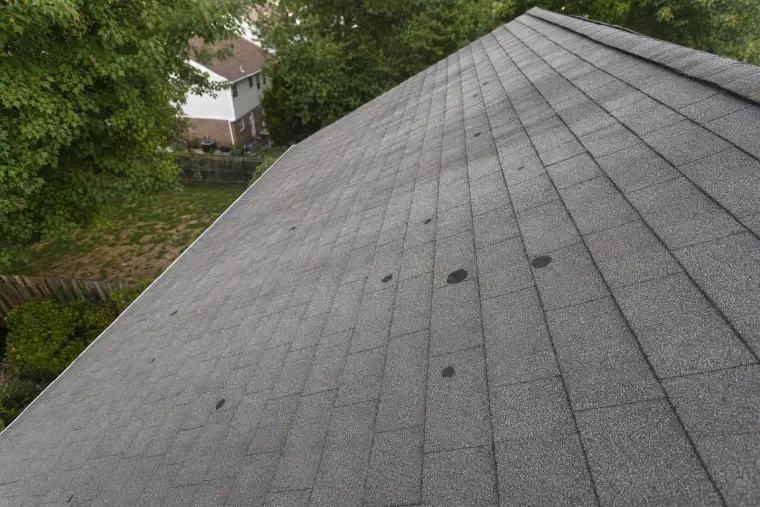
Hail damage on a roof looks like round dark spots where the granules were knocked off a shingle, scattered at random, with a soft bruise you can feel underneath. On metal it shows up as shallow dents. The marks are small, and they are easy to miss from the driveway.
The short version
- On asphalt shingles, look for round spots with bare, shiny asphalt, in no pattern and in different sizes.
- Press a spot with a thumb. A soft bruise points to hail. A hard pop with no soft spot is more likely a blister.
- Metal roofs and soft metal parts dent. Gutters, vents and downspouts show the storm better than shingles do.
- A dent that is only cosmetic is not the same as damage that lets water in.
- Our roof inspection is free, and it is the safest way to sort a fresh hit from old wear.
What does hail damage look like on asphalt shingles?
On asphalt shingles, a hail hit looks like a dark spot or bruise where the granules were knocked off. MU Extension describes it as a bruise or a dark spot (opens in a new tab) with the granules gone. Granules are the gritty coating on top of the shingle that shields the asphalt from sun.
Three things tell hail apart from other marks:
- The pattern is random. The Nebraska Department of Insurance says hail leaves a random pattern of strike marks (opens in a new tab) in various sizes. Marks that line up were made by something else, such as a ladder or a boot.
- The spot is soft. The same page says a hailstone leaves a bruise in the mat (opens in a new tab) that you can often feel with your fingers. The mat is the base layer under the granules.
- The asphalt is shiny. MU Extension says new hits look shiny because the freshly exposed asphalt has not had time to weather (opens in a new tab) to a dull color.
Granules in the gutter are a weaker clue. Nebraska’s page is blunt that granule loss does not prove damage (opens in a new tab), since an old roof sheds them anyway.
How does hail damage look on a metal roof?
On a metal roof, hail damage looks like shallow round dents, and the paint usually stays unbroken. The Insurance Institute for Business and Home Safety (IBHS) fired more than 9,000 artificial hailstones at a test structure. It reported that damage to both metal roof sections was cosmetic, leaving visible dents but no punctures (opens in a new tab).
The same test found that metal laid over old shingles dented more. Dents there were larger and deeper (opens in a new tab) than on metal installed over the roof deck. It is a small test on one house-sized structure, so treat the results as a pattern rather than a promise.
A cosmetic dent may not leak, but it can still matter to your insurance policy or your resale. Some policies treat cosmetic damage differently from damage that lets water in. Read yours, and ask the adjuster. For more on how metal holds up, see how safe metal roofs are.
What does hail do to gutters, vents and downspouts?
Soft metal dents first, so these parts are the best record of a storm. Gutters, downspouts, metal roof vents, flashing and the air conditioner cabinet all take dents from stones that only bruise a shingle. MU Extension says the number of dents in metal roof vents is a good indicator of hail amounts and size (opens in a new tab).
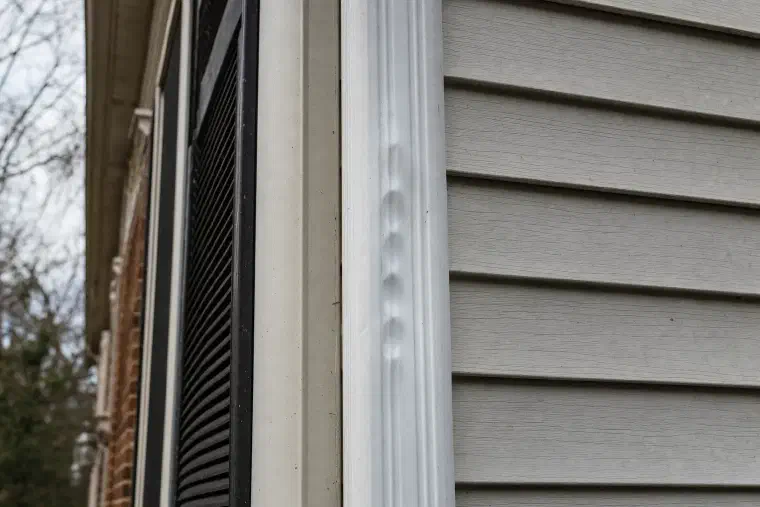
Check these before you look at the roof. They are at eye level, and they tell you whether the stones were big enough to worry about. A clean set of gutters with no dents is a good sign for the shingles above them.
How big does hail have to be to damage a roof?
Small hail usually does nothing to a sound roof, and the damage climbs with the size of the stones. The National Weather Service hail size chart (opens in a new tab) lists a quarter at 1 inch across and a golf ball at 1.75 inches. IBHS made its test stones 1, 1.5 and 2 inches wide.
On ordinary three-tab shingles in that test, most of the impacts were severe enough to count as functional damage (opens in a new tab), not just marks on the surface. Impact-resistant shingles did better, and most of the marks on them were cosmetic. We cover that trade in impact-resistant shingles.
What looks like hail damage but is not?
Blisters, foot traffic and old age all leave marks that pass for hail. Nebraska’s page says heat makes asphalt release gases that get trapped, and that a blister does not have the bruise (opens in a new tab) you can feel on a shingle a hailstone hit.
| What you see | More likely | Quick test |
|---|---|---|
| Round spots, random, soft underneath | Hail | Thumb press finds a bruise |
| Small pops or craters, hard underneath | Blister from heat | No bruise to feel |
| Scuffs in a line or path | Foot traffic | The marks follow where people walked |
| Grit in the gutter, no spots | Old shingles | Granule loss alone proves nothing |
We see the foot-traffic version all the time. HVAC techs, satellite installers, chimney sweeps and gutter cleaners scuff granules, and on a hot day their footprints crack the mat. We also see hail bruise a shingle that was already brittle from attic heat, which is why a hit on an older roof is not only about the storm.
Where do hail hits show up first?
Hail hits cluster on the slopes that faced the wind, and on the parts that stick up. The ridge cap along the peak, vents and the tops of dormers take the stones squarely. A slope facing away from the storm can look untouched while the one beside it is covered.
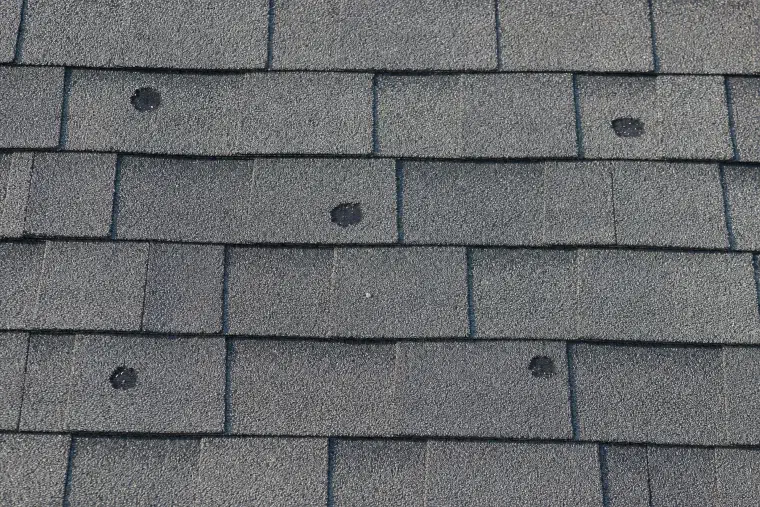
Hits land a few inches apart or a few feet apart, never in a row. That is why one slope tells you little. Someone checking a roof should look at every slope, and an adjuster may count hits slope by slope. The counting is covered in how a roof is inspected for hail damage.
Common questions
Can you see hail damage from the ground?
Sometimes. Dented gutters, downspouts and vents are easy to see from the yard, and binoculars help with the roof itself. Bruises on shingles are hard to see from far away. Stay off the roof, and let an inspector press the spots.
Does hail damage a roof right away?
Not always. A bruised shingle can hold for a while and then leak at a later hard rain, once the mat underneath wears through. IBHS said cosmetic marks should be monitored (opens in a new tab) to see whether they lead to more wear. So date your photos and get it checked.
Will insurance cover hail damage?
Often, but your policy and the adjuster decide, and we can’t say what a claim will pay. Nebraska’s insurance department says to contact your insurance company or agent once you think you have a hail claim. It also notes that replacement payments may come with a repair deadline, usually 180 days (opens in a new tab). Read the wording in your own policy.
What to do next
Photograph any dents you can see from the ground, write down the date of the storm, and have the roof looked at. Our free roof inspection includes a walk on the roof and a written report with photos. If the storm left something that needs fixing, our storm and wind damage roof repair page explains what that involves. The phone is answered 24/7.