

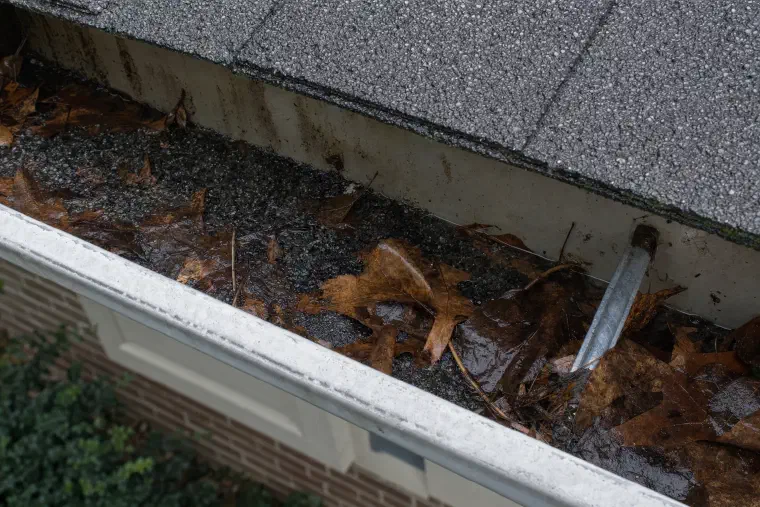
Shingle granule loss means the gritty, stone-like coating on your asphalt shingles is wearing off and washing away. A little is normal on any roof. Bare patches, or a gutter full of grit, tell you the shingles are aging or have taken a hit.
The short version
- Granules are the rough surface that shields the asphalt underneath from the sun.
- Some loss happens on every roof, starting the day the shingles are made.
- Bare, dark patches matter more than grit in the gutter.
- Foot traffic, tree branches, hail and age all knock granules loose.
- You can’t put granules back, so the question is how much roof life is left.
What are shingle granules for?
Granules are the small mineral pieces pressed into the top of an asphalt shingle. They give the shingle its color, and they shade the layer of asphalt underneath from sunlight. Once enough of them are gone, the asphalt below is out in the open.
That’s why the NRCA (the National Roofing Contractors Association) says a shingle’s service life can be shortened (opens in a new tab) when granules are dislodged enough to expose the coating asphalt. Bare asphalt dries out and cracks faster in the sun. If you want to know what else goes into a shingle, we cover that in our piece on what asphalt shingles are made of.
Is some granule loss normal?
Yes. The NRCA calls the loss of granules an ongoing process that begins when a shingle is made (opens in a new tab) and counts it as normal weathering. Rain, wind and foot traffic all knock loose granules off.
This Old House puts it the same way: some loss is normal with age (opens in a new tab). So a handful of granules in the gutter after a heavy rain is not a reason to worry.
What does granule loss look like?
It shows up in three places: the gutter, the downspout and the shingle itself. Here is how to read each one.
| What you see | What it usually means |
|---|---|
| A light dusting of grit in the gutter | Normal wear |
| Heavy grit in gutters or around the downspout | Shingles are aging, or something removed a lot at once |
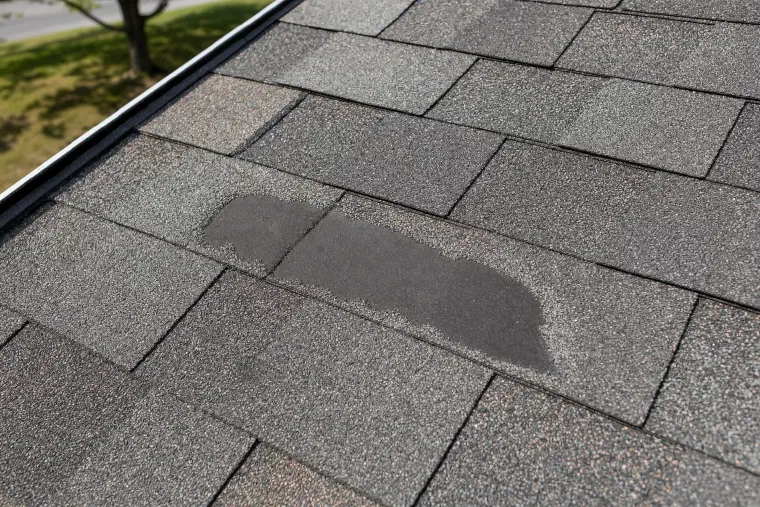
| Dark, smooth, bald-looking patches on the roof | Granules are gone and the asphalt is showing |
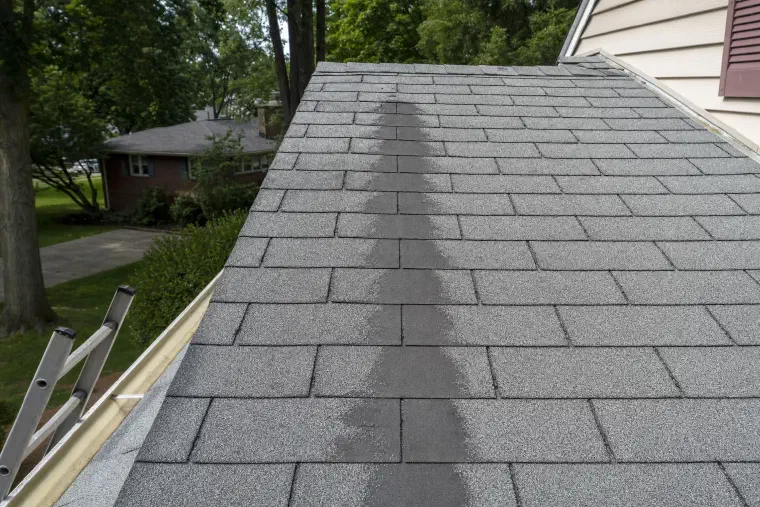
| A darker strip along one path | Foot traffic or a branch has been scuffing that spot |
| Loss spread evenly over the whole slope | Usual age wear, with the sun doing most of it |
This Old House points to excessive granule buildup in gutters or around downspouts (opens in a new tab) as a sign of aging shingles, and says shingles might also appear bald.
Does granule loss mean the roof is damaged?
Not by itself. The Nebraska Department of Insurance says plainly that granule loss does not prove damage (opens in a new tab). It also says a significant amount of granules at the end of downspouts may show potential damage, which is why a closer look is worth it.
The NRCA draws a similar line. It says shingles that lose enough granules to expose the bitumen (opens in a new tab) without any cracks in the reinforcing mat are typically already nearing the end of their service lives. In plain words, they are worn out rather than hit by a storm.
So the useful question is not “is there grit?” but “is there a bare patch, and how big is it?”
What knocks granules off a roof?
Age is the big one, but a few other things speed it up, and we see them all the time around Ellicott City.
- Tree branches. On wooded lots, limbs sweep across the shingles in the wind and strip granules like sandpaper.
- Foot traffic. Every HVAC tech, satellite installer, chimney sweep and gutter cleaner who walks the roof scuffs granules. On a hot day, their footprints can crack the shingle too. Paths that get walked a lot wear out years sooner than the rest of the roof.
- Hail. This Old House notes that hail impacts loosen shingle granules (opens in a new tab), which weakens the shingle.
- Pressure washing. The Asphalt Roofing Manufacturers Association warns that a pressure washer will cause granule loss (opens in a new tab) and very likely early failure of the roof. Scrubbing is no better, since the same group says friction may loosen and remove granules (opens in a new tab).
Can you fix granule loss?
No. Granules can’t be glued or sprayed back on in a way that lasts, so there is no repair for the loss itself. What you can fix is what caused it, and you can plan for the roof’s remaining life.
If the loss is in one spot, say a worn path or a patch under a branch, a roof repair on those shingles may be all you need. If it’s spread over the whole roof and the shingles are well past their middle years, the honest answer is that the roof is wearing out. Our piece on how long shingles last explains what we usually see in Maryland.
We’d rather repair than replace when a repair makes sense. If the roof is sound, we’ll tell you to wait.
Should you get the roof looked at?
If you see bare patches, a lot of grit near the downspouts, or a darker path across the slope, yes. You can’t judge this well from the ground, and climbing up yourself adds to the scuffing.
Our free roof inspection includes a walk on the roof and a written report with photos. It also gives you an estimate of how much life the roof has left, with the reasoning, and granule loss is one of the things we base that on. There’s no obligation to book work.
Keep in mind that an inspection is a snapshot, not a guarantee. A big wind or hail event next month can change things.
Common questions
Are granules in my gutter a sign I need a new roof?
Not on their own. A light layer is normal, and it’s heavy grit with bare patches on the roof that points to a roof near the end. Look at the shingles before you decide anything.
Should I clean the granules out of the gutter?
Yes, along with the leaves and debris, so the water can drain. Our gutter cleaning service covers this, and it’s a good time to look at the roof too.
Can I see granule loss from the ground?
Sometimes. Binoculars can show dark, smooth patches or a darker strip. Grit in the gutter is the easier clue, but only a look on the roof tells you how much is gone.
Does granule loss void a shingle warranty?
We can’t say, because each manufacturer writes its own terms. Read the warranty paperwork, and keep in mind that a “50-year” number covers manufacturing defects, not how long the roof will last in the field.
What to do next
Check your gutters and downspouts this week, and look at the roof from the yard. If you see bare patches, book the free inspection and we’ll tell you what we find, in plain words.


