

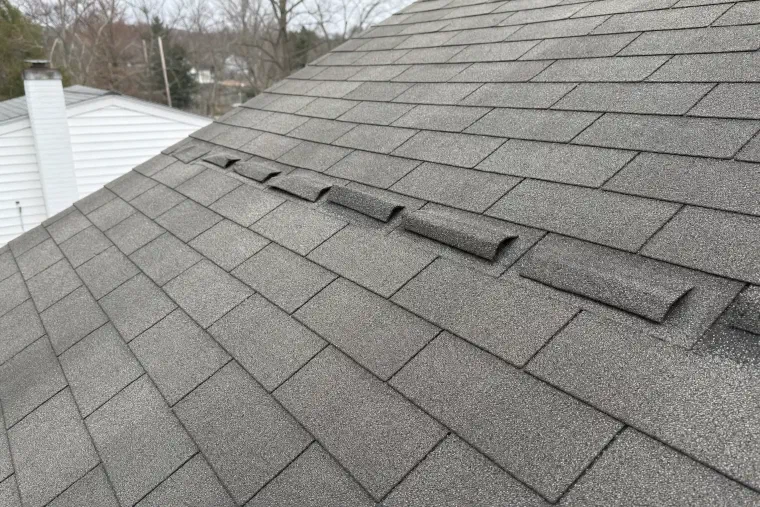
Wind damage to a roof looks like shingles that are missing, creased or lifted at the edges, and sometimes a loose ridge cap or bent flashing. You can spot some of it from the yard. The rest shows up only when someone gets close, so a roof that looks fine from the street can still be hurt.
The short version
- Missing shingles leave a bare patch with dark underlayment or nail heads showing. They are the easiest sign to find.
- A crease is a horizontal fold line across a shingle. It means the wind bent the tab, and those shingles tend to tear off in the next gust.
- Check the edges, corners and peak first. Wind pulls hardest there.
- Photograph everything before any repair, and keep receipts for a tarp.
- Our roof inspection is free, and it covers the slopes and the flashing you cannot see from the ground.
What are the signs of wind damage on shingles?
The signs are missing shingles, creased shingles, lifted corners and torn tabs. This Old House says strong winds can peel back or tear off shingles (opens in a new tab), tiles or sections of rolled roofing. Each sign tells you something different.
- Missing shingles. A bare patch, often with the dark paper under the shingles showing. You may find the shingles in the yard.
- Creased shingles. A fold line across the tab where the wind bent it up and back. On a textured shingle the crease can look like a thin, darker line, so it is easy to miss.
- Lifted or curled edges. The shingle no longer lies flat. The glue strip under it let go.
- Torn or broken tabs. Part of a shingle is gone and the rest is ragged.
- Granules in the gutter. A weaker clue on its own, since an old roof sheds them anyway.
A creased shingle is the one to take seriously. The paper-thin fold weakens it, and it is the shingle most likely to go next time the wind picks up.
Why do shingles lift in the wind at all?
Shingles lift when the glue strip under them lets go and wind gets underneath. Each shingle is held by nails and by a strip of sealant that bonds it to the course below. Once that bond is broken, a Penn State study notes, wind forced through the gaps (opens in a new tab) raises the pressure under the shingle, which makes it easier to pull off.
The same study surveyed roofs by pressing each shingle edge with a finger. It found more unsealed shingles on roofs 7 to 13 and 14 to 20 years old (opens in a new tab) than on roofs up to 6. Its authors concluded that a roof’s condition before the storm is a strong influence (opens in a new tab) on how well it holds up.
That matches what we see. Wind tends to find the weak spots a roof already had. A shingle nailed too high is held by its glue strip alone, and the same shingle can last 25 years or nine depending on where the nail went. Repeated 40 mph gusts can also wear a seal down over several years, with no single storm to blame.
Where on the roof does wind damage show up first?
It shows up first at the edges, corners and peak. Researchers at the Institute for Business and Home Safety (IBHS) note that earlier studies suggest roof cover damage is greatest at corners, edges and ridges (opens in a new tab). Those are the spots where the wind has the easiest grip.
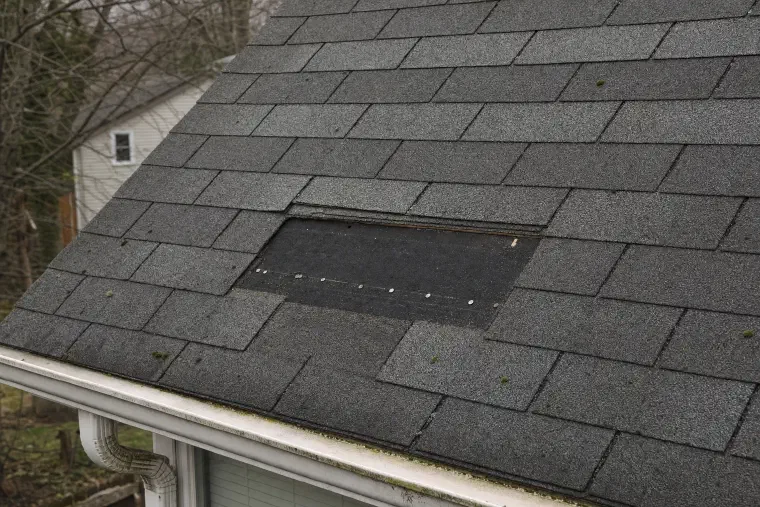
So start your look along the eave, the rake (the sloped edge at the gable end) and the ridge. Then check the slope that faced the wind. A storm usually hits one side much harder than the other, and the far side can look untouched.
What does wind damage look like on the ridge and the flashing?
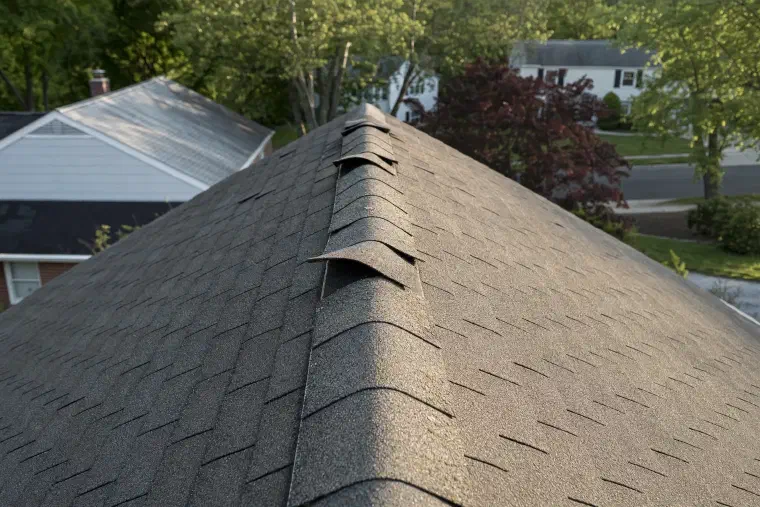
On the ridge, wind damage looks like ridge cap shingles that are lifted, curled or gone. The ridge cap is the row of shingles bent over the peak. It sits highest, takes the wind first, and a missing one lets rain in at the top of both slopes.
Flashing is the thin metal that seals the joints around a chimney, wall or vent. This Old House says to look for dents, displacement or gaps (opens in a new tab) in it. A bent or lifted edge there is a leak waiting for the next rain. Our page on storm and wind damage roof repair covers how we fix both.
How can you check from the ground?
Stand in the yard and look, ideally with binoculars. This Old House says you can often spot missing shingles (opens in a new tab), debris or visible damage from the ground that way. Stay off the ladder and the roof. A wet or damaged roof is slick, and nobody needs a second problem.
| What you see | What it likely means | What to do |
|---|---|---|
| Bare patch, dark paper showing | Shingles blew off | Photograph it, call, tarp if water can get in |
| Shingles in the yard | Missing shingles somewhere above | Walk the yard, note which slope they came from |
| Flapping or lifted tab | Seal let go | Get it looked at before the next windy day |
| Thin horizontal line across a tab | Crease from a gust | Get it looked at |
| Ridge cap curled or gone | Peak exposed | Call soon, since rain gets in at the top |
| Bent edge on chimney or wall metal | Flashing pulled loose | Get it looked at |
Inside the house, look at the ceilings for stains and at the attic floor for daylight or damp insulation. A stain is the last sign, though. Water has often been getting in for a while before it shows. We cover that in how to tell if your roof has storm damage.
How is wind damage different from hail damage?
Wind tears, lifts and folds shingles. Hail bruises them. Wind damage tends to follow the direction of the storm and gather at edges and corners, while hail marks are round and scattered at random across the whole slope. A bare patch or a crease is wind. A cluster of round dark spots is hail. Our guide to what hail damage looks like shows the hail side.
What should you do after wind damage?
Photograph it, keep water out and have it inspected. The Maryland Insurance Administration says a homeowners policy requires you to prevent further damage (opens in a new tab), for example by tarping a damaged roof, and that you should take photos or video before, during and after temporary repairs and keep receipts. Do not endanger yourself doing it.
A tarp is a stopgap. This Old House puts it plainly: those are short-term solutions (opens in a new tab). Emergency tarping typically runs $350 to $900, and it is worth asking whether that is credited toward the repair. If water is coming in right now, see emergency roof repair.
Fixing a handful of wind-lifted shingles typically runs $600 to $1,700, depending on the roof. A roof with widespread missing shingles may need more, and a roof near the end of its life may be better replaced than patched. We would rather tell you that after looking than guess from a phone call.
Common questions
Can wind damage a roof without removing shingles?
Yes. A shingle can crease or come unsealed and stay in place. It looks normal from the ground, but it is weaker and may blow off in the next gust. That is why a walk on the roof matters.
Will insurance cover wind damage to a roof?
Often, but your policy and the adjuster decide, and we can’t say what a claim will pay. Damage from a storm is treated differently from wear and age, and policies can carry a separate wind deductible. The Maryland Insurance Administration says any payment is generally subject to the deductible (opens in a new tab), so read your own wording and call your insurer.
How soon should you get wind damage checked?
Soon, and before the next storm. Missing shingles and lifted ridge caps let rain in at once. A crease or a loose tab does less harm today, but it is the weak spot the next gust will find.
What to do next
Walk the yard, photograph what you see and note the date of the storm. Then book our free roof inspection. It includes a walk on the roof, a look at the flashing and a written report with photos, kept separate from any price. The phone is answered 24/7.


