

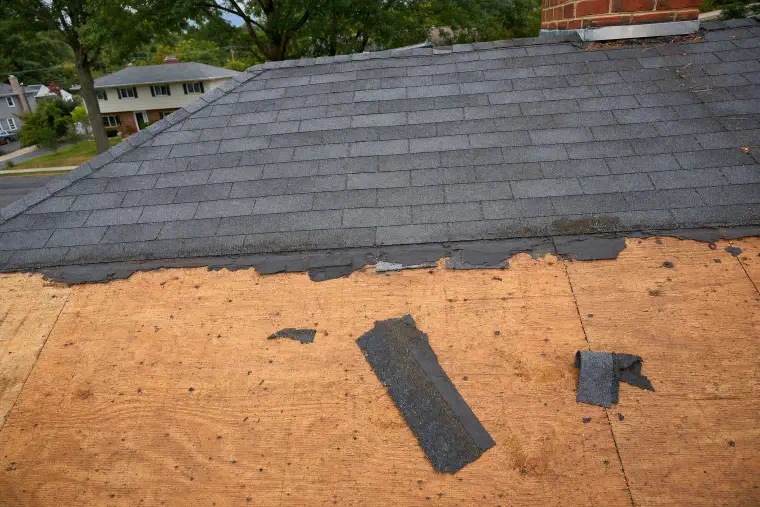
On roof replacement day, a crew tears off your old shingles, checks the wood underneath, puts down new waterproofing and metal edging, nails on the new shingles, and sweeps your yard for stray nails. For most 25 to 40 square roofs, all of that happens in one day. Here is the order it happens in, and what you need to do before the truck shows up.
The short version
- Most 25 to 40 square roofs take one day. Bigger or steeper roofs take two to five.
- The old roof comes off first, then the wood underneath gets checked.
- New waterproofing and metal edging go on before a single shingle.
- Rotted wood is found on the day, and extra sheets are priced per sheet.
- The day ends with a magnet sweep of your yard and the dumpster hauled away.
What happens first on roof replacement day?
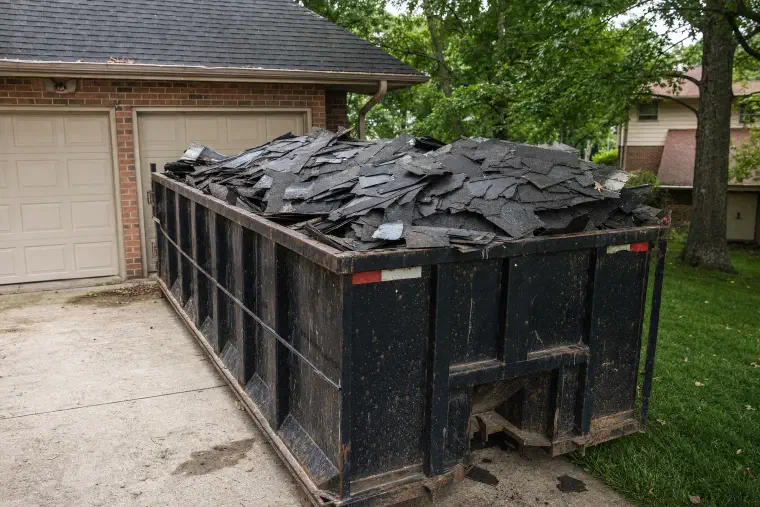
The first job is protecting your house and yard, then the tear-off starts. The crew sets up the dumpster, covers landscaping, and puts tarps where debris could land. Our roof installation includes the dumpster, haul-away and disposal fees, so you are not arranging a bin yourself.
Then the old shingles come off, usually from the top of the roof down. A good crew only strips as much roof as it can cover with new waterproofing the same day. That matters because a bare deck and a rain cloud do not get along. We don’t tear off a roof with rain in the forecast.
What do they check once the old shingles are off?
Once the shingles and old underlayment are gone, the crew walks the bare wood decking and looks for soft, dark or cracked boards. Decking is the plywood or boards the shingles are nailed to, also called sheathing. Anything rotted gets replaced before the new roof goes over it.
This is the part nobody can price exactly until the old roof is off. Decking is not part of the base price. It is priced per 4x8 sheet once the boards are seen, and replacement typically runs $70 to $150 installed per sheet. Our free roof inspection tells you ahead of time what the wood is likely to look like, but only the tear-off tells you for sure.
Sometimes the tear-off turns up something bigger, like a sagging ridge or a failed truss. That stops the day and needs an engineer’s letter, which is a different conversation than a few sheets of plywood.
How does the new roof go on, step by step?
The new roof goes on in layers, and the order is the whole point. Each layer covers the one below it, so every piece has to be in before the next one goes over it.
| Step | What goes on | Why it is there |
|---|---|---|
| 1 | Ice-and-water shield | Sticky waterproof sheet at the eaves, valleys and around anything that pokes through the roof |
| 2 | Drip edge | Bent metal strip along the roof edges that sends water into the gutter |
| 3 | Synthetic underlayment | A tear-resistant backup layer over the whole deck |
| 4 | Starter strip | First row of shingles at the eaves |
| 5 | Field shingles | The main roof surface, working up |
| 6 | Flashing and ridge vent | Metal at chimneys, walls and valleys, then the vent at the peak |
Underlayment, in the industry’s own words, is installed between the roof deck and the shingles (opens in a new tab). The shield at the eaves does a different job: it is there to help stop leaks from wind-driven rain and ice dams. The Asphalt Roofing Manufacturers Association says it should reach 24 inches inside the interior wall line (opens in a new tab) at a minimum, and some jurisdictions want it higher up the slope.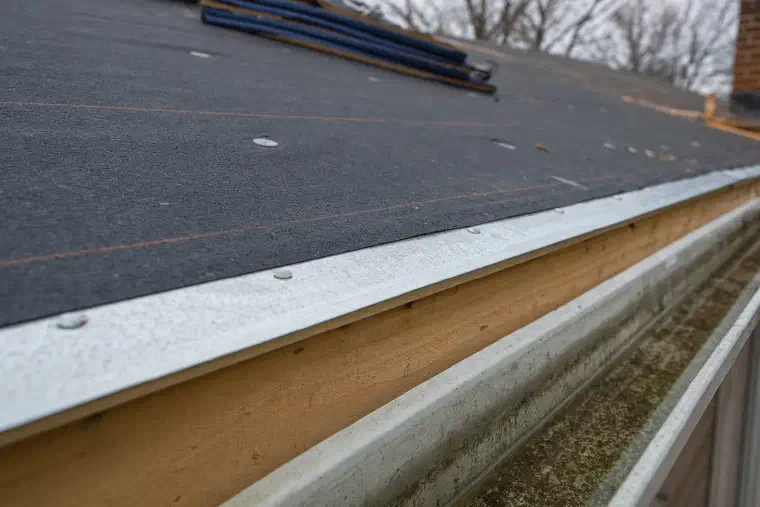
Why does the drip edge go in before the shingles?
Drip edge is a thin metal strip along the roof edges, and it goes on before the shingles because the shingles overlap it. It steers water into the gutter instead of letting it creep behind the gutter and rot the wood. This Old House says to install it under the felt at the eaves (opens in a new tab) and over the felt at the rakes, which are the sloped edges. Our drip edge article has the full picture.
Next comes the starter strip. The Asphalt Roofing Manufacturers Association describes it as the first row of specially sized shingles (opens in a new tab) applied at the eaves, needed to help prevent shingle blow-offs. Skipping it is a shortcut we see on other crews’ work, and you can’t see it once the roof is done.
Where do the nails go, and why does it matter?
Each shingle is nailed on a specific line, and where the nail lands decides how well the roof holds in wind. A nail set too high only catches the shingle, not the one underneath, so the shingle ends up held by its sealant strip alone. It looks perfect until a gust peels it. The same shingle can last 25 years or 9 depending on where the nail went.
Sealant is what holds shingles flat once the nails are in. IBHS research found that unsealing of shingles (opens in a new tab) remains the single greatest driver of wind vulnerability. That is also why we watch the thermometer. Shingles need more than 40°F to seal, so a very cold day can push the job.
How does the day end?
The day ends with new flashing, the ridge vent, a magnet sweep and a hauled-away dumpster. Flashing is the metal that seals the joints at chimneys, walls and valleys, and our installs use new flashing, not the old pieces, unless it is specified otherwise. The ridge vent or box vents follow the ventilation plan.
Then comes the part you will see from your driveway. The crew runs a magnetic nail sweep over the yard, driveway and beds, and cleans up the site. Satellite dishes and antennas come off during the job and don’t go back on, because a re-drilled mount can leak.

What should you do before the crew arrives?
Move your cars out of the driveway, clear anything fragile off your walls and attic shelves, and tell the crew about pets and kids. The hammering shakes things loose inside, and dust can come down from the attic. Garden beds near the house are worth a conversation, since that is where the tarps and dumpster go.
A few things are not part of the day. Gutters, gutter guards, rotted fascia and soffit carpentry, and interior repairs like drywall and paint are separate. Solar panels need their own company to detach and reset them first, and that is a different schedule.
Common questions
How long does roof replacement day take?
One day for most 25 to 40 square roofs. Roofs of 40 to 60 squares take two to three days, and 60 to 80 squares or steep pitches take three to five. Production halves on a 10/12 pitch or steeper. Our timeline article covers the weeks before the crew shows up.
Do I have to be home?
No. Most people go to work. Leave a phone number, and the crew can call if the decking turns out worse than expected.
What if it rains?
The job moves. A tear-off with rain in the forecast risks soaking the open deck, so it waits for a dry window. A delay can send the job back in the queue, so ask about the queue policy before you sign.
Can I pay for it over time?
Yes, there are payment options through our financing partner. See the financing page to check what is available.
What to do next
If you are planning a replacement, start with a roof that has been looked at. Our Roof Installation page covers what is included and what is priced separately, and the inspection is free.


