

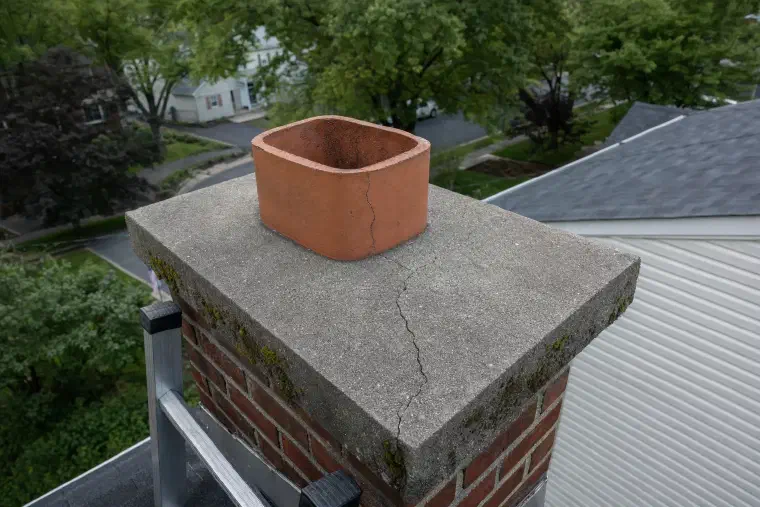
A chimney crown is the slab of concrete across the top of your chimney, around the flue pipe, that sheds rain off the brick. It cracks because it sits out in the sky taking sun, rain and freezing weather all year. Once it cracks, water can get into the brick below it.
The short version
- The crown is the sloped cap on top of the brick. It keeps rain from soaking straight into the chimney.
- It cracks from weather, mostly water getting in, freezing and pushing the crack wider.
- A cracked crown can leak into the chimney and show up as a stain near the roof.
- A small crack can be sealed. A crown that is crumbling usually gets rebuilt.
- Crown work is masonry. Roofers fix the flashing, a mason fixes the crown.
What is a chimney crown?
It is the cap that finishes the top of a brick chimney. This Old House describes it as a concrete slab, and when a mason rebuilds one it is poured over steel mesh. The mesh also helps stop the concrete falling down the chimney (opens in a new tab) while the new crown is made.
The shape matters. The center of a crown should slope down to the edges, and the same article says the edges should slope down sharply (opens in a new tab) to the edge of the chimney brick. That slope is what sends rain away from the brick instead of into it.
Do not confuse it with the chimney cap. The cap is the small metal hat over the flue opening. The crown is the concrete under it.
Why does a chimney crown crack?
Because it is the most exposed part of the house. Nothing covers it. Rain lands on it, the sun bakes it, and in a Maryland winter it freezes and thaws again and again.
Water is the real culprit. It gets into a small flaw, freezes, and pushes the flaw wider. The National Park Service says masonry is subject to deterioration, especially at the mortar joints (opens in a new tab), and that moisture trapped in masonry can build pressure that causes the surface to spall, which means flake or pop off. A crown is no different. Each cycle turns a hairline into a gap.
A few things make it worse:
- an old crown that has had decades of weather
- a crown that is flat or has no slope to shed water
We would not guess which one you have from the ground. A mason will tell you from a close look.
Why does a cracked crown matter to your roof?
Because the water does not stop at the crown. This Old House puts it plainly: cracks in the crown can allow water to seep (opens in a new tab) into the chimney structure and potentially damage the masonry beneath it.
From there it goes where water always goes. It soaks the brick, softens the mortar and runs down the inside of the chimney. Then it shows up as a stain on a ceiling or wall near the chimney, and the roof gets blamed.
That is the annoying part. A leak near a chimney is often the metal flashing where the chimney meets the roof, and sometimes it is the crown, and sometimes both. If you are chasing a stain, start with our guide to a leak in the ceiling.
How can you tell if your chimney crown is cracked?
Look at it from the ground with binoculars, or from a window above if you have one. Do not climb up to check.
| What you see | What it can mean |
|---|---|
| Fine hairline cracks across the top | Early weathering, worth sealing |
| A crack running along the flue pipe | Water has an easy way in beside the pipe |
| Chunks missing, or a crumbling edge | The crown is breaking down |
| Moss or dark staining on the top | Water sits there instead of running off |
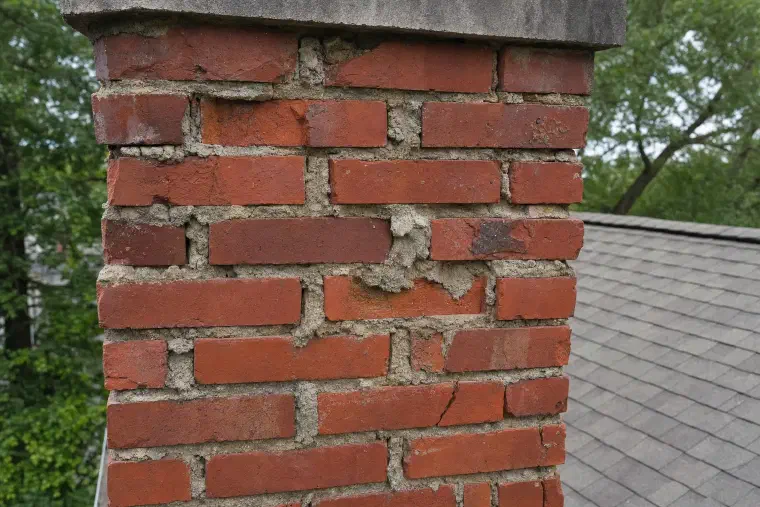
| White powder or flaking on the brick below | Water is getting into the brick |
| A stain on the ceiling near the chimney | Water is getting in somewhere, crown or flashing |
A crack by itself is not an emergency. A crack with brick damage below it is the one to take seriously.
Can a cracked chimney crown be repaired?
A small crack often can be sealed, and a crown that is falling apart is rebuilt. Rebuilding means breaking out the cracked concrete and pouring a new slab, shaped so water runs off the edges. This Old House lists a crown repair at $750 to $1,000 (opens in a new tab) on average and a rebuild at $1,000 to $3,000.
When chimney masonry cannot hold new flashing (crumbling mortar, flaking brick), the fix is repointing, a new crown or a rebuild. That typically runs $800 to $6,000 around Ellicott City, goes to a masonry sub, and can hold up the roof job while it is done. Masonry work cannot be done below 40°F, so winter can push it to spring.
We would not call a crown fixed because someone smeared caulk on it. Caulk lasts about 5 to 10 years, and after that it is a leak on a schedule.
What does the roofing side cost?
If the crown is fine and the flashing is the problem, a chimney reflash typically runs $800 to $2,200. If the chimney has to be rebuilt and reflashed, it typically runs $3,500 to $8,000. Chimney masonry work, repointing or a rebuild, is separate from a roof repair.
For other repair prices, see what a roof repair costs.
Common questions
Is the chimney crown the same as the chimney cap?
No. The crown is the concrete slab across the top of the brick. The cap is the metal cover over the flue opening. A cap keeps rain and animals out of the flue, and a crown keeps rain out of the brick.
Can I just paint or caulk over the cracks?
Caulk or sealer may hold a hairline crack for a while. They do not fix a crown that is crumbling or has no slope, and sealant wears out, so it needs checking again.
Does a free roof inspection check the crown?
Not in full. Judging the crown is a separate evaluation from our free roof inspection, which covers the roof surface, flashing, valleys, gutters and attic. A mason is the right person to say what the crown needs.
Which comes first, the crown or the flashing?
Masonry first. New flashing needs sound brick and mortar to be set into, so crumbling masonry is fixed before the flashing goes on. That is why a bad crown can delay a roof job.
What to do next
Look at the top of your chimney this week, and again after a hard freeze. If you see cracks, chunks missing or a stain by the chimney inside, have it looked at before another winter works on it. We can check the flashing and tell you whether the masonry needs a mason first. Start with our chimney flashing repair service, or learn how step flashing fits around a chimney.


