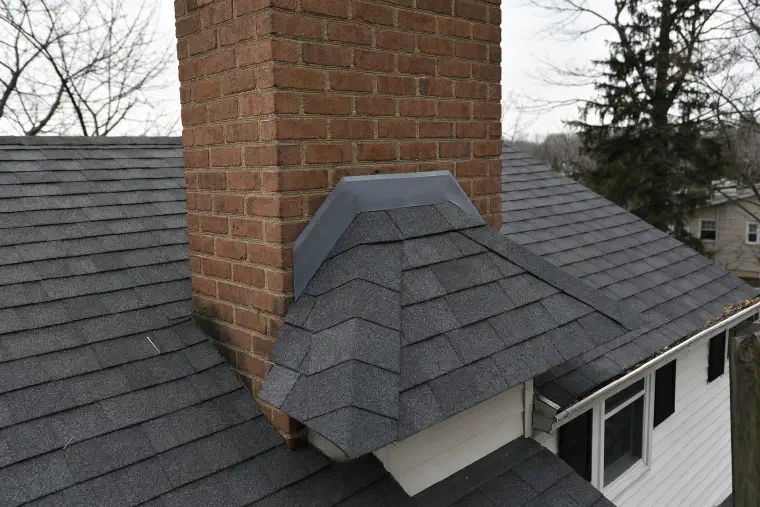
A cricket is a small peaked roof built behind a chimney, on the uphill side, that splits the rain and snowmelt running down the roof and sends it around both sides. Without one, a wide chimney acts like a dam. Water stops, sits and looks for a way in.
The short version
- A cricket is also called a saddle. It is a little two-sided roof, like a tent, behind a chimney.
- Its job is to push water and debris around the chimney instead of letting it pile up.
- A wide chimney needs one. The code line is 30 inches.
- Most chimney leaks start at the flashing, and a missing cricket makes that flashing work harder.
- You can often see whether you have one from the yard.
What is a cricket on a roof?
A cricket is a small, peaked structure that sits against the back of a chimney. This Old House calls it (opens in a new tab) a small, peaked plywood rooflet that diverts water and debris to either side of the chimney.
Picture the chimney as a rock in a creek. The roof is the creek bed, and the cricket is the pointed bit of bank that guides the water around the rock instead of letting it slam into it. The same trick is used behind skylights and other things that stick up through a roof.
The odd name is trade slang, and the small peak is the reason. The word “saddle” means the same thing.
Where does a cricket go?
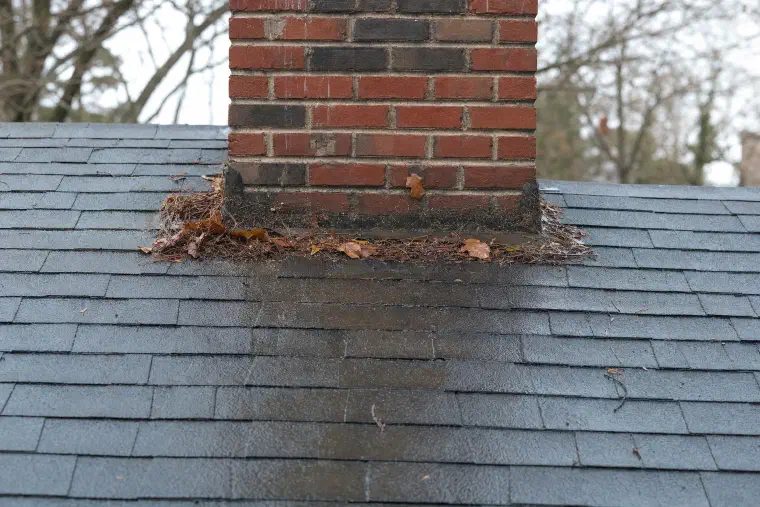
On the high side of the chimney. Water runs downhill, so the face of the chimney that points up the roof is the one that takes the hit. The cricket fills that corner and gives the water a ridge to follow.
This Old House says it is needed (opens in a new tab) for any chimney that comes through the roof below its ridge. A chimney right at the top, along the ridge, has no uphill side to speak of, so it usually doesn’t need one.
Does my chimney need a cricket?
Usually yes if it is wide. The asphalt shingle makers’ manual (opens in a new tab) strongly recommends one on any chimney 24 inches or wider, and says the International Residential Code requires one on any chimney wider than 30 inches.
The width is measured across the face that points up the roof. A wide chimney holds back a whole sheet of runoff, and the wider it is, the more water it holds.
Local code rules and your house can differ, so a roofer looking at your actual roof is better than a number. Our free roof inspection will tell you whether yours has one and whether it was done well.
What happens when there is no cricket?
Water collects where the chimney meets the roof. This Old House says that without one (opens in a new tab), rainwater can collect at that point and raise the risk of leaks.
Here is the annoying part. Leaves, pine needles and grit don’t wash past a wide chimney either. They stack up in the corner, hold moisture against the shingles and the metal, and feed moss. We see that a lot on wooded lots around Ellicott City, where branches drop a steady supply.
Snow and ice do the same thing. A cricket keeps them (opens in a new tab) from collecting on the uphill side of the chimney.
Is the cricket the same as flashing?
No. The cricket is the shape. Flashing is the metal that makes that shape waterproof. A cricket needs its own flashing, and it also changes how the chimney’s flashing is laid out, because there is one more corner for water to find.
Chimney leaks usually come from the flashing, not the brick. This Old House reports (opens in a new tab) that more often than not the culprit is the flashing, and that caulk is not a substitute for properly overlapped flashing. Our articles on counter flashing and step flashing explain the layers around the chimney.
A cricket that is covered in shingles and sealed with caulk alone is a scheduled leak. Caulk is a consumable with a 5 to 10 year life, so the seams of a cricket should be metal, lapped so water runs over the joint.
Cricket or no cricket: what does it change?
| Wide chimney with a cricket | Wide chimney without one | |
|---|---|---|
| Where water goes | Around both sides | Stops and pools behind it |
| Leaves and grit | Slide past | Pile up in the corner |
| Snow and ice | Split and slide past | Collect against the chimney |
| Flashing | Less standing water to resist | Works against a pool |
| Where leaks show | Rarely behind the chimney | Often a stain on the ceiling near it |
Can you add a cricket to an existing roof?
Yes. A roofer builds the little peaked frame behind the chimney, decks it, and flashes it into the main roof and the chimney. It is a small job on its own, but it is carpentry and metal work, not a dab of sealant, and it is far easier to do when the area is already opened up.
That is why we bring it up when chimney flashing is being redone. A chimney reflash typically runs $800 to $2,200 around Ellicott City. That is a typical range, not a quote, and it covers the reflash, not masonry work. Repointing or rebuilding brick is separate, and a chimney rebuild with new flashing typically runs $3,500 to $8,000.
Our roof installation includes new flashing at chimneys, walls, valleys, skylights and penetrations, unless the plan says to reuse it. Ask whether a wide chimney on your roof gets a cricket, and whether the chimney’s flashing is new.
Common questions
Is a cricket the same as a saddle?
Yes. Roofers use both words for the small peaked roof behind a chimney.
Can I see a cricket from the ground?
Often. Look at the uphill side of the chimney. If you see a small peak with its own shingles or metal, that is a cricket. If the chimney’s flat face meets the roof, there isn’t one. Binoculars help, and so does a phone camera on zoom. Please skip the ladder if you are not comfortable on one.
Do I need a cricket if my chimney is narrow?
Often not. The shingle makers’ advice starts at 24 inches wide. Between 24 and 30 inches they recommend one even though the code doesn’t require it.
Does a cricket stop a chimney leak?
Not by itself. A cricket helps water go around, but the flashing still has to hold. If a stain shows up near the chimney, the flashing and the mortar need a look first.
What to do next
If you have a wide chimney and no peak behind it, or a stain on the ceiling near it, have the roof checked before the next storm. Our chimney flashing repair work covers the metal around the chimney, and a free roof inspection will tell you what you have behind it.