

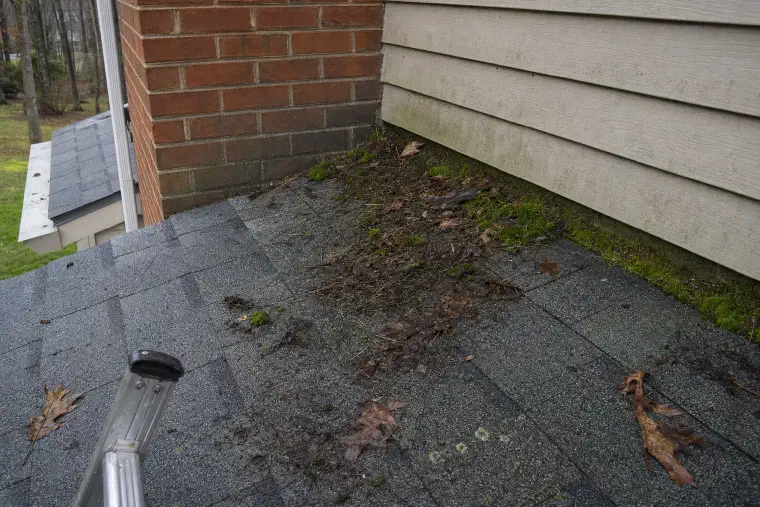
A dead valley is a flat or nearly flat spot where two roof surfaces meet and the water has nowhere good to go. Instead of running off like it does in a normal roof valley, it slows down, sits and collects leaves. That is why it tends to leak.
The short version
- A dead valley is a roofer’s nickname, not a code term. It means a corner of the roof that barely slopes, so water drains slowly.
- It usually forms where a porch roof, an addition or a dormer meets a wall.
- Leaves and moss pile up there, and the standing water finds the weak spots in the shingles and flashing.
- Sometimes clearing the debris is the whole fix. Sometimes the spot needs a small diverter built in.
- A valley repair typically runs $700 to $1,800.
What is a dead valley?
Think of a regular roof valley as a gutter that runs down the roof, with a steady slope that carries water to the eave. A dead valley is the same meeting of two roof surfaces with the slope taken out. The water arrives and then stalls.
You’ll find them where a roof was changed or added to. A low porch roof ties into the house wall. An addition meets the old roofline. A small dormer sits close beside a wall. Each of these can leave a pocket where one surface drains toward another that is almost flat.
Roofers don’t all use the term the same way, so if a contractor says it, ask them to point at the spot. What matters is the shape: a low corner that drains slowly.
Why does a dead valley leak?
Because shingles are built to shed water, not sit in it. The Asphalt Roofing Manufacturers Association says that on lower slopes water drains more slowly (opens in a new tab), creating a greater chance of water backing up. It also says the point where a lower slope meets a steeper one needs special attention because water can build up there.
That is a dead valley in one sentence. Water that lingers gets under shingle edges, soaks into the nail holes and works its way along the flashing. Add leaves and it gets worse.
The Building America Solution Center says valleys and penetrations are among the most vulnerable areas (opens in a new tab) for water getting in. A dead valley is a valley that also drains badly, so it has both problems at once.
What does debris do to a dead valley?
It turns a slow drain into a dam. Leaves and twigs settle in the flat part and nothing washes them out, because there isn’t enough slope to move them. Moss follows, holds moisture against the shingles and lifts their edges.
In the wooded lots around Ellicott City we see this constantly. Debris damming in valleys and gutters pushes water up under the shingles above the ice-and-water line. In winter the same pocket holds meltwater that freezes and thaws, which is hard on any seam.
The annoying part is that you can’t see it from the ground. A ceiling stain is the last stage, not the first. Water has usually been getting in for a long time before anything shows inside.
How do you tell if you have a dead valley?
Look for a corner where the roof is almost flat and water would have to crawl to leave. Binoculars from the yard are enough for a first look. Please don’t climb up to check.
| What you see | What it usually means |
|---|---|
| Leaves, twigs or moss packed in a roof corner | The spot isn’t draining or washing itself clear |
| A dark stain on shingles along a wall | Water is sitting against the wall flashing |
| Shingle granules piled in the low corner | Shingles there are wearing faster than the rest |
| A brown ceiling stain under a roof corner | Water has likely been getting in for a while |
| A leak that only shows up in hard rain | Often a flashing problem that depends on wind direction |
How do you fix a dead valley?
Start with the cheap fix, which is getting the debris out. That is sometimes the whole repair, and we bill it as a service call. If the spot keeps filling up, it needs a better path for the water.
What that looks like depends on what’s wrong:
- A small diverter. A cricket is a small diversion roof (opens in a new tab) that keeps water from collecting on the uphill side of a chimney. The same idea can steer water out of a pocket against a wall. Our guide to what a cricket is shows how one is built.
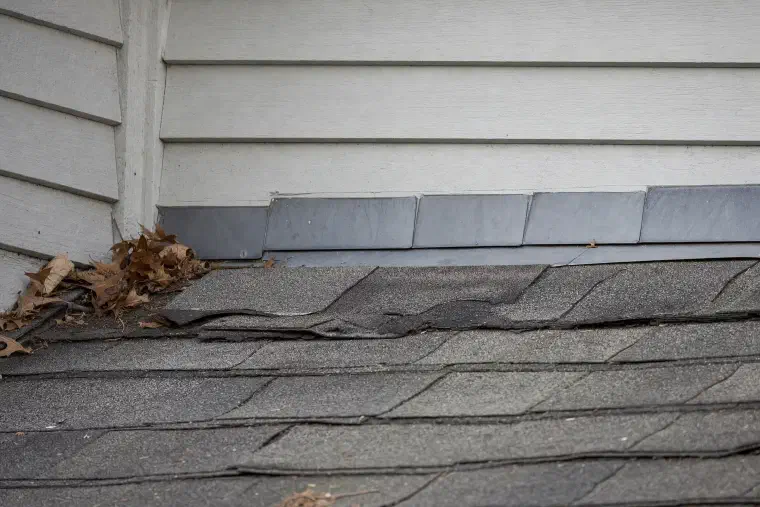
- New flashing. If the old metal has lifted, rusted or been covered in tar, it gets replaced. Reused flashing is a common shortcut, and caulk is a scheduled leak since it wears out in 5 to 10 years. Our page on roof flashing repair covers the work.
- A different roof covering in the flat part. Slopes this low can’t take ordinary shingles. The Asphalt Roofing Manufacturers Association says to never apply shingles on slopes lower than 2:12 (opens in a new tab). A flat pocket may need a low-slope membrane instead.
What does a dead valley repair cost?
A valley repair typically runs $700 to $1,800, and that sits in the middle tier where most repair calls land. Step flashing typically runs $700 to $1,900. A low-slope membrane typically runs $2,500 to $6,000.
If the decking underneath turns out to be wet or soft, replacing it is added at $150 to $500 or more. The repair is scoped to one spot, so any other problem we find is a separate estimate. We can’t promise a leak will stop, since finding leaks is a matter of probabilities, but we’ll tell you what we find before we start.
Common questions
Is a dead valley the same as a regular valley?
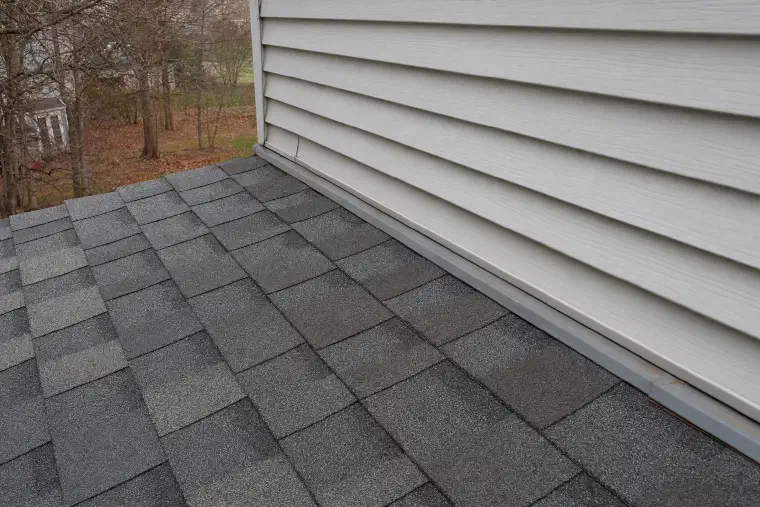
No. A regular valley slopes steadily toward the eave and carries water away. A dead valley is flat or nearly flat, so water slows down and sits.
Can I clear a dead valley myself?
You can reach some from a ground-level porch roof with a soft brush, but roofs are slippery and moss makes them worse. If it needs a ladder, we’d leave it to a roofer.
How often should it be cleared?
At least once a year, and after leaves come down in the fall. A shaded roof under big trees may need it more often.
Will a dead valley void a shingle warranty?
We can’t say for your shingles. Warranties differ, so read the paperwork. The Asphalt Roofing Manufacturers Association’s rule about slopes under 2:12 is a good reason to ask any installer how a flat spot is being handled.
What to do next
If you’ve got a roof corner that stays wet, fills with leaves or sits above a ceiling stain, have it looked at before the decking goes soft. A free roof inspection covers the valleys, and roof repair is the place to start if the spot is already leaking.


